Advancing the Baku to Belém Roadmap: Mobilizing High-Impact, Transformational Finance in EMDEs

Conferences - By : Sarah BENDAHOU
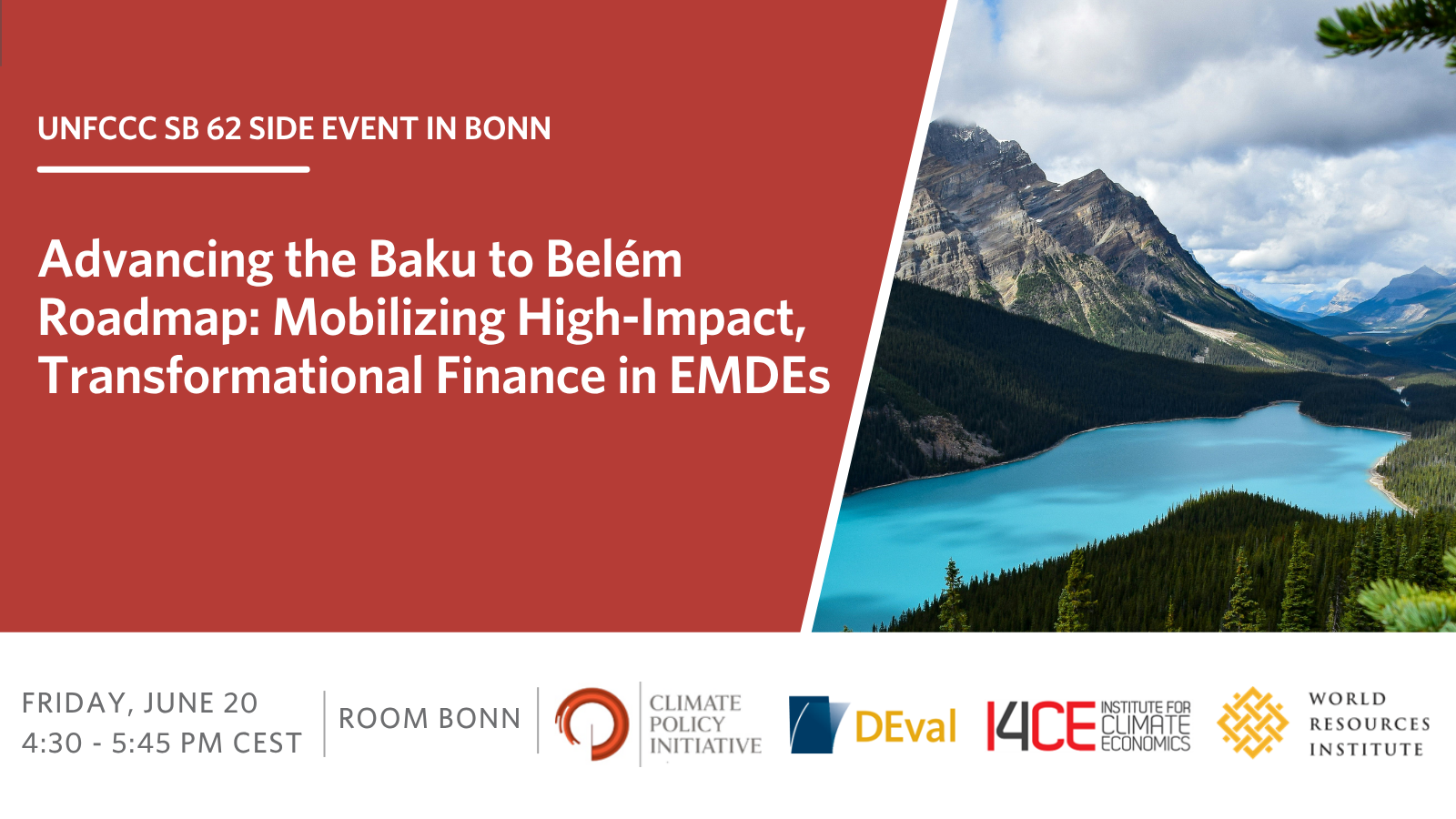
Date: June 20, 2025

Time: 4:30-5:45 PM CEST

Organised by I4CE, DEval, Climate Policy Initiative (CPI), World Resources Institute (WRI) 

Event organised on the sidelines of the June Climate Meetings in Bonn (SB 62)

The event will explore climate finance to EMDEs and discuss ways to reach the $300bn and $1.3tn targets via public and private finance for adaptation and mitigation using emerging evaluation methods and more efficient use of finance for impact, alignment, equitable distribution, and transparency.


As public budgets face growing pressure and shifting priorities, there is a pressing need for stronger evidence on which climate finance approaches are most effective, for whom, and what can be scaled or replicated. Understanding the quality of climate finance is crucial to making the most of limited resources and ensure the delivery of tangible, on-the-ground results.


Agenda


4:30pm – Welcome and overview of the event, Baysa Naran, Senior Manager, Climate Policy Initiative (CPI)


4:40pm – Understanding the concept of “quality” of climate finance and defining “transformational finance”

Moderator: Baysa Naran, Senior Manager, CPI

Keynote presentations

  • Understanding and defining the quality of climate finance, Costanza Strinati, Manager, CPI

  • Defining transformational finance for climate, Sarah Bendahou, Researcher, I4CE 


Panel discussion followed by Q&A 

  • Ana Toni, National Secretary for Climate Change, Brazil Ministry of the Environment and Climate Change
  • Hendrikje Reich, Head the International Climate Finance Division, German Federal Foreign Office
  • Alexis Bonnel, Strategy and Foresight, Agence française de développement (AFD)

 

5:10pm – Ensuring high impact of climate finance

Moderator: Baysa Naran, Senior Manager, CPI

Keynote presentations:

  • Transparency, distribution, and impact of mitigation ODA, Thomas Wencker, Senior Evaluator, DEval

  • High-impact adaptation finance, Carter Brandon, Senior Fellow, WRI


Panel discussion followed by Q&A 

  • Ana Toni, National Secretary for Climate Change, Brazil Ministry of the Environment and Climate Change
  • Hendrikje Reich, Head the International Climate Finance Division, German Federal Foreign Office
  • Alexis Bonnel, Strategy and Foresight, Agence française de développement (AFD)


5:40pm – Wrap-up and closing by Baysa Naran, Senior Manager, CPI

20 Jun 2025

Advancing the Baku to Belém Roadmap: Mobilizing High-Impact, Transformational Finance in EMDEs

I4CE Contacts
Sarah BENDAHOU
Sarah BENDAHOU
Research Fellow – Development finance Email
To learn more
  • 11/28/2025 Foreword of the week
    COP30: The missed turn to implementation – and the coalitions moving ahead anyway

    COP30 concluded with an agreement, proving that multilateralism is still alive. However, the results are underwhelming: no push to transition away from fossil fuels, no decision on deforestation, and mixed outcomes on adaptation metrics.  On climate finance, Belém failed to shift from ambition to implementation. Negotiations quickly drifted back to a battle on yet another high-level quantitative target. The decision to triple adaptation funding by 2035 disappointed many, with its distant time horizon, lack of baseline and non-binding wording. COP30 also missed the opportunity to engage with – and build consensus around – concrete measures outlined in the Baku to Belém roadmap to get to $1.3 trillion. Instead, it defaulted to launching new processes – a work programme on climate finance and a ministerial roundtable on the NCQG.  

  • 11/21/2025 Foreword of the week
    How to strengthen climate risk management and supervision to protect financial stability

    Climate change does not conform to business, political or supervisory regime cycles– its adverse long-term impacts lie beyond such horizons. Ten years ago, when Mark Carney highlighted this paradox in his landmark Tragedy of the Horizons speech, climate change was not considered a financial stability risk. Today, European supervisory stress tests estimate up to €638 billion in banking losses over 8 years, while the European Central Bank (ECB) reveals that over 90% of eurozone banks face climate and environmental risks. A key question arises: Is the supervisors’ primary focus on greening the financial system sufficient in the face of rising risks, especially stranded assets? 

  • 11/13/2025
    How solidarity levies can help bridge the climate and development finance gap

    The climate and development finance gap is large and widening, as Official Development Assistance (ODA) declines and needs multiply. With shrinking fiscal space in vulnerable countries, solidarity levies are gaining attention as a predictable source of international finance. Launched at COP28 by Barbados, France, and Kenya, the Global Solidarity Levies Task Force (GSLTF) is the main initiative in this space.

See all publications
Press contact Amélie FRITZ Head of Communication and press relations Email
Subscribe to our mailing list :
I register !
Subscribe to our newsletter
Once a week, receive all the information on climate economics
I register !
Fermer