In 2019, I4CE made a commitment to contribute to decarbonisation and carbon neutrality. We intend to play our part in tackling the real-world challenges of the climate transition. We have an action plan that we revise each year after carrying out our annual assessment of our greenhouse gas emissions. Here, we present our 2024 emissions, an analysis of how it compares with previous years, and an action plan update.
Results and analysis
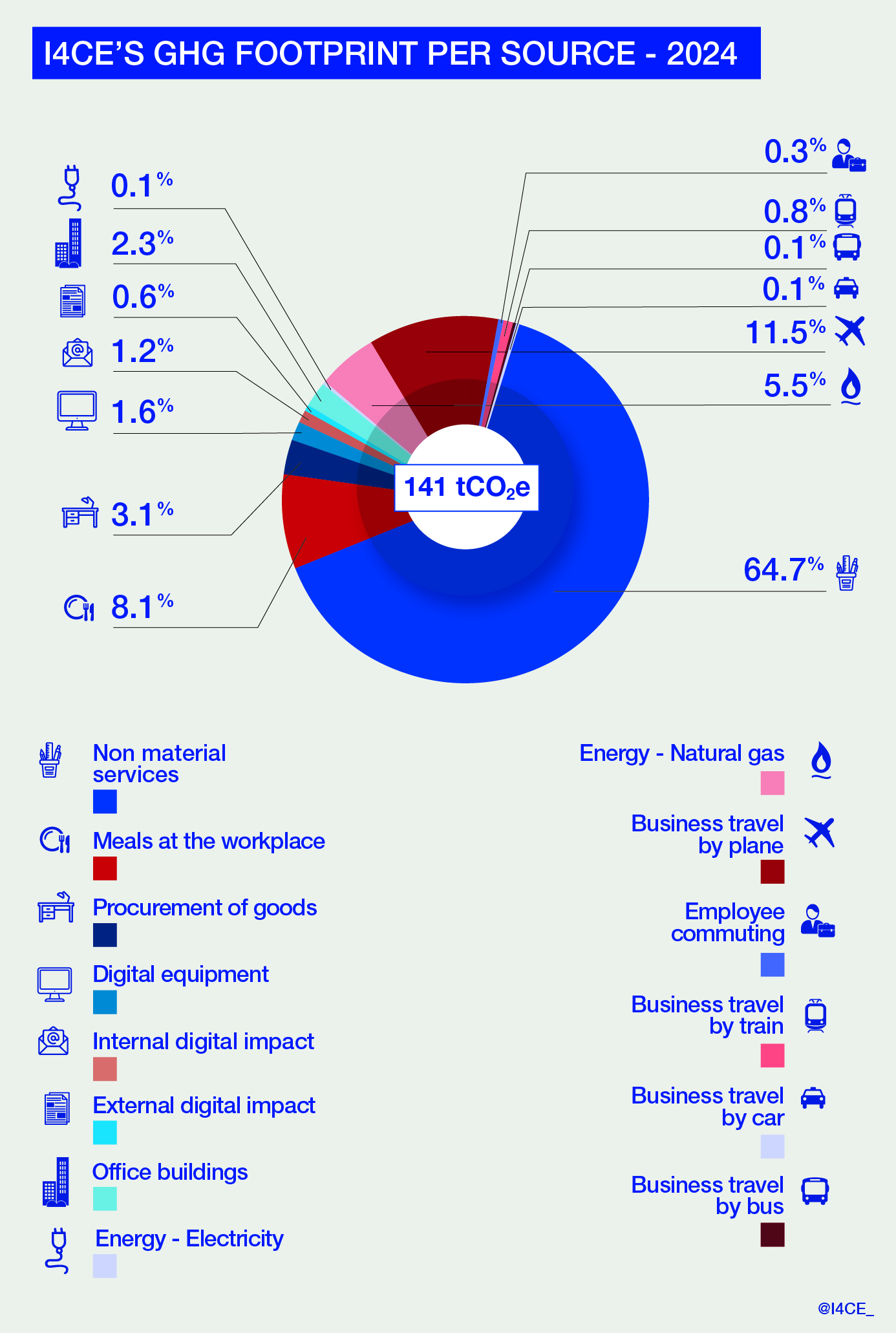
The 2024 carbon footprint shows that the Institute emitted 141 tCO2e, i.e. 3.4 tCO2e per year per employee.
Figure 1: Breakdown of emissions by source – I4CE 2024
Click on this button to see the figure 1
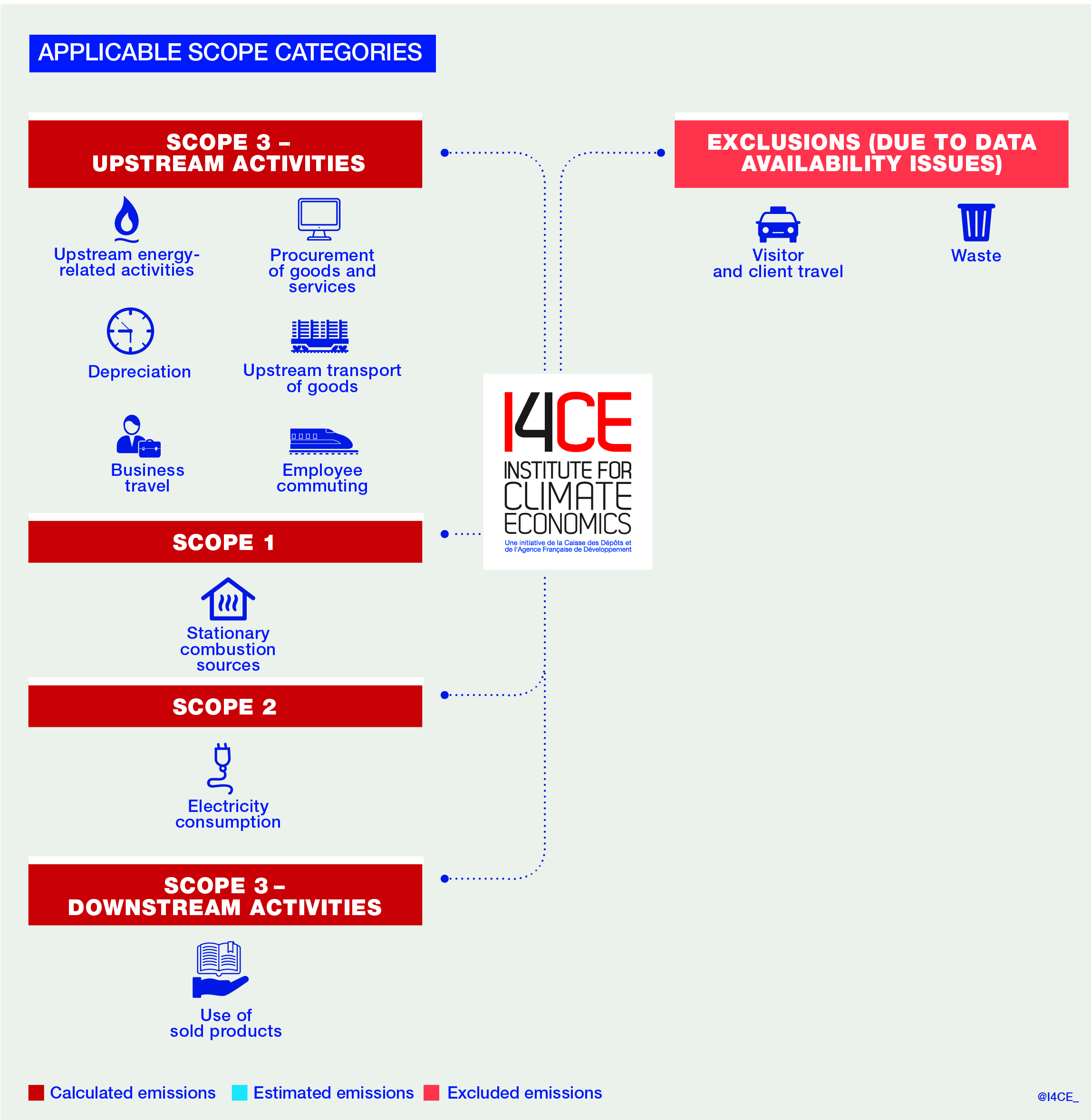
The most significant emission sources were included in this assessment, from manufacturing to the use of equipment and buildings, communications, meals and employee travel (see Figure 2).
Each year, we aim to keep the same set of assumptions to enable us to compare our results with those of previous years.
Figure 2: Scope of greenhouse gas emissions assessment
Click on this button to see the figure 2
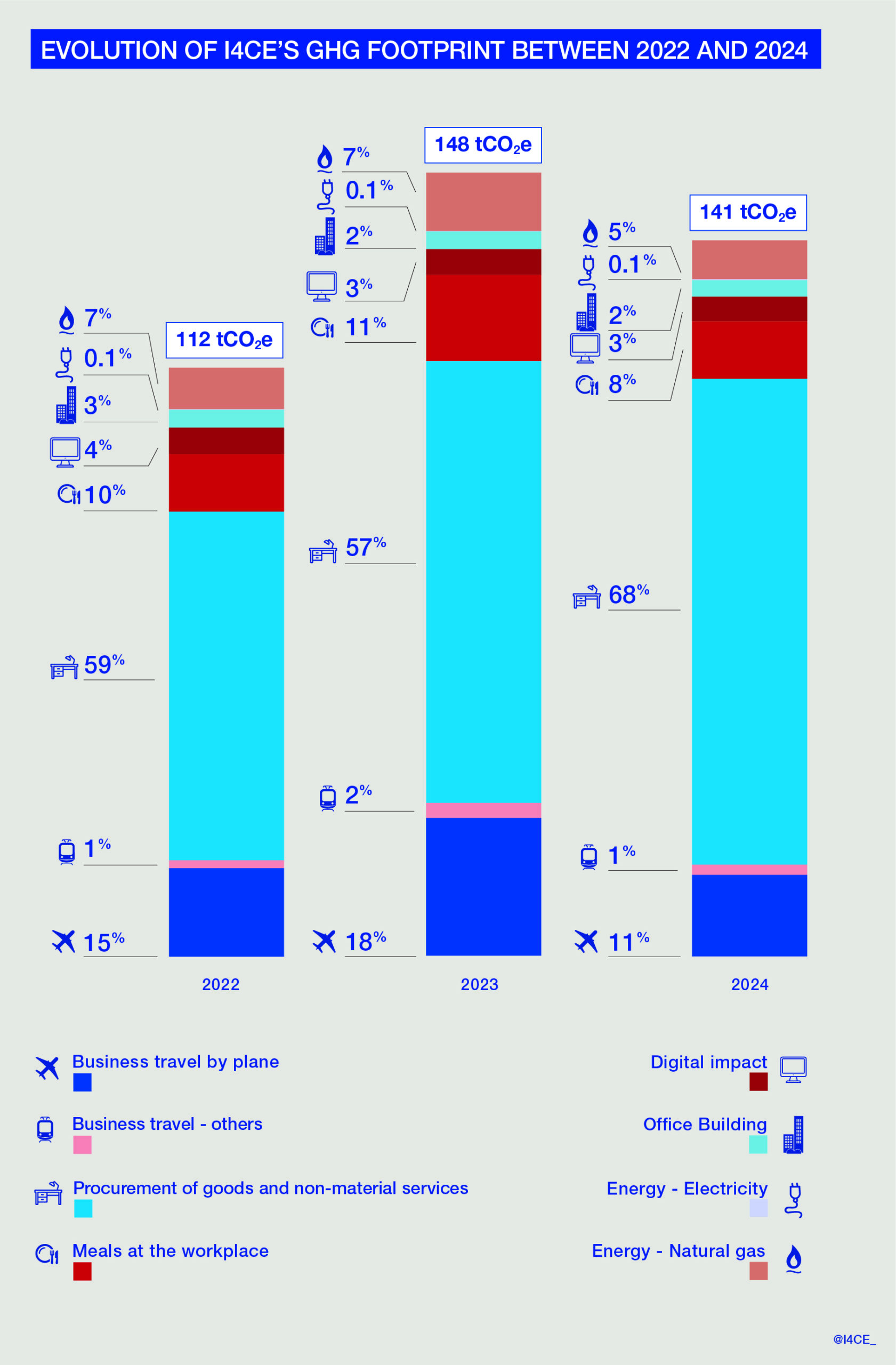
I4CE’s greenhouse gas emissions have slightly decreased over the course of a year, from 148 tCO2e to 141 tCO2e. This 4.9% decrease in our emissions between 2023 and 2024 can be explained by a decrease of more than 10 tCO2e from our international travel. Business travel in 2024 represented similar emissions to those of 2022 despite an increase in the international team’s size (which had 6 fewer employees in 2022). Emissions per employee decreased by 8.2% while the number of employees increased from 39 to 41 FTEs.
On the other hand, an increase of more than 11 tCO2e of emissions from the procurement of goods and services (including for example accommodation during business trips and work with external contractors), due to the increase in FTEs and inflation, explains why the overall decrease in I4CE’s emissions does not reflect the level of decrease in emissions from business travel.
I4CE identifies and implements ways to limit its carbon footprint: for example, 41% of the team’s daily meals are in line with a flexitarian diet, and 51% with a vegetarian diet. In addition, all meals provided at internal events are 100% vegetarian, thus limiting the impact of employee meals in our greenhouse gas footprint.
Figure 3: Emissions by source between 2022 and 2024 in kgCO2e
Click on this button to see the figure 3
Primary source of emissions: service procurement by the Institute (95 tCO2e; 75.1%)
This category includes all external services required for I4CE’s operations, from digital licences to the graphic design required in some of our projects. To calculate this emissions source, we applied the set of monetary ratios provided by ADEME, which enables the conversion of euros spent into CO2e emitted, according to the service category. Although this method is a source of uncertainty due to its lack of granularity, it nevertheless enables us to compare our emissions very accurately from one year to the next, while maintaining the same classifications.
This source of emissions continues to increase, after an increase from 62 to 82 tCO2e between 2022 and 2023, it reaches 91 tCO2e in 2024. This increase is primarily due to the increase in the Institute’s staff, and inflation, and consequently related expenses. These emissions mainly come from banking and insurance services, fees, telecommunications, and printing services.
Second source of emissions: business travel (18 tCO2e; 13%)
I4CE intends to reduce the impact of its business travel by favouring online meetings and participation to events but also by incentivising train over air travel whenever an alternative exists. Air travel in I4CE’s footprint decreased to 13% in 2024 compared to 17.6% in 2023. The team working at the international level at I4CE has in fact less participated in international events compared to the previous year. Business travel by car, as well as employee commuting continue to represent minor emissions, respectively 0.1% and 0.3%.
Third source of emissions: employee meals (11 tCO2e; 8%)
Emissions from this source were estimated on the basis of a survey on the composition of employee meals. More than half of the team’s meals are part of vegetarian diets, which has a 80% lower greenhouse gas impact than a conventional diet, according to ADEME. In addition, I4CE systematically offers vegetarian meals at its internal events, while meals provided at external events feature at least one vegetarian option.
Fourth source of emissions: energy (8 tCO2e; 6%)
Heating I4CE’s offices with gas is the fourth largest source of emissions (5.5%). Electricity consumption to power the Institute’s digital equipment represents only 0.1% of the overall carbon footprint.
Energy-related emissions are equivalent to those of 2023 overall although there is a slight decrease resulting from limited heating during the day in the offices.
Finally, regarding electricity, as I4CE premises are located in a green courtyard, the Institute does not require any air conditioning during summer. Electricity-related emissions are below 0.1 tCO2e. I4CE is supplied with 100% renewable energy via Enercoop.
The I4CE climate action plan
In 2019, I4CE made a commitment to contribute to decarbonisation and carbon neutrality. We intend to play our part in tackling the real-world challenges of the climate transition. We have an action plan. An internal working group has been set up to carry out an annual assessment of the Institute’s greenhouse gas emissions to assess our impact, thus enabling us to define an action plan to reduce our emissions. All of I4CE’s actions in this regard are listed below.
1. Transport
-
For business travel, a travel charter has been implemented: no flights within mainland France or abroad where a train alternative exists that offers a journey time of less than six hours. Some “long distance” travel will remain necessary for I4CE’s work, especially as the Institute becomes more international, but videoconferencing between international partners are already preferred, an option that is to be increasingly favoured. When travel is unavoidable, it will be optimized to minimize the number of journeys made by employees and partners, as is the case for travel to the Conference of the Parties (COP) as part of the international climate negotiations, during which the I4CE team attends and organizes several workshops and conferences. In addition, to encourage team members to choose the train rather than the plane whenever possible, if a train journey results in a working day of more than 14 hours, including travel time, then the employee receives a half-day off to compensate for the time spent travelling.
-
For commutes: the Institute encourages employees to use public transport by reimbursing Navigo cards above the legal minimum rate (75% instead of 50%). In addition, even before the adoption of the new Mobility Orientation Law (Loi d’Orientation des Mobilités – LOM), I4CE introduced a sustainable mobility package of up to €500/year to encourage low-carbon transport such as cycling. This type of package is not yet obligatory for companies or associations. I4CE also finances train commutes for long-distance teleworking employees.
2. Building / energy
- I4CE was able to choose a renewable electricity supplier, Enercoop, for its current premises.
- I4CE allows employees to telework in the Île-de-France region or in other cities, depending on their contract. This enables the office to operate as a flexible workspace (or “flex-office”), i.e. facilitating the dynamic assignment of workspaces according to use, rather than assigning offices to individuals, which allows the optimal use of office space and avoids the need for a larger office. ADEME sets out a methodology to address the rebound effects of teleworking, according to which the flex-office approach more than offsets the impact of any increase in the use of transport, and the use of any additional resources required to work from home.
3. IT / digital / web
- The Institute’s IT equipment consists entirely of reconditioned computers. I4CE also favours the repair of IT equipment, rather than replacement, whenever possible.
- Since 2022, I4CE has also purchased reconditioned phones for its employees, giving them the option of using a work phone in addition to a personal one, or to use a dual sim phone to avoid having multiple phones.
4. Service providers
Wherever possible, I4CE supports service providers with environmental and social commitments.
- Office cleaning: I4CE has chosen a cleaning service provider with ISO 140017 environmental certification and AFAQ EI8 social certification. The cleaning products used are not harmful to the environment and waste is sorted daily.
- Caterers: meals for internal events are 100% vegetarian. Meals for I4CE-organized external events always offer at least one vegetarian option.
- Printing: for many years I4CE has worked with an Imprim’vert certified company. This eco-label is awarded to printers who work to reduce the environmental impact of their activities. In addition, the Institute is committed to a just-in-time printing approach, which limits printing to only that which is strictly necessary. In addition, all I4CE publications are available on the Institute’s website and can be consulted online.
5. Contribution to the national climate effort
Despite all our efforts, today and tomorrow, I4CE‘s impact on climate will never be zero. Reducing our emissions is the priority, “deep decarbonization” is the objective, but the reality is that we continue to emit and will have unavoidable emissions in the future.
Changes in agricultural and forestry practices can be implemented for carbon sequestration today and in the coming decades. Financing these projects allows responding to the climate urgency while bringing other co-benefits (e.g. biodiversity, local economy). The Institute is therefore committed to contributing to the global effort of carbon neutrality by financing certified projects on French soil that are commensurate with its emissions. To this end the Institute uses the Label Bas Carbone (low-carbon label). Does this constitute carbon offsetting? I4CE prefers to use the term “contribution”, because we believe that financing projects does not cancel out I4CE‘s carbon footprint.