Publications

Ex-post evaluation of the Kyoto Protocol : Four key lessons for the 2015 Paris Agreement

15 mai 2014 - Etude Climat

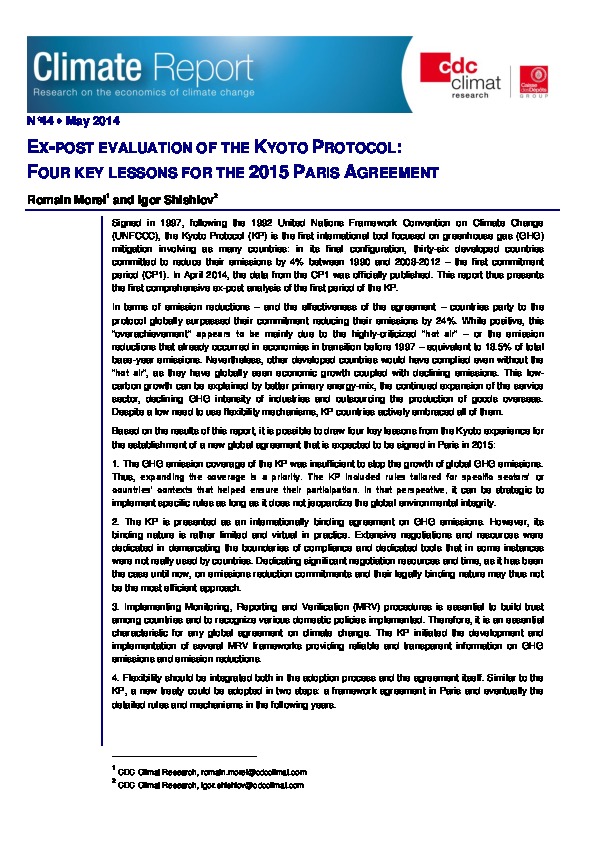
Signed in 1997, following the 1992 United Nations Framework Convention on Climate Change (UNFCCC), the Kyoto Protocol (KP) is the first international tool focused on greenhouse gas (GHG) mitigation involving as many countries : in its final configuration, thirty six developed countries committed to reduce their emissions by 4% between 1990 and 2008-2012 – the first commitment period (CP1). In April 2014, the data from the CP1 was officially published. This report thus presents the first comprehensive ex-post analysis of the first period of the KP.

Based on the results of this report, it is possible to draw four key lessons from the Kyoto experience for the establishment of a new global agreement that is expected to be signed in Paris in 2015 :

1. Expanding the coverage : striking a balance between overall environmental integrity and flexibility for specific circumstances
2. Removing the virtual specter of internationally legally binding commitments and limiting the focus on methods of compliance
3. Focusing on MRV processes
4. Providing flexibility in the agreement and its adoption process
Ex-post evaluation of the Kyoto Protocol : Four key lessons for the 2015 Paris Agreement Télécharger
Pour aller plus loin
  • 03/03/2023 Tribune
    TRIBUNE – Planification, libertés locales et financement de la transition

    La planification écologique nationale doit trouver son articulation avec la démocratie et les libertés locales pour définir la nouvelle donne économique et budgétaire pour les collectivités.

  • 03/03/2023
    Réforme de la Banque mondiale : bientôt un nouveau pilote à bord

    Après la démission soudaine mi-février de David Malpass, le président de la Banque mondiale choisi par Donald Trump, Washington a de nouveau surpris le monde jeudi dernier en proposant de nommer Ajay Banga, longtemps PDG de Mastercard, comme son successeur. Non seulement l’annonce a été très rapide, mais le profil controversé du candidat a également suscité une certaine perplexité. Son expérience limitée tant dans les projets d’aide publique au développement que dans la contribution à la lutte contre le changement climatique a alimenté une grande partie du scepticisme. Sa connaissance du secteur privé dans les pays du Nord et du Sud a cependant su rassurer. 

  • 02/03/2023
    Soutenir les institutions financières de pays en développement dans leur démarche d’alignement avec les objectifs climatiques

    Comment maximiser l’impact des institutions financières internationales ? Vous trouvez un exemple dans ce rapport écrit en partenariat avec NewClimate Institute, et qui présente des recommandations à destination des institutions financières internationales pour soutenir l’alignement de leurs institutions financières partenaires, dans les pays en développement, avec les objectifs de l’Accord de Paris. Et plus largement pour contribuer à la transformation des systèmes financiers locaux.  

Voir toutes les publications
Contact Presse Amélie FRITZ Responsable communication et relations presse Email
Inscrivez-vous à notre liste de diffusion :
Je m'inscris !
Inscrivez-vous à notre newsletter
Une fois par semaine, recevez toute l’information de l’économie pour le climat.
Je m'inscris !
Fermer