COP30 Official Side event – The Road From Belem: How COP30 will drive a ” New Era of Implementation” on Resilience and Adaptation
Conferences Webinars - By : Diana CÁRDENAS MONAR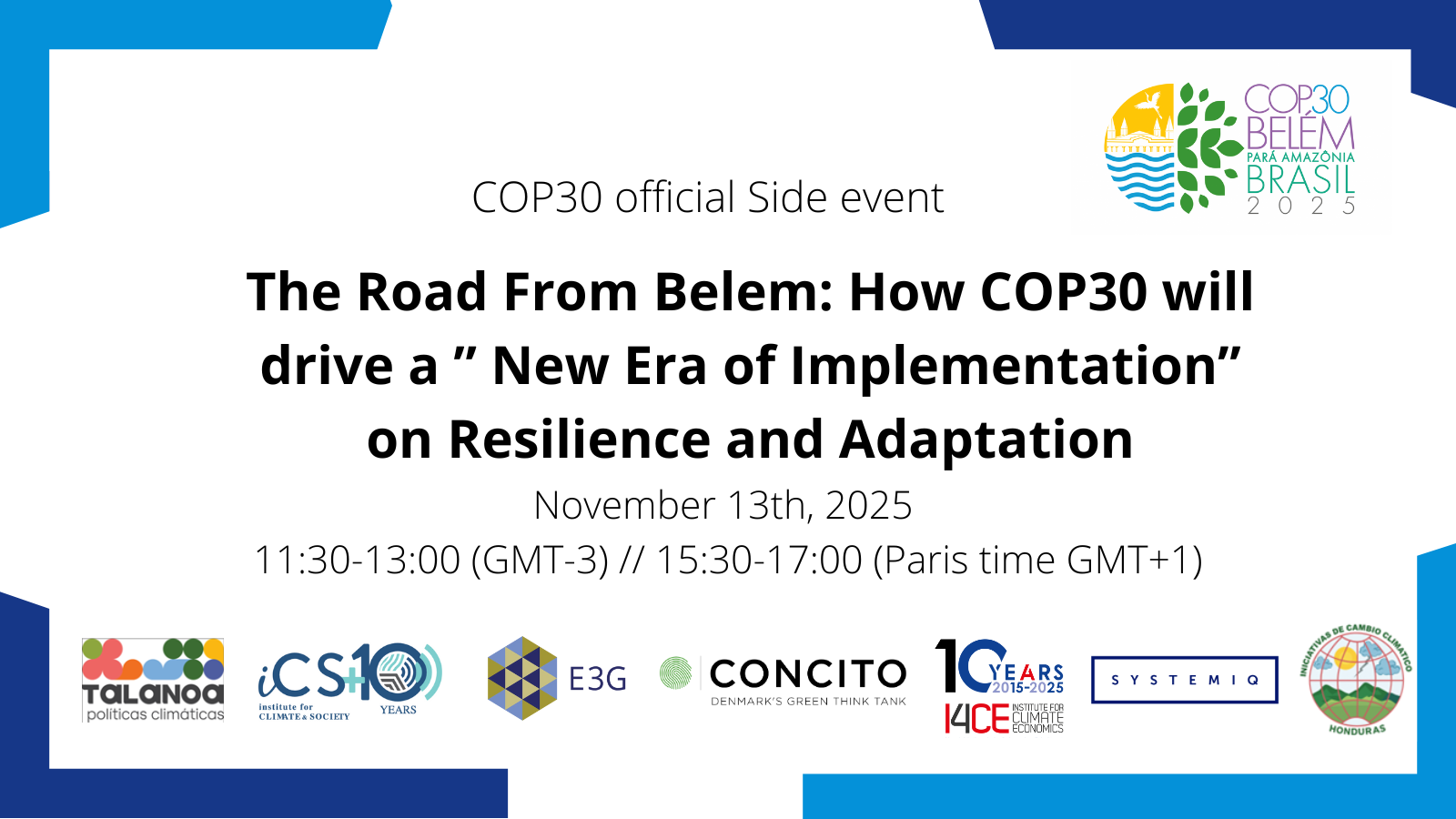
Location: Side event room 5
Date: November 13th, 2025
Time: 11:30 – 13:00 (GMT-3) // 15:30-17:00 (Paris time GMT+1)
Co-hosts: Institute for Climate and Society (iCS), E3G, CONCITO, Institute for Climate Economics (I4CE), Systemiq, Fundación Nacional de Cambio Climático de Honduras
Format: High-level dialogue and moderated panel discussion
Context:
COP30 takes place at a pivotal moment for the global climate agenda. Ten years after the Paris Agreement, two years after the first Global Stocktake, and as Parties are expected to deliver updated NDC3.0, (Nationally Determined Contribution) the world enters a decisive decade for implementation. While global attention has often centred on mitigation and overall climate finance volumes, success now depends equally on scaling up adaptation and resilience, especially for the most vulnerable, and improving the quality of finance to ensure that communities, economies, and ecosystems can withstand and thrive amid escalating climate impacts.
Adaptation and resilience investments have become critical economic and political priorities, shaping how countries, communities, and businesses navigate an era of worsening and more frequent climate shocks.
The COP30 Presidency has placed implementation at the heart of its vision, emphasising the need to translate plans into tangible results on the ground. COP30 represents an opportunity to define what an implementation era for adaptation and resilience truly looks like: one that connects global ambition with local delivery and shifts from fragmented projects to long-term, nationally driven action, creating a virtuous loop.
Held during the first week of COP30, this dialogue offers a timely space to reflect on and inform efforts to accelerate adaptation. Panel sessions will explore new evidence on the economic and investment rationale for adaptation and resilience, leading examples of systemic approaches to finance adaptation and how coordinated outcomes from global processes can help spread such efforts.
The event will link national implementation and the Global Goal on Adaptation, Article 2.1(c), the Baku to Belem Roadmap, the Action Agenda and the G20, grounding these processes in practical investment cases that deliver social and economic returns. In doing so, it will explore how COP30 can lay the foundation for a decade of delivery where resilience and adaptation are prioritised alongside mitigation as part of a coherent implementation agenda.
Objectives
To explore how COP30 can mark the start of a new phase of implementation: one where adaptation and resilience are financed, country-led, valued, and delivered at scale; and dive-into how ongoing finance reforms inside and outside the COP process can channel resources and accountability toward lasting results beyond Belém.
Agenda
11:30: Setting the context: Drawing on early signals from COP30 and the Leaders Summit, this discussion will consider how adaptation and resilience are shaping the agenda for what’s needed at COP and the next decade.
- Natalie Unterstell, President, Talanoa
- Ivan Oliveira, Deputy Secretary for Sustainable Finance, Brazil Ministry of Finance
11:40: Panel 1: Making it real: leadership and delivery on Belem+
Purpose:
- Explore how leadership at all levels, from finance ministries, MDBs, national institutions (public and private), local governments, community leaders and the private sector can turn ambition into delivery, including through systemic approaches to enabling and catalyzing finance, such as country platforms. Panel to also consider what signals or guidance from the UNFCCC / multilateral system would help enhance their efforts.
Moderator:
- Maria Netto, Executive Director, iCS
Speakers
- Chris Bartlett, Vanuatu
- Sam Mugume, Ministry of Finance, Uganda (confirmed)
- Mads Libergren, Danish Ministry of Finance. Workstream 4 lead in the Coalition of Finance Ministers for Climate Action
- Tracy Kajumba, LIFE-AR
- Tariye Gbadegesin, CEO, Climate Investment Funds (CIF)
- Stephane Hallegate, World Bank
12:10: Panel 2: From processes to practice: how international initiatives, national leadership, and market action are converging to shape the implementation era.
Purpose:
Follow up by unpacking how live international processes, the Baku to Belém Roadmap, the G20 Finance track, Article 2.1(c) discussions, adaptation initiatives are converging to enable this delivery whilst also taking into consideration the real cost of adaptation. The session will highlight how economic and financial decision-makers are operationalising resilience and how multilateral cooperation can accelerate action and investment at scale.
Moderator:
- Maria Netto, Executive Director, iCS
Speakers
- Asger Garnak, Investment and Finance Lead, CONCITO
- Ben Abraham, Talanoa
- Guido Schmidt-Traub, Systemiq.
- Louise Kessler, Director, I4CE
- Maria Fernanda Martinez, Fundacion Nacional de Cambio Climático de Honduras
12:50: Closing remarks by Nick Mabey, CEO, E3G