Publications

COPEC Chapter 1: THE EU ETS EMISSIONS REDUCTION TARGET AND INTERACTIONS WITH ENERGY AND CLIMATE POLICIES

30 November 2015 - Special issues - By : Kimon KERAMIDAS (ENERDATA) / Kimon KERAMIDAS (ENERDATA)

This Publication is an extract from the Coordination of EU Policies on Energy and CO2 (COPEC) report, produced jointly by I4CE – Institute for Climate Economics and Enerdata, and in collaboration with IFPen. The report provides new, factual, independent and quantified analysis on EU ETS operationality by 2030, to examine the necessary conditions to improve its environmental and economic effectiveness.

COPEC Chapter 1 on The EU ETS emissions reduction tagret and interactions with energy and climate policies;– provides a synthesis of the European Commission’s proposal on the 2030 Framework for climate and energy policies
– Provides an analysis on the extent energy policies that support Renewable Energy Sources (RES) and Energy Efficiency (EE) targets, which are complementary to the Greenhouse Gas Emissions (GHG) target have impacted the European Union Emissions Trading Scheme (EU ETS) and the consequences on the European allowances (EUA) surplus until 2030
– Presents two scenarios for the EU ETS and their potential impact on EUA prices, on additional investment costs and the effort sharing between EU ETS sectors leading to 2030
– Provides an overview of how three other emissions trading schemes in the world manage their GHG emission reduction target
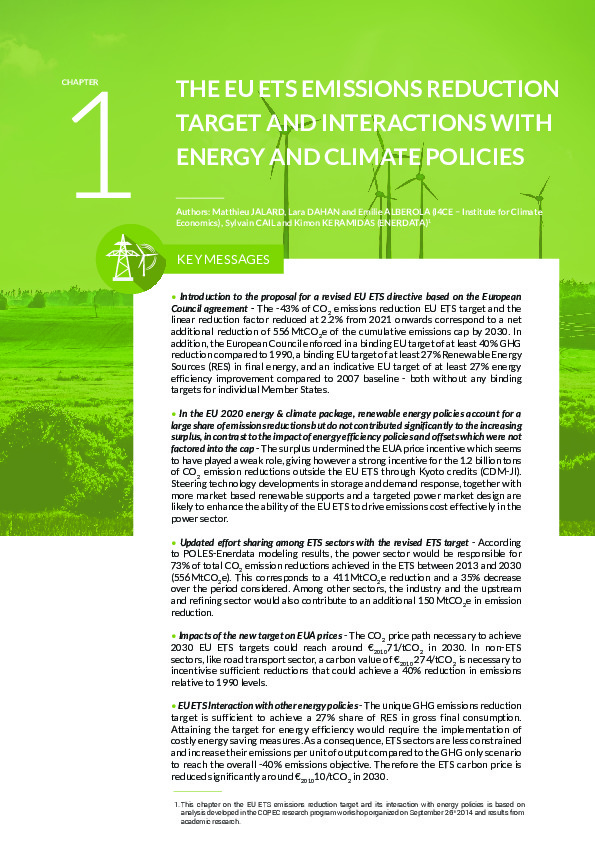
COPEC Chapter 1: THE EU ETS EMISSIONS REDUCTION TARGET AND INTERACTIONS WITH ENERGY AND CLIMATE POLICIES Download
To learn more
  • 06/19/2026 Foreword of the week
    Unblocking finance for low-carbon agriculture 

    With the entry into force of the European carbon farming certification framework (CRCF), the European Union now has a first-of-its-kind tool to certify climate-friendly agricultural and forestry practices.

  • 06/18/2026
    Designing a robust carbon certification methodolgy for forest management in Europe

    An Improved Forest Management (IFM) methodology has been initiated under the Carbon Removals and Carbon Farming regulation (CRCF), alongside a near-finalised afforestation methodology. As concerns grow over the declining capacity of Europe’s forests, determining which forest management practices should be incentivised through carbon certification is far from straightforward. 

  • 06/18/2026
    Double claiming of agricultural carbon credits : time to stop worrying

    In France, after the French “Low Carbon Label” (le Label bas carbone, LBC) certification scheme, there remains a systemic lack of funding for agricultural projects. Among the reasons mentioned by the agri-food industries is the fear of “double claiming”.

See all publications
Press contact Amélie FRITZ Head of Communication and press relations Email
Subscribe to our mailing list :
I register !
Subscribe to our newsletter
Once a week, receive all the information on climate economics
I register !
Fermer