Publications Agriculture and food

Does more sustainable food increase consumer budgets?

14 October 2021 - Climate Brief - By : Lucile ROGISSART / Valentin BELLASSEN / Claudine FOUCHEROT

Consuming less animal products and wasting less lighten the budget, but increasing consumption of organic products adds to it. In total, does adopting a sustainable diet increase or decrease consumer spending?


Report available in French only


While some studies give a clear-cut answer to this question, it actually varies according to at least three factors:

  • The ambition of the sustainable diet: the level of substitution between animal and plant proteins, the share of sustainably produced products (which is simplified to organic), and the level of waste reduction;
  • The economic conditions, in particular the price of organic products compared to conventional products;
  • The initial base of consumers and the prices at which they buy their products, which are strongly correlated with income.


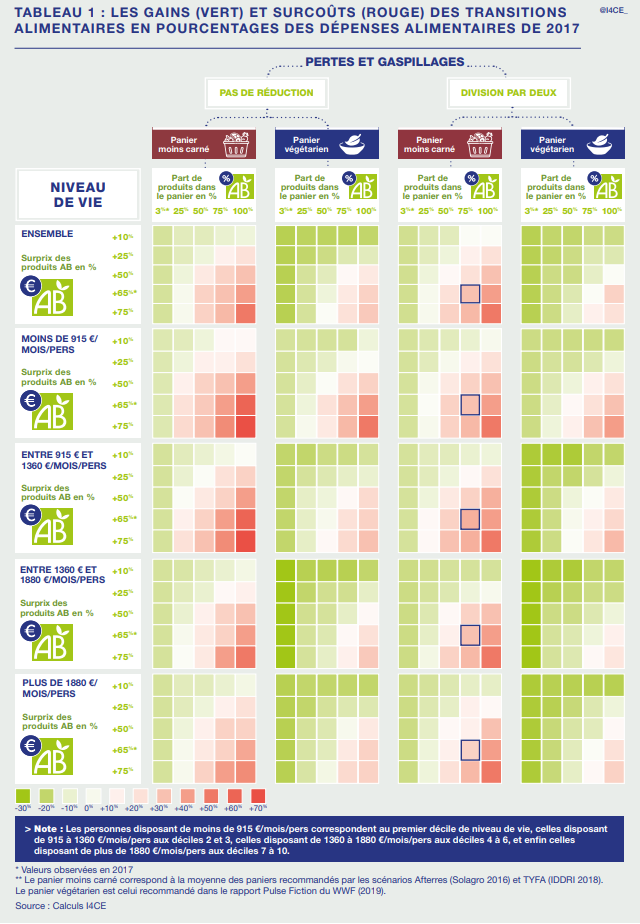
I4CE has developed a calculator to measure the effects of each of these factors on the household food budget. Depending on the level of these parameters, the transition to a more sustainable diet can range from a 30% gain to an additional 67% of the consumer’s initial food budget. People with the lowest incomes have the highest potential additional costs.


At current prices, regardless of reductions in animal products and waste, consuming mostly organic food is more expensive, especially for the poorest households. The price premium for organic over conventional would have to fall from 65% today to 10% for all households to be able to adopt a less meaty 100% organic diet without increasing their budget.


If a high consumption of organic products is targeted, public policies must therefore manage the tension between remunerative prices for sustainable farming practices and an increase in food expenditure acceptable to households.
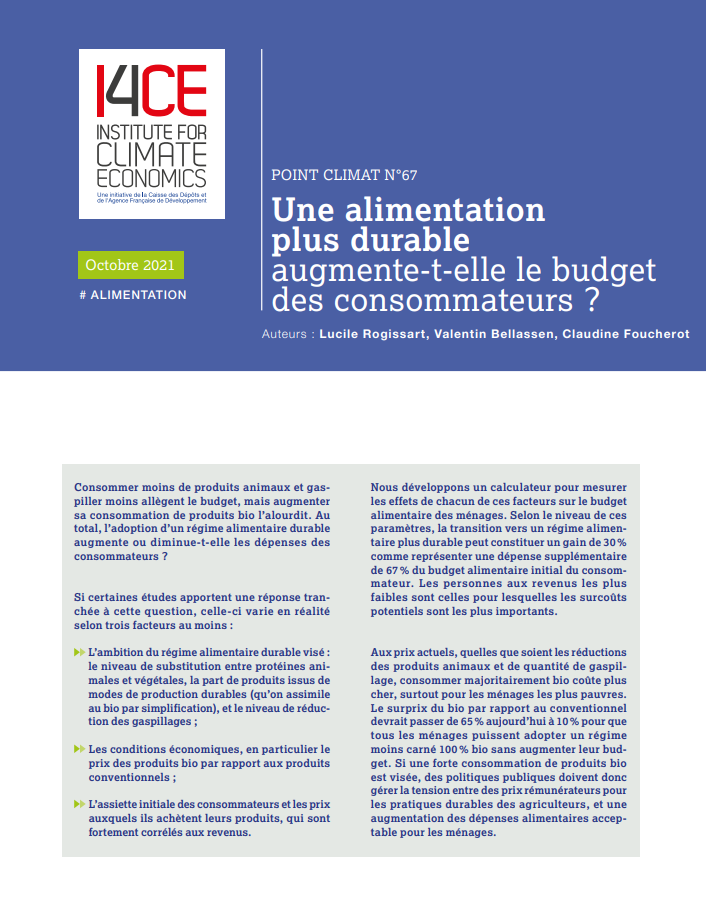

Click on this button to see the graphic

Does more sustainable food increase consumer budgets? Download
I4CE Contacts
Lucile ROGISSART
Lucile ROGISSART
Research Fellow – Financing the agricultural transition, Food systems Email
To learn more
  • 01/23/2026 Foreword of the week
    Financing carbon farming practices: lessons learnt in France can reinforce the EU level initiatives

    In a challenging economic and political context, especially for the agriculture sector, some incentive schemes can still help bring stakeholders together in climate transition and resilience initiatives. This is the case with carbon certification schemes, which both ensure the credibility of the climate impact of the actions implemented and provide remuneration for farmers and foresters for changes in practices. Some of these measures, such as replacing mineral fertilisers (mostly imported) with organic fertilisers, also help to meet the sector’s needs for resilience and strategic independence, which are crucial in the current context.

  • 01/16/2026 Blog post
    CBAM and fertilisers: ring-fencing budgets to help farmers reduce their use of mineral fertilisers

    The Carbon Border Adjustment Mechanism (CBAM) came into force on 1 January 2026. It is a carbon tax applied at the borders of the European Union to imports of certain industrial products covered by the EU Emissions Trading System (EU ETS). Nitrogen-based mineral fertilisers are included in this initial list of products. To avoid an increase in costs for the farmers concerned, the level of the tax has been reduced for fertilisers, and they may even be temporarily excluded from the scope of the CBAM. Yet, for the climate, but also for France’s strategic independence and food sovereignty, the CBAM will ultimately have to be fully applied to mineral fertilisers. To limit or even avoid an increase in farmers’ fertiliser expenditure, we need public policies – some of which are currently under threat. Ring-fencing budgets for these policies would be a way to support farmers’ incomes and the food sovereignty of both the European Union and France, while reducing the carbon footprint of our food system. 

  • 06/12/2025
    Six years of carbon certification in France: an assessment of the Label Bas-Carbone

    Six years after its inception, this study aims to review this mechanism and its projects: what activities are being implemented in the field, what impact are they having on the climate, with what robustness or, on the contrary, what limitations in terms of measurement, environmental integrity, accessibility, etc.? This exercise is also intended to feed into the process of continuous improvement of the scheme and to provide feedback for the current implementation of the European carbon certification framework (Carbon removals and carbon farming: CRCF).

See all publications
Press contact Amélie FRITZ Head of Communication and press relations Email
Subscribe to our mailing list :
I register !
Subscribe to our newsletter
Once a week, receive all the information on climate economics
I register !
Fermer