State of play of the EU’s climate-specific development finance
Bilateral ODA fell by 26% in 2025, with the five largest donors – including France and Germany – each cutting their foreign aid. How will climate finance, and the EU’s leadership on providing it, fare in this context ?
This report provides perspective by outlining the state of play of Europe’s climate-specific development finance since the adoption of the Paris Agreement. It discusses the shortcomings of climate finance as a purely quantitative metric, and suggests an upcoming window of opportunity for continued European leadership on climate finance effectiveness.
Debates on international climate finance have long focused on aggregate volumes and headline pledges. However, declining Official Development Assistance (ODA) budgets and growing scrutiny on additionality, effectiveness and actual access to climate finance now make it imperative to look beyond totals. From a provider perspective, shifting from a purely quantitative approach to a qualitative one raises the question of the optimization of international climate finance allocation strategies across policy objectives – mitigation and adaptation – instruments, geographies, and sectors. As concessional resources decrease, donor governments face sharper trade-offs in how climate finance is allocated, how it interacts with ODA, and how it can simultaneously deliver impact for both climate and development.
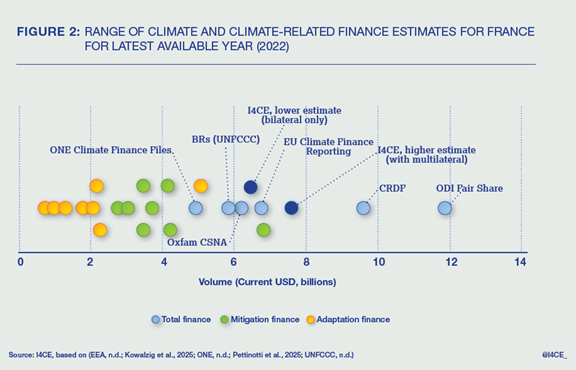
Drawing on a comprehensive analysis of available data, this report shows that current development and climate finance reporting systems – while deeply intertwined – remain fragmented, heterogeneous, and poorly suited to assessing or informing strategic resource allocation by donors. Differences in accounting practices, treatment of loans and grants, and approaches to climate relevance significantly limit comparability across donors and weaken their ability to assess and orient the distribution – in terms of geographies, sectors, etc. – of the concessional resources they allocate to climate-specific development finance on one hand and its actual impact on the other.
To address these limitations, this report relies two alternative and donor-comparable metrics:
- climate-specific development finance
- climate-specific grant equivalent
These metrics provide a robust basis for comparing donor strategies and assessing how scarce public concessional resources are deployed. An in-depth analysis of climate finance from the European Union (EU) Member States using these metrics reveals both the scale of Europe’s contribution and the diversity of national approaches.
The report finds that:
- The EU clearly emerges as a global leader in international climate finance, both as a provider and as an active player through multilateral channels.
- Specific climate finance allocation strategies differ widely across EU donors. Behind the EU’s aggregate leadership lies significant heterogeneity among Member States’ climate finance. Priorities and allocation strategies vary in terms of adaptation versus mitigation, financial instruments, geographic targeting, sectoral focus, and balance between climate mainstreaming and targeted, high-impact interventions.
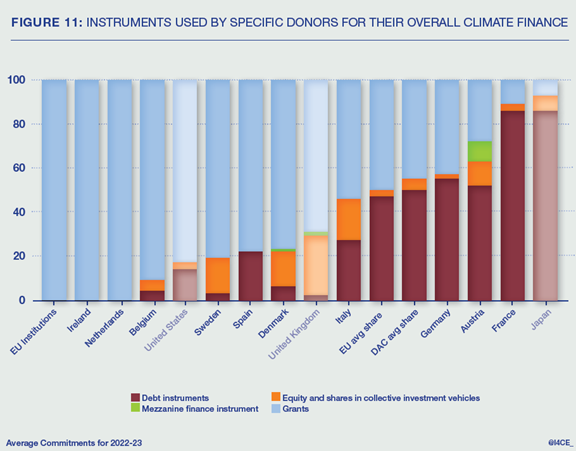
- The instrument mix and the relative scarcity of public resources for grants appear as a key binding constraint for most donors.
As many EU countries are expected to revise or renew their climate finance targets in the coming months, we recommend EU climate finance providers use this window of opportunity to increase coordination, strategic alignment, and – ultimately – impact on the ground, notably by shifting the focus from purely quantitative commitments to more qualitative ones, with a particular focus on the geographic targeting and the differentiated use of financial instruments. The ongoing negotiations over the EU’s next Multiannual Financial Framework for 2028-2034 represent a concrete and time-sensitive entry point for advancing this agenda at EU level.
We also recommend launching a global, comprehensive and coordinated climate finance effectiveness agenda, mirroring and complementing efforts made since the early 2000s on the aid effectiveness agenda. This agenda should be understood as firmly embedded within broader development objectives and the wider aid architecture. Its purpose is not to create a climate-versus-development divide, but to use the climate finance lens to strengthen the overall effectiveness and impact of aid, including broader development goals.
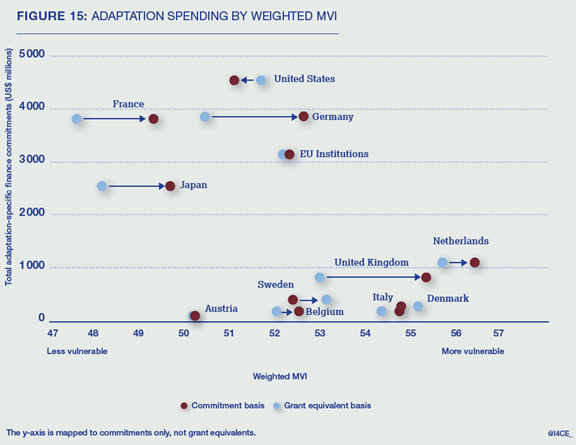
Finally, as part of this new climate finance effectiveness agenda, we argue that the development of provider-specific indexes to assess the geographic targeting of climate finance flows would be a particularly useful first step. We illustrate their relevance by proposing a simple aggregate metric to assess the current geographic targeting of international adaptation finance and discuss the premises for an analog index on mitigation. We suggest that donors should adopt such metrics both to increase transparency and to guide their own climate finance allocation strategies.