Publications

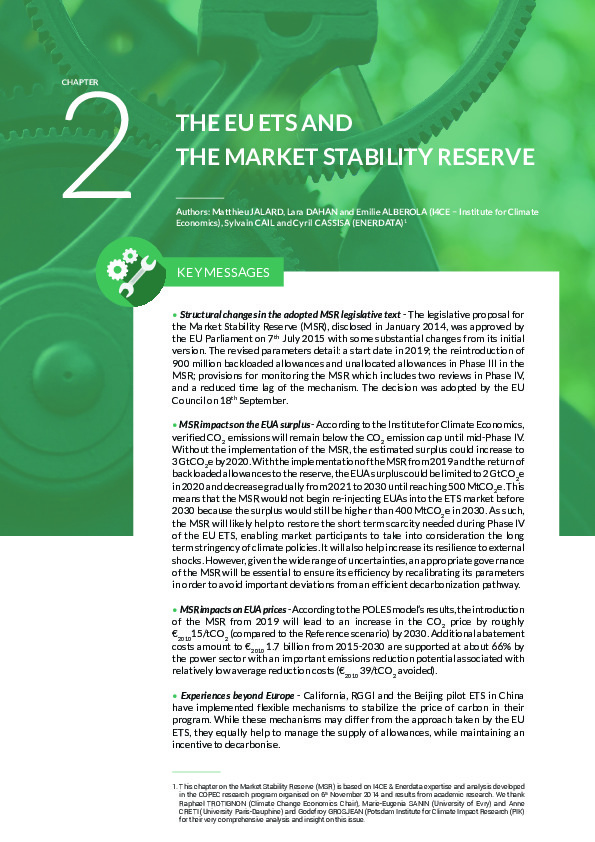
COPEC Chapter 2: THE EU ETS AND THE MARKET STABILITY RESERVE

30 novembre 2015 - Hors série - Par : Sylvain CAIL (ENERDATA) / Cyril CASSISA (ENERDATA)

This Publication is an extract from the Coordination of EU Policies on Energy and CO2 (COPEC) report, produced jointly by I4CE and Enerdata, and in collaboration with IFPen. The report provides new, factual, independent and quantified analysis on EU ETS operationality by 2030, to examine the necessary conditions to improve its environmental and economic effectiveness.

COPEC Chapter 2 on the EU ETS and the Market Stability Reserve;
– Introduces the design of the Market Stability Reserve proposal adopted on 7th July 2015 to be implemented in the EU ETS from 2019 onwards
– Provides an analysis of the consequences of introducing the MSR and its potential impacts on the EU ETS supply-demand balance, with specific reference to the level of EUA surplus expected in 2030
– Uses POLES modelling results to demonstrate the potential impacts of the MSR on the EUA price, investment and effort sharing among EU ETS sectors leading to 2030
– Provides an overview of three other emissions trading schemes in the world which have implemented provisions to help stabilize the price of carbon in their programs
COPEC Chapter 2: THE EU ETS AND THE MARKET STABILITY RESERVE Télécharger
Pour aller plus loin
  • 03/03/2023 Tribune
    TRIBUNE – Planification, libertés locales et financement de la transition

    La planification écologique nationale doit trouver son articulation avec la démocratie et les libertés locales pour définir la nouvelle donne économique et budgétaire pour les collectivités.

  • 03/03/2023
    Réforme de la Banque mondiale : bientôt un nouveau pilote à bord

    Après la démission soudaine mi-février de David Malpass, le président de la Banque mondiale choisi par Donald Trump, Washington a de nouveau surpris le monde jeudi dernier en proposant de nommer Ajay Banga, longtemps PDG de Mastercard, comme son successeur. Non seulement l’annonce a été très rapide, mais le profil controversé du candidat a également suscité une certaine perplexité. Son expérience limitée tant dans les projets d’aide publique au développement que dans la contribution à la lutte contre le changement climatique a alimenté une grande partie du scepticisme. Sa connaissance du secteur privé dans les pays du Nord et du Sud a cependant su rassurer. 

  • 02/03/2023
    Soutenir les institutions financières de pays en développement dans leur démarche d’alignement avec les objectifs climatiques

    Comment maximiser l’impact des institutions financières internationales ? Vous trouvez un exemple dans ce rapport écrit en partenariat avec NewClimate Institute, et qui présente des recommandations à destination des institutions financières internationales pour soutenir l’alignement de leurs institutions financières partenaires, dans les pays en développement, avec les objectifs de l’Accord de Paris. Et plus largement pour contribuer à la transformation des systèmes financiers locaux.  

Voir toutes les publications
Contact Presse Amélie FRITZ Responsable communication et relations presse Email
Inscrivez-vous à notre liste de diffusion :
Je m'inscris !
Inscrivez-vous à notre newsletter
Une fois par semaine, recevez toute l’information de l’économie pour le climat.
Je m'inscris !
Fermer