Clean Industrial Transition Monitor: Moving to a clean industrial future in Europe
The transition to a clean and competitive industrial base is crucial to strengthening Europe’s resilience and strategic economic independence. The Clean Industrial Transition Monitor by the European Climate Neutrality Observatory (ECNO) assesses real-world progress using more than 50 indicators and provides a comprehensive and nuanced picture of both progress and remaining gaps.
Europe is under pressure, economically and politically. Policymakers are seeking to boost EU independence and resilience to preserve its prosperity in a volatile international environment. The transition to a clean and competitive industrial base is at the heart of this strategy. ECNO has analysed its real-world progress and the proposed policies under the Clean Industrial Deal.
Main insights and recommendations
- There is progress towards a clean and competitive industry in Europe. However, the results show that the transition still faces major weaknesses, including insufficient demand for clean products and materials, gaps in infrastructure development, limited financing, and difficulties diversifying the supply of critical raw materials.
- The Clean Industrial Deal has the potential to close important policy gaps: The CID represents the EU’s most comprehensive attempt so far to create the conditions for a competitive clean industrial base in Europe. The analysis shows that its >80 dossiers largely cover the weaknesses identified.
- Focus on demand-side policies marks an important shift in EU industrial strategy: The Industrial Accelerator Act (IAA), the Public Procurement Act and the Corporate Fleets initiative aim to create lead markets for clean materials and technologies. Implemented effectively, these policies could provide the reliable demand signals needed to unlock investment in low-carbon production and to scale new industrial value chains in Europe.
- A robust ETS carbon price remains the foundation of Europe’s clean industrial transition: The EU Emissions Trading System (ETS) is the central economic signal underpinning the entire EU climate and industrial policy framework. It helps narrow the cost gap between fossil-based and low-carbon production and provides financing for industrial decarbonisation projects.
- Fair transition financing is still missing from the package: Positive trends in job creation and employment rates highlight the potential of the clean transition to generate new economic opportunities across Europe. To sustain this momentum, long-term financing beyond the Recovery and Resilience Facility and the Just Transition Fund will be needed. Successor instruments within future cohesion policy frameworks should support regions in harnessing the opportunities through economic diversification and reskilling.
- An economic and security imperative to safeguard the long-term industrial vision against short-term measures: Short-term political measures – such as lowering carbon costs, weakening climate legislation or focusing primarily on deregulation – could weaken Europe’s industrial base over the long-term. Accelerating electrification and renewable energy deployment, while moving away from imported fossil fuels, is Europe’s long-term strategy to boost industrial competitiveness and economic resilience.
- Europe’s clean industrial strategy must continue to look beyond its borders to succeed: European industries rely heavily on exporting industrial products. To sustain competitiveness and ensure it does not transition in isolation, the EU must maintain leadership and forge strategic partnerships for a global clean transition. By staying committed to its vision and policies, the EU can signal reliability, influence international standards, and open opportunities for its clean industrial products abroad.
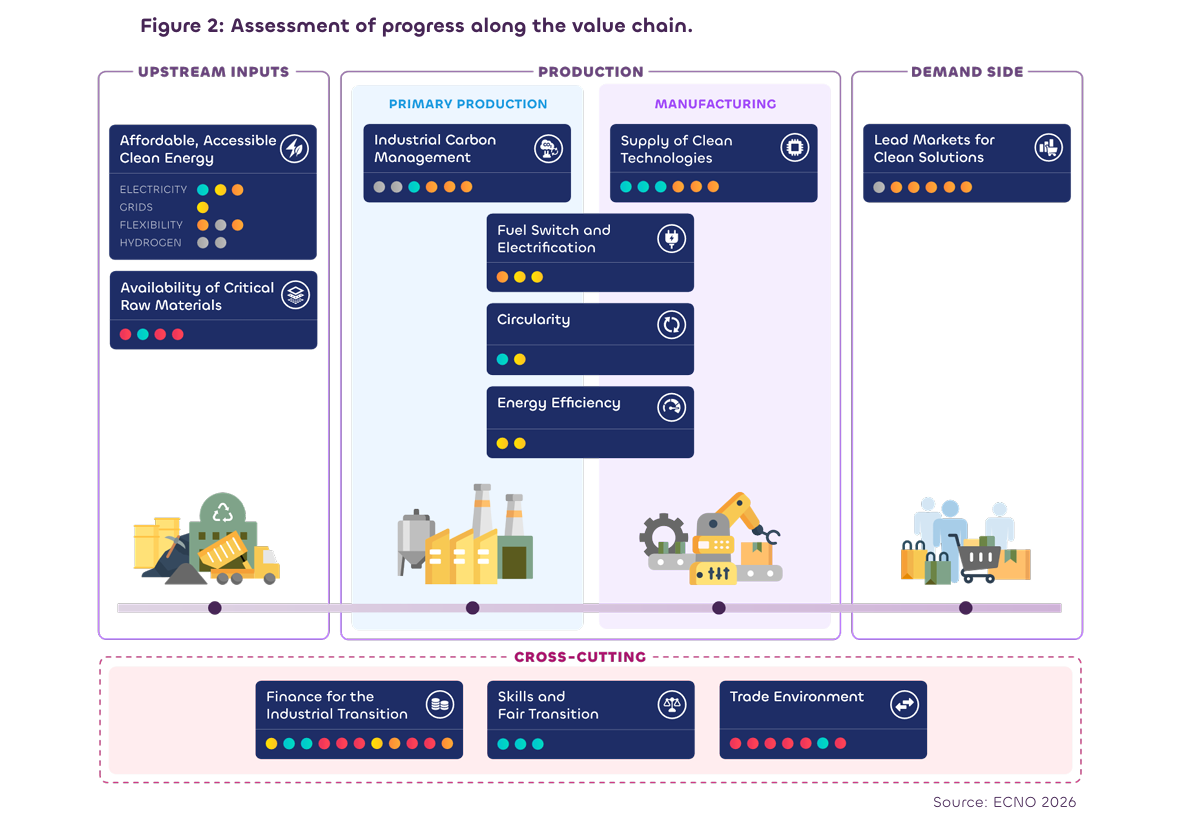
This assessment of the clean industrial transition builds on the 2025 ECNO Flagship Report that analyses progress across the whole economy, assessing around 200 indicators. The Clean Industrial Transition Monitor takes over 50 indicators and their classifications from the 2025 ECNO Flagship Report and applies them to 11 enabling conditions, distributed across the industrial value chain. The report contains detailed assessments for each enabling condition.