Publications

Low-carbon innovation is up, but not because of the EU ETS

16 February 2013 - Carbon Trends

The EU ETS is the main instrument of European climate policy, and many policymakers envisage it as a driving force of the EU’s transition to a low-carbon economy. By putting a price on emissions, the scheme is expected to encourage heavy polluters to develop new low-carbon technologies. At first glance it is encouraging to notice, then, that patenting for low-carbon technologies has surged in Europe since 2005. When analysing new data we find compelling evidence that the EU ETS has indeed encouraged regulated companies to develop new low-carbon technologies, but this effect is concentrated among too few companies to account for the surge in low-carbon patenting.
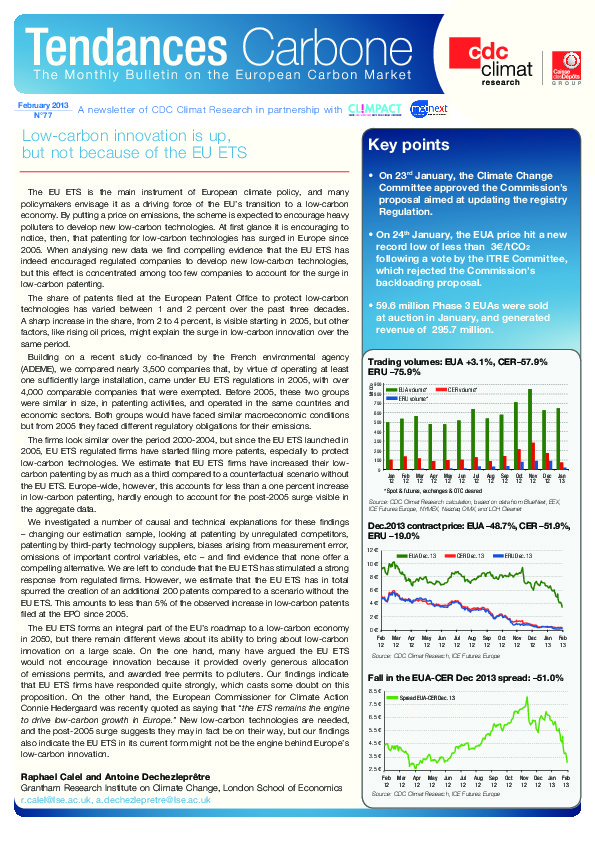
Low-carbon innovation is up, but not because of the EU ETS Download
To learn more
  • 02/19/2026 Blog post
    Food sovereignty relies on ecological planning

    The upcoming food sovereignty conferences are likely to shape debates on the future of French agriculture in 2026. The main responses provided over the past two years can be summarised as follows: remove production constraints to produce more of everything (both animal and plant products), to recover market shares in France and abroad. Seeking to produce more of everything without considering adaptation or transition is a form of denial, at a time when climate change is hitting farmers hard and regularly, and when our dependence on imported fertilisers and oilseed meals undermines our sovereignty. The conferences must take these considerations into account — otherwise, they will serve only to perpetuate the notion of an illusory sovereignty. 

  • 02/19/2026
    Which production assets for more resilient and sustainable agricultural and food sectors? Which investment needs? Which stranded assets?

    Les choix d’investissements des secteurs agricoles et alimentaires des années à venir sont déterminants. Pour pérenniser leurs productions et faire face aux crises, les secteurs agricoles et alimentaires français doivent évoluer vers des systèmes plus résilients et durables. L’enjeu est d’autant plus crucial que différentes vagues d’investissements sont en cours ou à venir dans ces secteurs. Dans cette étude, I4CE a estimé qu’environ 100 milliards d’euros d’outils de production agricoles et alimentaires sont affectés par la transition. Une coordination et une planification des investissements semblent incontournables, notamment pour en limiter les coûts.

  • 01/23/2026 Foreword of the week
    Financing carbon farming practices: lessons learnt in France can reinforce the EU level initiatives

    In a challenging economic and political context, especially for the agriculture sector, some incentive schemes can still help bring stakeholders together in climate transition and resilience initiatives. This is the case with carbon certification schemes, which both ensure the credibility of the climate impact of the actions implemented and provide remuneration for farmers and foresters for changes in practices. Some of these measures, such as replacing mineral fertilisers (mostly imported) with organic fertilisers, also help to meet the sector’s needs for resilience and strategic independence, which are crucial in the current context.

See all publications
Press contact Amélie FRITZ Head of Communication and press relations Email
Subscribe to our mailing list :
I register !
Subscribe to our newsletter
Once a week, receive all the information on climate economics
I register !
Fermer