Publications Adaptation Public finance

The adaptation reflex in public investment in practice: Pathway for 2025 and prospects

Report only available in French

The 3rd French national climate change adaptation plan (PNACC3) seeks to generalize an “adaptation reflex” in all public investments and all public support for investment. Operationalizing this ambition is essential for:


  • Stop investing in infrastructure, buildings and equipment that will not be ready to cope with the consequences of climate change;
  • Seize the best opportunities available by taking advantage of investments already planned to strengthen the level of adaptation of the French economy at lower cost. 


To move in this direction, we have identified 5 initial areas – together involving up to 25 billion euros of existing annual investment – in which action can be taken as early as 2025 by activating the following levers:
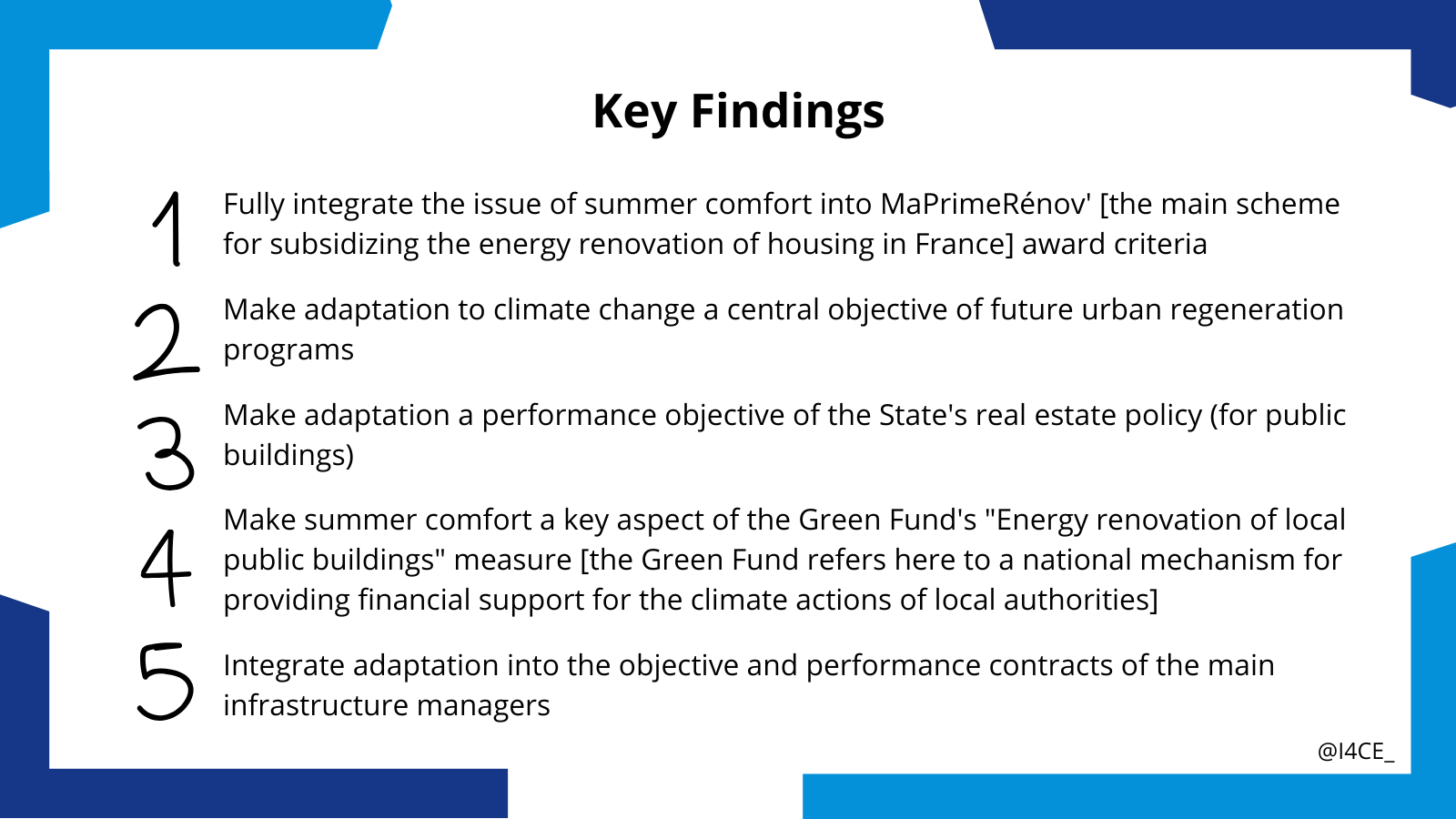


For major infrastructure, architectural or industrial projects already launched, conducting stress tests them in the light of +4°C would make it possible to reconsider decisions already made by identifying the most critical ones to adapt before the choices of location or design become irreversible. 


To take this a step further, four generic methods can be considered, depending on the field and type of investment, in order to progressively generalize this scheme for taking adaptation into account to all investments affected by the impacts of climate change:


  • Taking adaptation into account right from the design stage of future programs;
  • Adapting norms and standards ;
  • Deploying a “tracc-proofing” approach (verification of compatibility with the national reference warming trajectory) on a case-by-case basis for major projects;
  • Contractualizing investments on the basis of adaptation strategies: asset management strategies, regional or sector strategies. 


Whatever the approach to operationalization, it will be essential to establish a form of accountability for the implementation of the adaptation reflex. This must involve not only the administration, but also Parliament, independent audit bodies such as the Cour des Comptes, and civil society. 
The adaptation reflex in public investment in practice: Pathway for 2025 and prospects Download
I4CE Contacts
Vivian DEPOUES, PhD
Vivian DEPOUES, PhD
Research Lead – Adaptation to climate change Email
Guillaume DOLQUES
Guillaume DOLQUES
Research Fellow – Climate Change Adaptation Email
To learn more
  • 10/31/2025 Foreword of the week
    A Paris Climate & Nature Week with a touch of ‘green budget’

    We were proud to contribute to the inaugural Paris Climate & Nature Week hosted by Sciences Po from 27 to 29 October, marking the 10 years of the Paris Agreement. I4CE weighed in on some of our core topics– lessons learnt over the past decade of climate action which can accelerate the  transition; the links between climate and development finance; as well as adaptation and the cost of inaction.

  • 10/28/2025
    Adapting France to +4°C: current resources, additional needs, and funding options

    Cette étude s’inscrit dans la continuité des travaux d’I4CE engagés depuis plusieurs années sur la qualification et la quantification des besoins et des moyens pour l’adaptation en France. Elle propose une vision d’ensemble de ce que l’on peut dire à date sur ces aspects, basée sur le suivi et l’analyse d’une quinzaine de domaines d’action publique concernés par le changement climatique. Alors que l’adaptation est souvent un grand oublié des PLF, ce rapport apporte des éléments sur l’effort consenti aujourd’hui, les besoins identifiés pour demain et les modalités de répartition des coûts.

  • 03/21/2025 Foreword of the week
    Adaptation finance in the EU: what role for insurers and other private financial institutions?

    The President of the European Commission, Ursula von der Leyen, has committed to presenting a European Climate Adaptation Plan in 2026. The European Commission has previously emphasised public budgets as the main source of coverage for climate-related disasters. But if both the EU’s and member states’ budgets are strained by competing investment priorities and high debt levels in some cases, what are the complementary avenues for financing adaptation in the EU? How can private financial actors, such as banks, insurance companies or asset management firms, support adaptation efforts, not only to ensure resilience (i.e. recovery) from climate disasters, but also to prevent impacts before they arrive?

See all publications
Press contact Amélie FRITZ Head of Communication and press relations Email
Subscribe to our mailing list :
I register !
Subscribe to our newsletter
Once a week, receive all the information on climate economics
I register !
Fermer