Adapting France to +4°C: current resources, additional needs, and funding options
This report, originally published in French in September 2025, is first a contribution to the public debate on adaptation in France. The methodologies applied, the data collection process, as well as the analytical framework proposed, may inform broader discussions in Europe, as the preparations for an EU integrated framework for European climate resilience and risk management are well underway.
Adaptation momentum has grown significantly in recent years, but has been weakened in 2025
Since 2020, resources devoted to adaptation have increased across all areas of public policy affected by climate change. The period 2020-2024, in particular, has been a genuine turning point, both in understanding the issues at stake and in scaling up national resources. At this stage, there are no longer any significant blind spots, though funding levels and coverage are still limited in some areas.
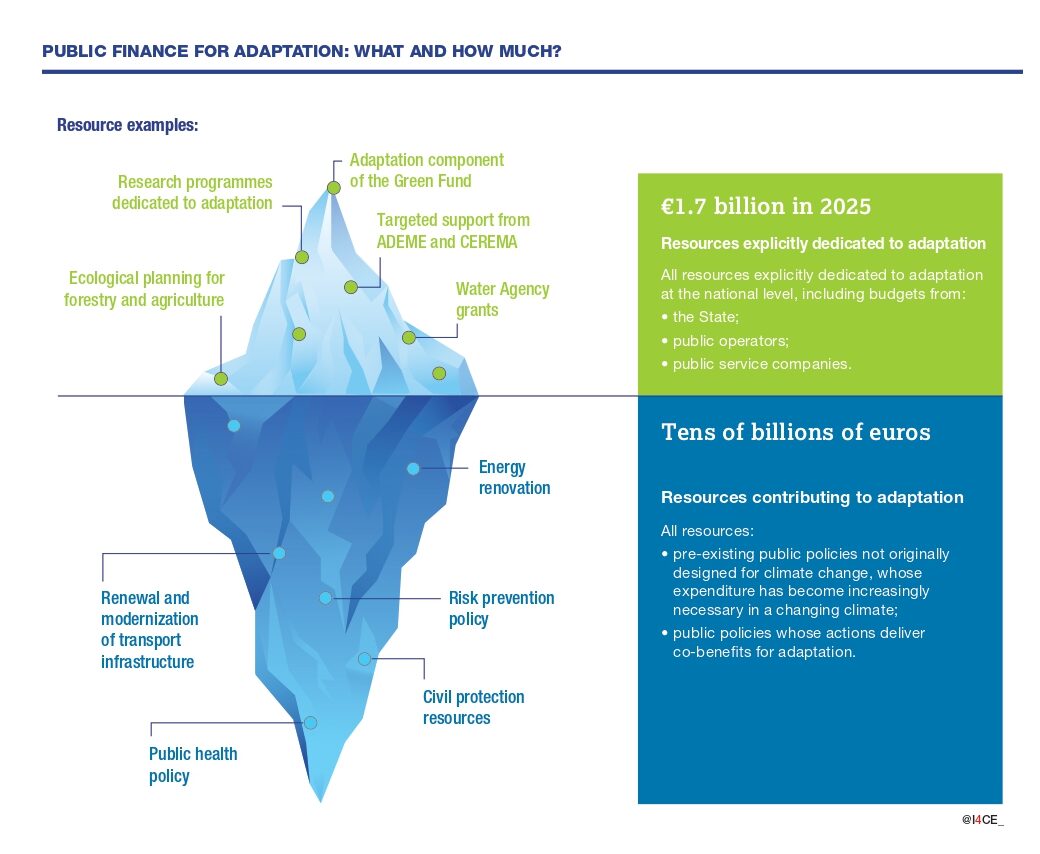
As a result of this momentum, €1.7 billion has been explicitly dedicated to adaptation in 2025, through national budget allocations and resources mobilized by public operators, financial institutions and public service companies. These funds are mainly created or expanded to implement adaptation measures via the Water Agencies and various mechanisms such as the Green Fund, the Barnier Fund and the France 2030 calls for projects. They also include resources allocated to research and innovation, as well as to adaptation initiatives supported through technical and coordination capabilities.
More broadly, all relevant public policies and investment programmes are increasingly integrating climate change considerations. This suggests that tens of billions of euros of expenditure, while not explicitly dedicated to adaptation, contribute significantly to it. These include, in particular:
- investments in the transition with proven co-benefits for adaptation, such as infrastructure modernization, building energy renovation and forest renewal;
- policy measures that, by their very nature, help manage climate risks, such as flood prevention, civil protection and environmental health policies.
Although these co-benefits are increasingly sought, overheating during heatwaves in public buildings such as schools and transport hubs, as well as in homes – despite recent renovations – shows that adaptation is still not adequately integrated and vulnerabilities remain.
During budget debates, it is particularly important to monitor the tens of billions of euros in resources that contribute to adaptation (not only the billions explicitly dedicated to adaptation), since changes to these resources, generally decided on the basis of considerations other than adaptation itself, have a direct impact on the country’s capacity to adapt.
The situation is more mixed when it comes to the human resources of public operators contributing to adaptation. To date, several key operators have been identified – including ADEME, CEREMA, Météo-France and the National Forestry Office (Office national des forêts, ONF) – that are responsible for coordinating, supporting, providing technical expertise, and implementing adaptation measures. Monitoring their staffing levels provides an indication of their capacity to maintain and develop the new skills and functions required in the context of climate change. However, despite a slight increase in 2024, the long-term trend shows a significant decline since 2015, particularly for ONF (a reduction of 1,218 FTEs), Météo-France (584 FTEs), the Water Agencies and the National Institute of Geographic and Forest Information (Institut national de l’information géographique et forestière, IGN) (198 FTEs each).
While the period from 2020 to 2024 has seen genuine progress on this issue, more recent developments have cast significant doubt on the continuation of this momentum. Whether in budgets specifically dedicated to adaptation – such as the Green Fund and certain France 2030 measures – or more broadly in resources contributing to adaptation, 2025 marks the end of the upward trend observed in recent years. Some budgets are already facing sharp cuts, particularly in the forestry and agriculture sectors.
Until now, resources have mainly been used to catch up, with efforts largely focused on maintaining existing models
Analysis of the resources currently allocated to adaptation shows that few have been deployed proactively. In most cases, a climate event acts as the trigger for budgetary decisions: heatwaves prompt a reassessment of resources for public health or energy production policies; fires do the same for civil protection. Funding is then released, initially with the aim of catching up with climate changes that have already occurred. However, this reactive spending is often accompanied by forward-looking work which, for now, has little influence on action plans and dedicated budgets.
Current adaptation efforts still focus largely on preserving existing agricultural, economic and tourism models. This is understandable – adaptation often aims to protect existing systems – yet it exposes a clear gap between rhetoric calling for transformation and the reality of adaptation policies.
A foundation of essential requirements, regardless of the adaptation pathway chosen
In addition to the resources already mobilized, we have identified a set of further requirements corresponding to measures that must be taken whatever adaptation vision is ultimately pursued. These include:
- Strengthen resources for support and technicalexpertise. Effective preparation depends on access to the right expertise – vulnerability assessments, technical data – to inform decisions and to provide robust support, particularly for local actors and communities. Public expertise already exists within organizations such as Météo-France, CEREMA, ADEME and ONF, built up over years of investment in research and experimentation. The challenge now is to go further and to make this expertise available to those who need it most:
– Complete all studies identified in the PNACC-3 (the French 3rd national adaptation plan).
– Consolidate the steering and coordination of adaptation policy at the national level – €6.4 million/year.
– Strengthen public technical expertise –Mission adaptation – €4 million/year.
- Make adaptation a systematic consideration in investment flows.This means both stopping investment in infrastructure, buildings or facilities that are unsuitable for a changingclimate, and leveraging planned investments to enhance the overall level of adaptation of the French economy, while reducing costs.
- Improve crisis response. Faced with climate impacts that can no longer beavoided, andgiven the low level of anticipation observed to date, it is essential to increase the resources dedicated to preventing and managing climate-related crises. Whatever choices future governments and local authorities make, France will have to cope with climate events that are longer, more intense and occur earlier in the season. For the safety of the population and the resilience of the economy, investment is urgently needed in response capacities, in line with emerging risks (such as a sufficient fleet of operational water-bombing aircraft, pumping capacity, emergency stockpiles, etc.), in warning systems and crisis preparedness (monitoring mechanisms, crisis planning, exercises), and in the robustness of damage-response systems. Failure to act now would mean condemning ourselves to endure repeated crises and to make impossible choices over which relief operations to launch and which communities to support.
Choices to be made, policy programmes for adaptation to be developed
Beyond these essential requirements, which can bring together a range of political perspectives, adapting to climate change requires structural choices that define both our adaptation objectives and the pathways to achieve them. Deciding what we want to preserve (an economic activity, an industry, a set of buildings, a service level) and what we are prepared to change is, above all, a political decision.
Choosing to maintain existing economic models, consistent with current trends, may in some cases be a defensible option and constitute an adaptation objective in itself. But this must be done explicitly, taking into account the limits and conditions of viability of current models, for example, irrigated agriculture, winter tourism, or service levels for energy or transport infrastructure. The necessary resources must also be secured: maintaining the public insurance model requires significant investment in prevention; maintaining access to water calls for investment to improve efficiency and reduce consumption; maintaining transport service levels demands major investment in renewal and modernization.
Conversely, preserving the status quo at all costs will not always be possible or even desirable. In such cases, measures to reconfigure spaces, reinvent sectors and transform territories can be envisaged and tested. These alternative political visions may be motivated by their intrinsic benefits (an agroecological, less productive agricultural model, for example, may bring greater benefits for biodiversity and the climate) but also by economic considerations and the efficient use of public funds (for example, when increased expenditure on sand replenishment or dyke reinforcement in response to coastal erosion eventually places a lasting burden on local finances).
These options reflect political visions of adaptation that must be debated as such. To date, they remain open in most of the areas studied. Different approaches to climate change lead to very different actions and requirements. To inform and structure this debate, our work provides cost components to enrich the discussion with quantified data.

In the run-up to national and local elections, it will be essential for stakeholders to assess their adaptation options objectively, and to develop coherent strategies that reflect their vision of the challenges ahead. The cost components presented in this study provide a useful foundation for this purpose.
The emerging but already crucial question: who will pay?
In recent years, discussions on how to allocate responsibility and share the costs of adaptation have intensified. They are taking place against a backdrop in which well-established mechanisms – such as those financing risk prevention, civil protection and water management – are already showing their limitations as needs increase. Yet few structural decisions have been made so far on how adaptation will be financed.
For now, discussions remain fragmented, with each stakeholder advancing its own proposals and funding ideas within its area of competence. Taken together, however, these exchanges reveal some common ground:
A recurring theme is the direct contribution of users to cover the adaptation needs of services affected by climate change, for example through water, electricity or transport tariffs. While this user-financing model has the merit of transparency, questions remain about its social acceptability and the ability of private actors to absorb still poorly quantified cost increases.
Solidarity is also central to the debate on adaptation financing. Equalization mechanisms are being discussed between regions so that less exposed or more fiscally robust areas can support those already affected or less well-off, for instance, in relation to flood risk, forest fires or declining snowfall.
In particular, given that adaptation serves the public interest, the use of national solidarity is increasingly being discussed. It extends the long-standing principle that all citizens share the costs of climate-related losses, exemplified by the natural disaster compensation scheme. Increasingly, this collective financing approach is being called upon to fund vulnerability reduction measures in a growing number of territories, each perceiving itself as particularly at risk and therefore entitled to benefit from coastal and mountain areas to the Mediterranean region. However, this raises difficult questions about fairness and long-term sustainability.
To date, there is no comprehensive national framework for financing adaptation. Developing such an approach is now essential to:
- gain a clearer understanding of the available options, their advantages and limitations;
- bring greater coherence to sectoral discussions that sometimes target the same financing mechanisms without prior coordination or consultation;
- define and prioritize the principles of national burden-sharing for adaptation.