Publications Development finance

Climate and development finance institutions

9 October 2015 - Special issues - By : Ian COCHRAN, Phd

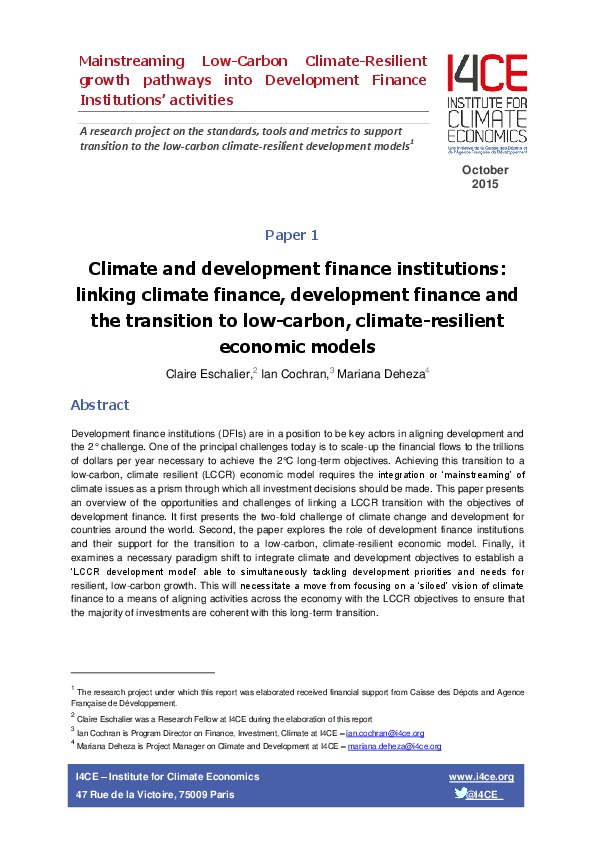
Climate and development finance institutions: linking climate finance, development finance and the transition to low-carbon, climate-resilient economic models

Paper one in I4CE’s research project on the standards, tools and metrics to support the mainstreaming of ‘Low-Carbon Climate-Resilient’ growth pathways into activites of development finance institutions.

Abstract
Development finance institutions (DFIs) are in a position to be key actors in aligning development and the 2° challenge. One of the principal challenges t oday is to scale-up the financial flows to the trillions of dollars per year necessary to achieve the 2°C lo ng-term objectives. Achieving this transition to a low-carbon, climate resilient (LCCR) economic model requires the integration or ‘mainstreaming’ of climate issues as a prism through which all investment decisions should be made. This paper presents an overview of the opportunities and challenges of linking a LCCR transition with the objectives of development finance. It first presents the two-fold challenge of climate change and development for
countries around the world. Second, the paper explores the role of development finance institutions and their support for the transition to a low-carbon, climate-resilient economic model. Finally, it examines a necessary paradigm shift to integrate climate and development objectives to establish a ‘LCCR development model’ able to simultaneously tackling development priorities and needs for resilient, low-carbon growth. This will necessitate a move from focusing on a ‘siloed’ vision of climate finance to a means of aligning activities across the economy with the LCCR objectives to ensure that the majority of investments are coherent with this long-term transition.

The research project under which this paper was elaborated received financial support from Caisse des Dépots and Agence Française de Développement during its first phase. The research presented in this publication was carried out by I4CE on an independent basis. CDC group and AFD are not liable under any circumstances for the content of this publication.
To learn more
  • 11/28/2025 Foreword of the week
    COP30: The missed turn to implementation – and the coalitions moving ahead anyway

    COP30 concluded with an agreement, proving that multilateralism is still alive. However, the results are underwhelming: no push to transition away from fossil fuels, no decision on deforestation, and mixed outcomes on adaptation metrics.  On climate finance, Belém failed to shift from ambition to implementation. Negotiations quickly drifted back to a battle on yet another high-level quantitative target. The decision to triple adaptation funding by 2035 disappointed many, with its distant time horizon, lack of baseline and non-binding wording. COP30 also missed the opportunity to engage with – and build consensus around – concrete measures outlined in the Baku to Belém roadmap to get to $1.3 trillion. Instead, it defaulted to launching new processes – a work programme on climate finance and a ministerial roundtable on the NCQG.  

  • 11/13/2025
    How solidarity levies can help bridge the climate and development finance gap

    The climate and development finance gap is large and widening, as Official Development Assistance (ODA) declines and needs multiply. With shrinking fiscal space in vulnerable countries, solidarity levies are gaining attention as a predictable source of international finance. Launched at COP28 by Barbados, France, and Kenya, the Global Solidarity Levies Task Force (GSLTF) is the main initiative in this space.

  • 11/12/2025
    Bridging the Finance Gap: Leveraging National and Subnational Public Financial Institutions for Localised Climate and Development Action

    National Public Banks (NPBs) and Subnational Public Financial Institutions (SPFIs), including development banks and agencies as well as climate and green funds at the subnational level, play an increasingly vital role in financing climate action and the just transition. While national governments provide frameworks aligned with nationally determined contributions (NDCs), actual implementation occurs largely at the subnational level, which currently lacks sufficient funding. SPFIs can work as financial intermediaries, as they not only understand local needs and have stronger ties with local governments and businesses, but also access much larger volumes of capital from more diverse sources. 

See all publications
Press contact Amélie FRITZ Head of Communication and press relations Email
Subscribe to our mailing list :
I register !
Subscribe to our newsletter
Once a week, receive all the information on climate economics
I register !
Fermer