Estimation of Public Spending Related to Agricultural Crises in France Between 2013 and 2022
Report only available in French
Putting Agricultural Risk Management on the Agenda
In recent years agriculture has been hit by numerous crisis in France: adverse climatic events (primarily droughts, floods, and frost) and health crisis (notably avian flu), directly impacting agricultural production. Broader crisis, such as COVID-19 pandemic and the Russia’s invasion of Ukraine, have also indirectly but significantly affected the agricultural sector. Climate change, the ongoing Ukraine conflict, and overall geopolitical tensions suggest that these crisis and their impacts will become a lasting pattern in the future. These are crucial factors to consider when defining and strengthening food sovereignty.
Agricultural Crisis Compensation: Necessary but Unsatisfactory for All
In response to these crises and the resulting wealth loss, the French government provides support to farmholdings, notably through crisis aids. This assistance is essential, particularly for farmers in vulnerable economic situations. This report does not question the need for public aid when significant crises occur.
However, these emergency supports are unsatisfactory for everyone involved. When they increase, everyone loses: the government spends more without reducing the farms’ vulnerability to future crisis, and farmers, who would prefer to earn a living from their work, sometimes lose everything. It is in everyone’s interest to make farms less exposed to risks.
It is thus important to assess the amount of losses, track their evolution, and explore ways to mitigate them in the future. Focused on public expenditure, our study provides objective data and contributes to the debate on improving France’s agricultural risk management system.
Public Spending for Agricultural Crises Compensation and Prevention Increased Significantly from 2013 to 2022
We estimated the amount of French public spending related to agricultural crises over the past ten years (2013–2022) using public budget execution documents. This evaluation includes both crisis aids and management expenses, as well as prevention and risk monitoring expenses. The estimated amounts are a minimum because we could not account for personnel costs, local authority expenditures, and part of the European Union’s contributions. The study covers the period from 2013 to 2022, focusing on the pre-reform crop insurance system.
Over this period, French public spending for crisis aids and management sharply increased (Figure 1), reaching just over €2.1 billion in 2022. These expenses, almost entirely funded by the Ministry of Agriculture, accounted for approximately 40% of its total forecast budget in 2022. For comparison, they equaled 20% of the subsidies France received from the Common Agricultural Policy (CAP) that year.
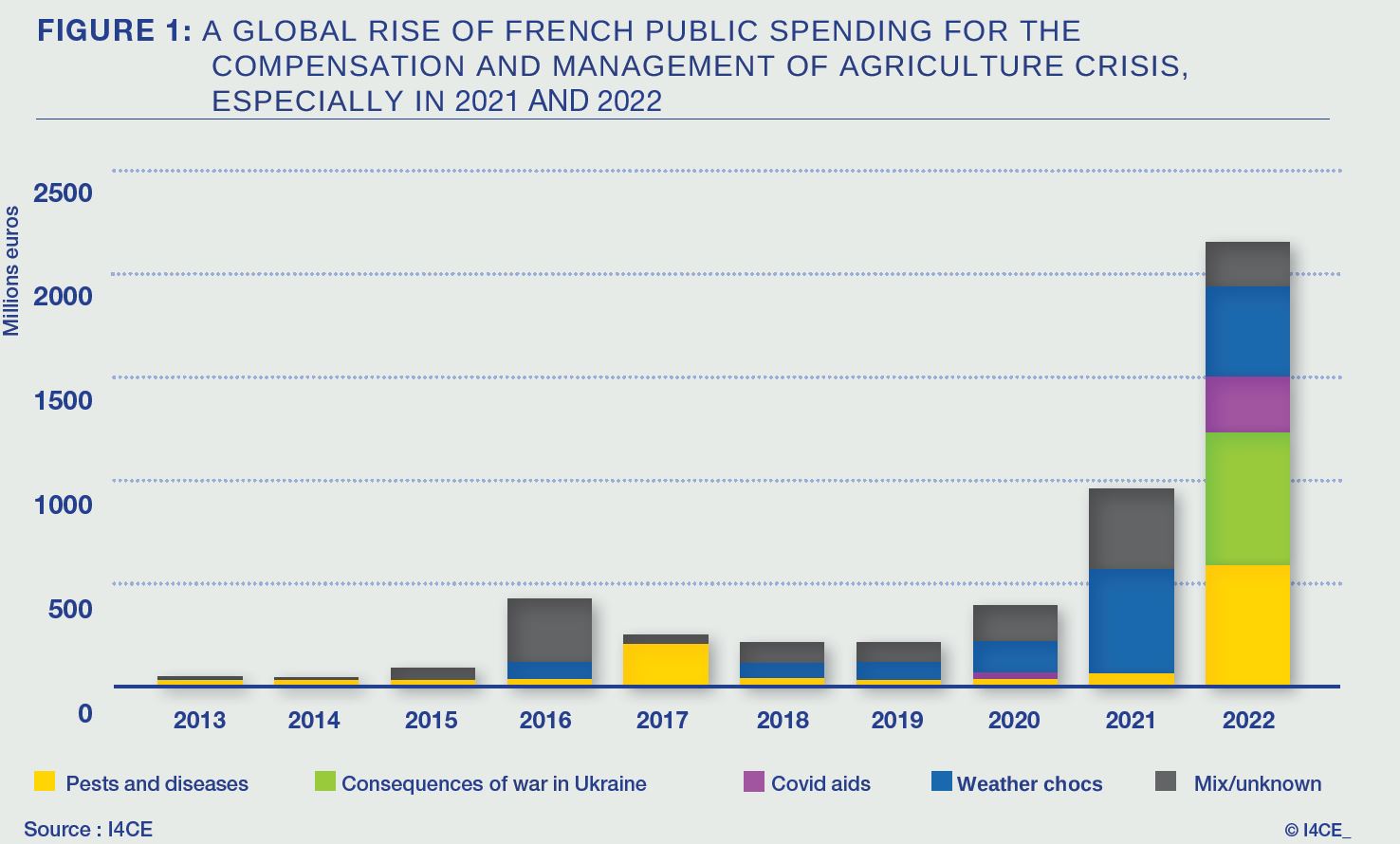
Crises prevention and monitoring expenses (not shown in Figure 1) also rose but to a lesser extent, increasing from €181 million in 2013 to €453 million in 2022. Most of this increase occurred after 2018, driven by higher subsidies for crop insurance and investment aid for climate risk protection.
A Rising Trend Raising Concerns About Public Resources and Ecological Transition
The rise in compensation can be explained by three non-exclusive factors: (i) the increasing severity of risks, (ii) the growing economic losses caused by each risk, and (iii) the increasing public share in covering these losses (possibly due to farmers’ declining capacity to handle crises alone). Further research is needed to determine the relative contribution of each factor.
In any case, the increase in public spending over the past decade and the likely continuation of this trend is problematic for several reasons. First, it may indicate greater vulnerability among farmers to these risks. Second, it raises questions about the balance of public resources. Financially, the multiplication and intensification of crises pose a challenge, as the state often acts as the insurer of last resort. In terms of human resources, the increasing strain questions the state’s ability to manage future crises.
Finally, this trend raises concerns about funding for the ecological transition. In a constrained budgetary context, using financial resources to cover losses from crises can come at the expense of actions crucial to the ecological transition. This is especially true for human resources: agents dealing with crises are not available for other missions, such as advancing the transition. Additionally, frequent occurrence of crises often leads to environmental and/or climate policy delays and exemptions.
Preparing for More Resilient Agricultural Models, Better Adapted to Climate Change
It is first necessary to continue improving agricultural risk management tools. Some initiatives are already underway, particularly with the reform of crop insurance. It would also be beneficial to strengthen climate risk prevention, drawing inspiration from long-standing health risk prevention practices.
Next, a broader effort is needed to address the vulnerability of our agricultural model. The goal is not only to better manage crises when they arise but also to make farms and the food system more robust and resilient to risks. This is particularly important regarding adverse climatic events, by more clearly identifying what the agricultural sector adapted to climate change will look like, how to achieve it, and how to plan its financing.
This broader reflection inevitably raises questions about the current funding of the agricultural sector and the food system. The agricultural sector in France benefits from about €15 billion in public support, with nearly €10 billion coming from the Common Agricultural Policy (CAP). French public funding needs to be better aligned with the requirements of resilience and, more broadly, the transition of the agricultural sector and food system.