Publications
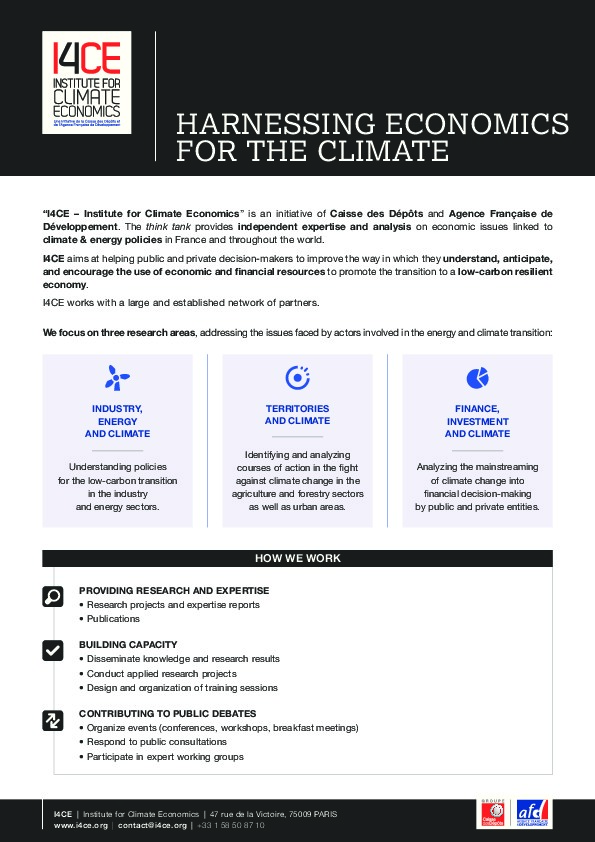
I4CE flyer Download
To learn more
  • 01/23/2026 Foreword of the week
    Financing carbon farming practices: lessons learnt in France can reinforce the EU level initiatives

    In a challenging economic and political context, especially for the agriculture sector, some incentive schemes can still help bring stakeholders together in climate transition and resilience initiatives. This is the case with carbon certification schemes, which both ensure the credibility of the climate impact of the actions implemented and provide remuneration for farmers and foresters for changes in practices. Some of these measures, such as replacing mineral fertilisers (mostly imported) with organic fertilisers, also help to meet the sector’s needs for resilience and strategic independence, which are crucial in the current context.

  • 01/21/2026 Blog post
    On Carbon Removals and Carbon Farming the devil is in…the demand

    The implementation of carbon farming practices on European farms and in European forests is a lever for achieving carbon neutrality, but also for farm resilience, the adaptation of forest stands to climate change and for contributing to our strategic independence. Certifying and financing low-carbon practices is the objective of the CRCF (Carbon Removals and Carbon Farming) regulation, which will come into effect in 2026. Now seems the right time to draw lessons from six years of experience with a similar standard in France: the “Label Bas-Carbone” (Low Carbon Label – LBC). The results show that striking a balance between scientific rigour and accessibility for stakeholders has led to the development of a substantial range of projects. However, the real challenge is to build sufficient and appropriate demand to finance the projects. There is no miracle solution, but complementary financing channels may emerge. 

  • 01/16/2026 Blog post
    CBAM and fertilisers: ring-fencing budgets to help farmers reduce their use of mineral fertilisers

    The Carbon Border Adjustment Mechanism (CBAM) came into force on 1 January 2026. It is a carbon tax applied at the borders of the European Union to imports of certain industrial products covered by the EU Emissions Trading System (EU ETS). Nitrogen-based mineral fertilisers are included in this initial list of products. To avoid an increase in costs for the farmers concerned, the level of the tax has been reduced for fertilisers, and they may even be temporarily excluded from the scope of the CBAM. Yet, for the climate, but also for France’s strategic independence and food sovereignty, the CBAM will ultimately have to be fully applied to mineral fertilisers. To limit or even avoid an increase in farmers’ fertiliser expenditure, we need public policies – some of which are currently under threat. Ring-fencing budgets for these policies would be a way to support farmers’ incomes and the food sovereignty of both the European Union and France, while reducing the carbon footprint of our food system. 

See all publications
Press contact Amélie FRITZ Head of Communication and press relations Email
Subscribe to our mailing list :
I register !
Subscribe to our newsletter
Once a week, receive all the information on climate economics
I register !
Fermer