Public support for agricultural and food investments in France
What contribution to a resilient and sustainable transition?
The wave of agricultural and food investments in the coming years is decisive for the longevity of these sectors and the cost of future crises. Public authorities are already steering these investments. Are these orientations consistent with the imperatives of resilience and sustainability?
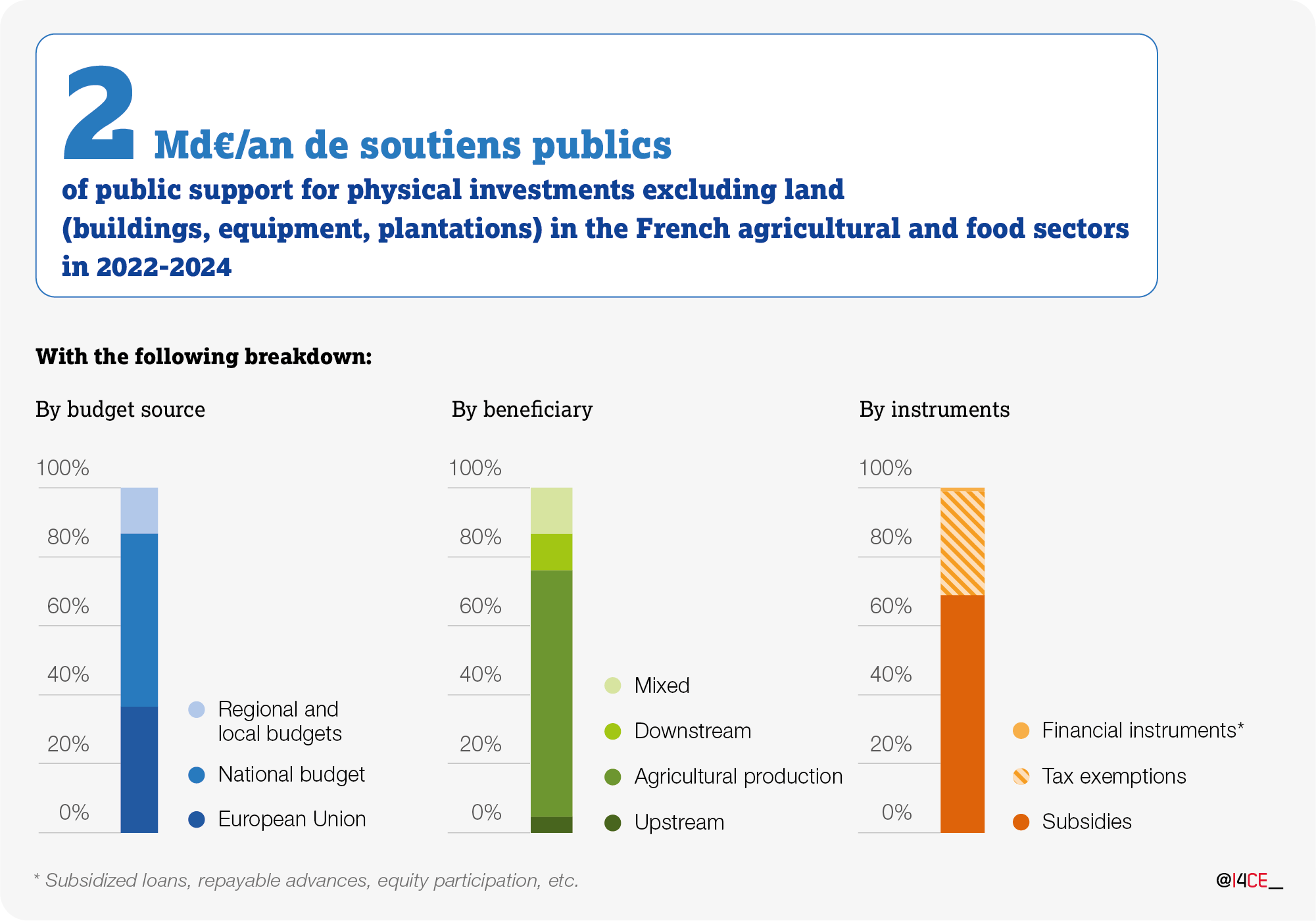
In 2022-2024, the French agricultural and food sectors received around €2 billion per year in public support for their investments in buildings, equipment and plantations
This amount corresponds to a parenthesis of high investment support, which is likely to close. The 2020-2026 period was indeed marked by the France Relance and France 2030 plans, which translated, in whole or in part, into direct support for physical investment. Given constraints on public budgets, these schemes will potentially not be renewed in the short term, at least not on the same scale. This differs from CAP investment aid, exemptions from mandatory levies linked to the sale of equipment, and other national and regional schemes, which are renewed every year.
At €1.6 billion, farms received nearly 80% of this support. This amount represents 10% of farms’ annual physical investment. The remainder goes mainly to the downstream segment (food-processing industries), and very little to the upstream segment (input production, hydraulic infrastructure, animal feed). Public support to the downstream segment represents around 3% of the annual physical investment of companies in this sector.
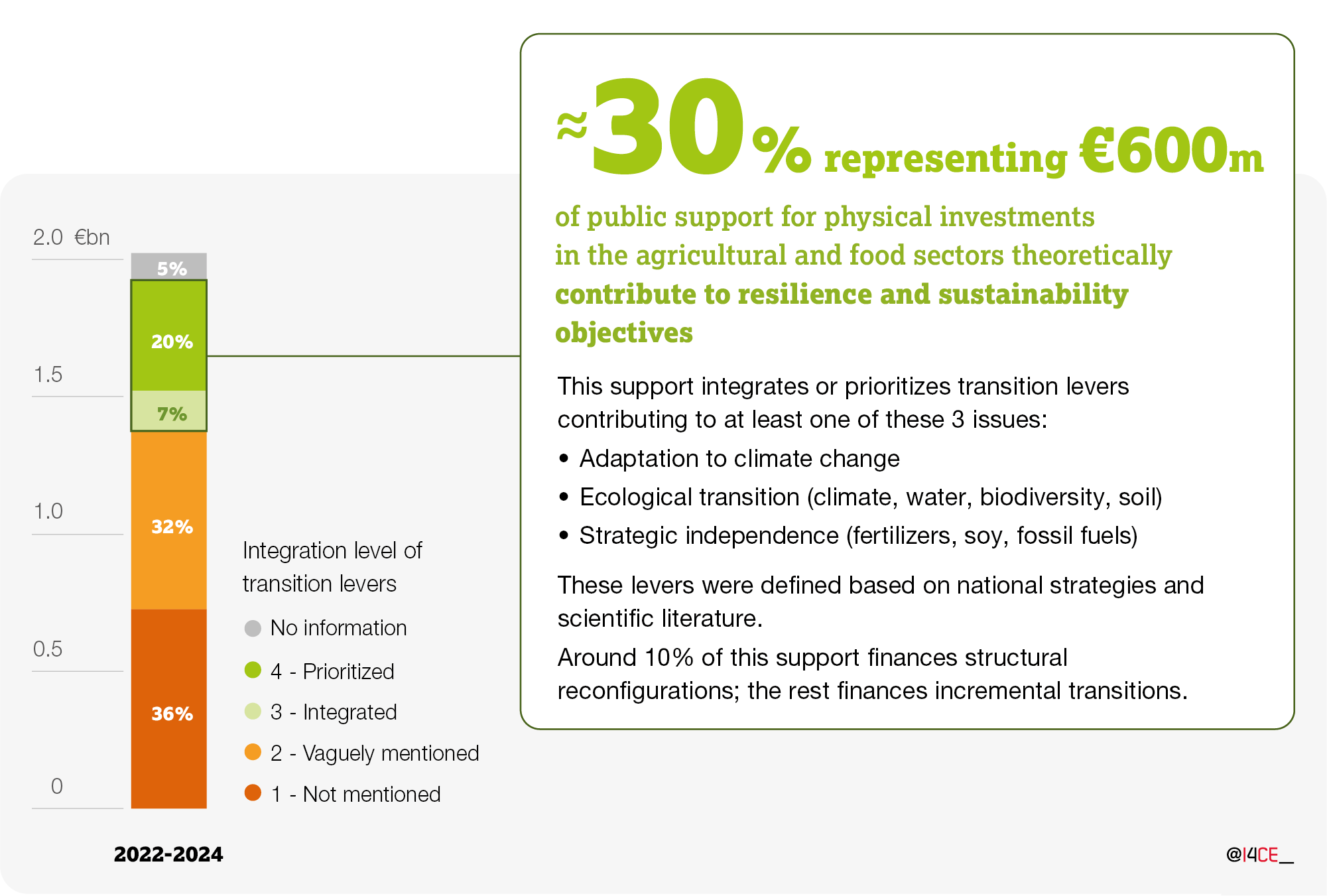
Of this total, around 30% (€600 million) of the support is, at least theoretically, directed toward a more resilient and sustainable transition
The contribution of this support to resilience and sustainability objectives relies on the identification of transition levers (I4CE 2026) drawn from the 3rd National Low-Carbon Strategy, documents from the General Secretariat for Ecological Planning, and a collective INRAE volume on adapting agriculture to climate change (Debaeke et al. 2025). The contribution is theoretical, in that it concerns the explicit ex ante orientations of the schemes or of the projects they select, and not their real ex post effects.
The various schemes supporting physical investment contribute unequally to these resilience and sustainability objectives: the France 2030 and France Relance plans strongly integrated them into their orientations, whereas the equipment-related tax exemptions do not mention them.
Around 90% of these €600 million mainly target incremental and energy-related transition levers. Particularly targeted are incremental adaptations of perennial crops, increased renewable energy production on farms, reduced energy consumption (especially fossil), and optimization of water, plant protection product and fertilizer use.
Only 10% of this support finances structural transitions, notably:
- Diversification of crop production (including legumes),
- Support for the reduction of livestock herds and their possible territorial reorganization,
- Development of organic farming,
- Relocation of perennial crops to more favorable climate zones.
These structural transitions imply particularly significant reconfigurations downstream (silos, slaughterhouses, dairies, etc.), a link in the chain that nonetheless receives very little investment support.
Recommendations for more resilient, sustainable and cost-effective public investment support
Our recommendations aim both to allocate current support more efficiently and to systematically integrate resilience and sustainability objectives – although not all support needs to prioritize these issues. Greater integration of these objectives must also take place within the other types of support not studied here (income support, support for intermediate consumption, etc.). These recommendations can be combined with a constant overall budget.
Secure the longevity of supported projects by introducing three minimum criteria
Public support schemes for long-term investments (buildings and plantations), whether or not they are dedicated to resilience and sustainability objectives, should verify three minimum criteria:
- The project’s compatibility with the future climate and water availability.
- The project’s contribution to strategic independence, by not increasing extra-European imports of critical products (fertilizers, soy, fossil fuels).
- The project’s contribution to the necessary diversification of agricultural production, in particular through crop production.
To be operational for public officials and beneficiaries, these criteria should be easy to assess in a certified public tool. The first criterion could build on existing tools, such as Climadiag, which would need to be expanded. The second and third criteria require defining monitoring indicators and validation thresholds – an obviously complex and political exercise.
- Develop the appropriate tool, building on existing ones, and define indicators and validation thresholds.
- Make certain CAP investment aid, national aid for vineyards and orchards, downstream aid in investment plans, and national financial instruments conditional on these criteria.
Strengthen support for the restructuring and development of value chains
As mentioned above, too little public support targets structural changes, which are nonetheless essential.
- Increase the amounts of public support for investments in projects to structure or restructure resilient and sustainable value chains, including at a minimum actors in agricultural production and the downstream segment.
- Increase the amounts of support dedicated to downstream infrastructure that integrates resilience and sustainability issues.
- Maintain or even strengthen the targeting of agricultural investment aid toward Cuma (machinery-sharing cooperatives) and other collective structures and projects (GIEE, EIP, etc.). These structures not only allow investments to be pooled, but also facilitate the uptake and spread of changes in practices.
- Increase the budget for training and support schemes for changing practices, and make them a more systematic condition of investment aid, as several Regions do with CAP aid.
These recommendations apply to all public support for agricultural and food investments.
Reserve support for environmental investments for cases where it is most effective and cost-efficient
According to the literature, the investment subsidy is theoretically effective in achieving an environmental objective under two conditions:
a) The physical investment is an unavoidable means of achieving the intended result. For example, investment in an electric motor to reduce fossil energy consumption;
b) The physical investment has a negative or uncertain private return for the person making it.
Financial instruments (loan guarantees, subsidized loans, repayable advances, equity stakes, etc.) are effective if condition a) is met and the private return on the investment is positive, but the investor faces a credit constraint (debt ratio too high, cost of capital too high, etc.). We therefore recommend:
Reducing or even ending direct subsidies for investments that optimize the use of a resource (energy, inputs, water) and that have a certain positive private return, notably in some CAP and France 2030 investment aid.
Replacing this support: :
- Ideally, with payments for environmental services (PES) – for example the CAP’s agri-environment-climate measures (AECM) – if the objective is directly to reduce the use of these resources.
- Otherwise, with financial instruments if the objective is to help with acquiring these optimization tools.
Refine the targeting of any support for “agroecological” equipment
Direct support for investment in so-called agroecological equipment is rarely effective. If this type of support were nonetheless maintained, we recommend:
- Limiting it to non-fossil-powered equipment, which is essential for the transition and whose low maturity in the agricultural sector makes returns uncertain.
- For this support, favoring “criteria-based” calls over “first come, first served” calls, whose effectiveness is criticized, both in terms of transition objectives and the efficiency of public spending.
In addition to investment subsidies, an exemption from mandatory levies on capital gains from the sale of agricultural equipment (Article 151 septies of the French General Tax Code) encourages individual investment. It is estimated to generate around €600 million in foregone tax revenue in 2025.
- Exclude, at a minimum, self-propelled equipment not running on alternative energies (electricity, hydrogen, bioNGV) from eligibility for the Article 151 septies exemption.
Improve the processes for monitoring, control and evaluation of schemes, and the transparency of information
This study and the literature consulted highlight a need to improve the monitoring and evaluation processes of support schemes.
- Design monitoring, control and evaluation processes before schemes are rolled out, particularly for innovative schemes.
- Where available, strengthen the transparency and availability of data on this public support.
Even in a crisis, maintain an ambition of resilience and sustainability
After the shock of the 2020 lockdowns, public authorities implemented a recovery plan in two stages: massive support to avoid bankruptcies, then more limited, structural support (France Relance) to steer the economic recovery.
On the agricultural side, this second stage mainly took the form of direct aid for investment in agricultural equipment, through “first come, first served” calls. While the urgency in which these schemes were designed can be understood in hindsight, they should be avoided as far as possible in the future. Any investment support in the event of a recovery plan should therefore incorporate all of the recommendations above.
The complete study is available in french only.