The State of Europe’s Climate Investment – 2026 Edition
The energy crisis exposes the European Union’s (EU) structural vulnerabilities: accelerating investment in clean energy and low-carbon technologies is key to securing economic prosperity, energy independence, and households’ purchasing power
The new energy crisis, in the wake of what the International Energy Agency’s Executive Director describes as “the greatest threat to global energy security in history”, once again highlights the EU’s structural vulnerability to fossil-fuel dependence. Soaring oil prices increasingly weigh on households’ purchasing power and undermine EU’s energy security and industrial competitiveness. In this context, a fossil-free economy is no longer solely an environmental objective, but also a strategic economic imperative. Accelerating investment in low-carbon infrastructure, electrification, energy efficiency, and clean technology (clean tech) will reduce the EU’s dependence on imported fossil fuels, strengthen its industrial base, and protect citizens from future energy price shocks.
Key findings
Fossil fuel prices
As fossil fuel prices soar, accelerating clean investment has become an imperative to reduce the EU’s dependence on imported fossil fuels, strengthen its industrial base, and protect citizens from future energy price shocks.
Climate investment stalls
After surging in 2022 in response to the energy crisis, climate investment has since stagnated, reflecting a broader lack of long-term investment planning. Only investment in clean road transport has increased.
Needs unmet
Clean investment reached 534 billion euros in 2025, covering only 61% of annual needs to reach EU’s 2030 target.
Uneven sectoral progress
Progress is uneven: solar, battery storage, public charging points and cleantech manufacturing are on track, but wind energy, grid infrastructure and buildings renovation remain underfunded.
Long term strategies needed
To meet the 2030 and 2040 targets, the EU and its Member States must move beyond crisis-driven investment and commit to long-term investment strategies that provide clear and stable signals to investors, businesses, and citizens.
After a sharp rise in 2022, following the energy crisis triggered by the war in Ukraine, investment in clean energy has stagnated, reflecting a broader lack of long-term investment planning. At the time, public decision-makers, businesses, and citizens chose to invest more heavily in moving away from fossil fuels and improving energy efficiency, although this investment was still insufficient. Since then, however, momentum has faded. Investment in the low-carbon transition reached 534 billion euros in 2025, well below the estimated 878 billion euros needed annually to meet the EU’s 2030 climate targets. An increase in investment across certain sectors in the first months of 2026 suggests that the EU economy could once again ramp up investment in response to the current energy price crisis. Yet, to translate this dynamic into a sustained upward trend, robust long-term investment planning is essential. Beyond sustaining long-term climate goals, such a forward-looking approach would also reduce the need for governments to implement costly emergency measures to shield citizens and businesses from energy price spikes in the future.
Figure 1. The investment deficit in energy, buildings, transport, and cleantech manufacturing is estimated at 344 billion euros in 2025.
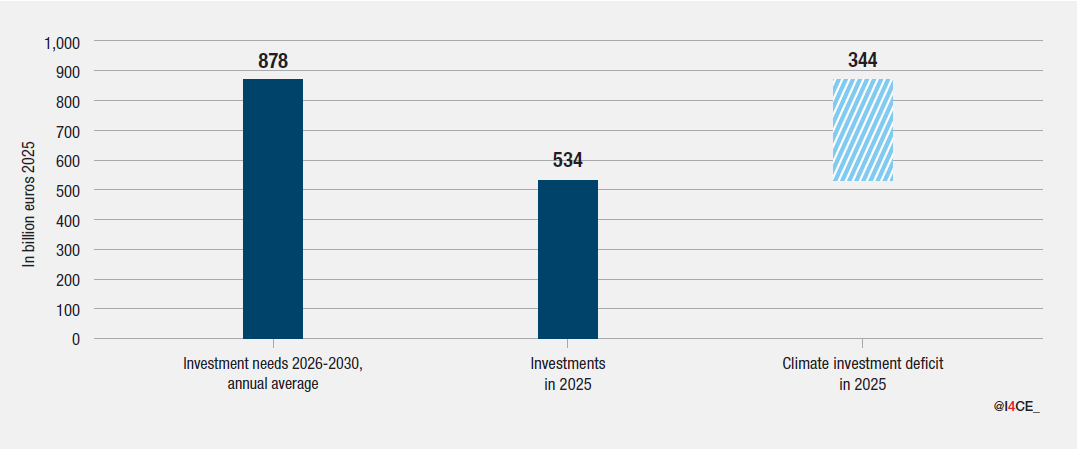
Source: I4CE. All figures are in 2025 euros. On the left, this graph represents the average climate investment needs per year for the EU to reach its climate objectives between 2026 and 2030 in the energy, buildings, transport, and clean tech manufacturing sectors (878 billion euros). It compares them to the 2025 investments for the same sectors (534 billion euros). The difference between the two gives the climate investment deficit (344 billion euros).
Investment rebounds slightly in 2025, but remains well short of what is needed to meet the EU’s 2030 targets
After contracting in 2024, investment rebounded slightly in 2025 across the energy, buildings, transport, and cleantech manufacturing sectors, reaching 534 billion euros. This represents a 2.4% growth compared to 2024, bringing investment levels close to those recorded in 2023. The 2025 growth was mainly driven by a 23% increase in investment in electric road transport, supported by the continued uptake of battery electric passenger vehicles. Conversely, investment in renewable and nuclear energy fell by 9%, continuing a downward trend since 2022, reflecting slow permitting procedures, limited grid capacity (with grid investment stagnating since 2023), and slower-than-expected growth in electricity demand. Investment in residential and non-residential building renovation also declined by 5% in 2025, led by the reduction of certain public support schemes, specifically in the residential sector. Finally, investment in wind turbines, solar panels, batteries, electrolysers and heat pumps manufacturing stagnated in 2025 compared to the previous year, in a context of a global decline in cleantech manufacturing investment.
Figure 2. After contracting by 2% in 2024, climate investment in the EU economy grew by 2% in 2025, reaching 534 billion euros, close to the 2023 level.
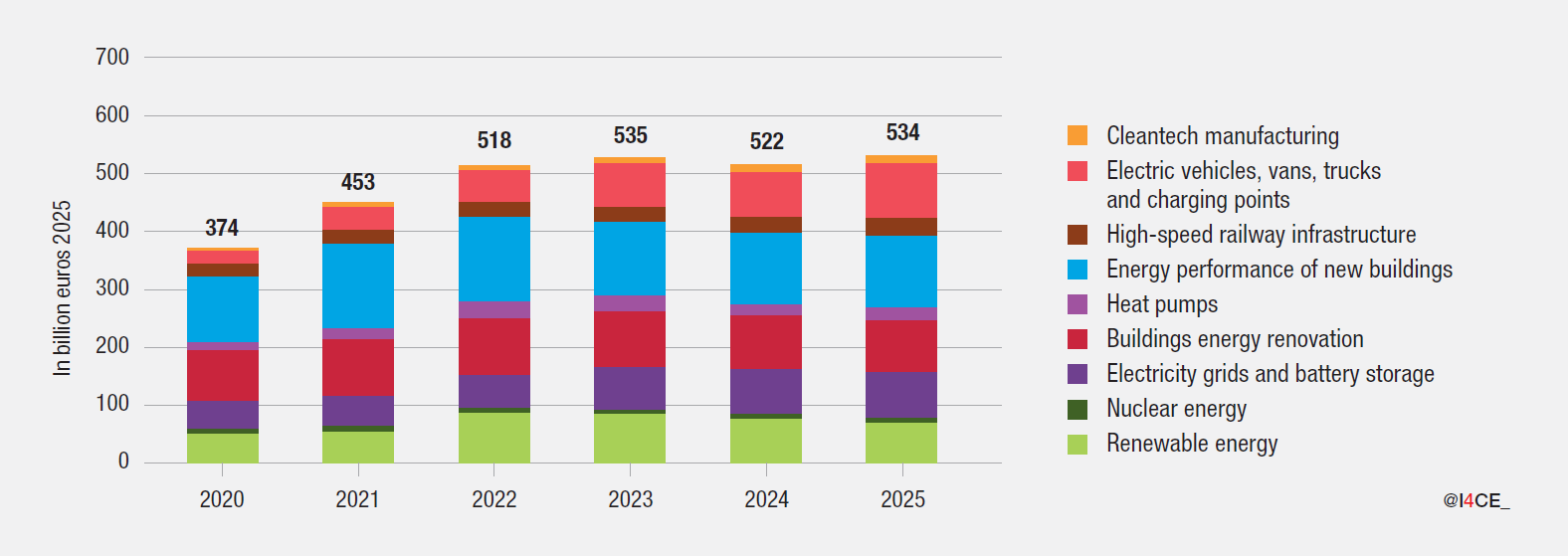
Source: I4CE All data are in 2025 euros. This figure represents climate investment in the energy, buildings, transport, and cleantech manufacturing sectors between 2020 and 2025.
With current investment covering only 61% of the 878 billion euros needed annually to meet the EU’s 2030 targets, the investment gap stands at 344 billion euros, 45 billion wider than in 2024. While investment has grown overall, it has consistently fallen short of what is needed, creating a moving target effect. Every year of underinvestment adds to future requirements, widening the deficit and making the challenge progressively harder as 2030 approaches.
Figure 3. The climate investment gap grew by 45 billion euros between 2024 and 2025, to reach 344 billion euros.
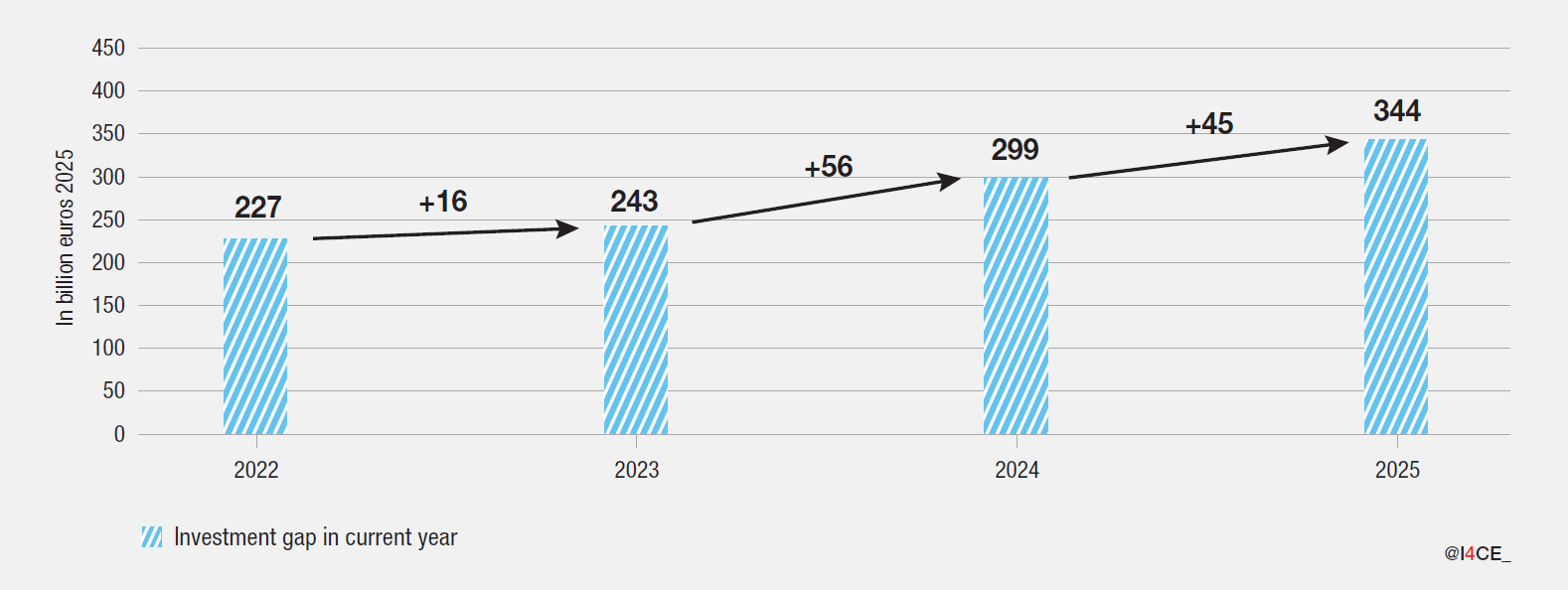
Source: I4CE All data are in 2025 euros. This figure represents the evolution of the climate investment gap between 2022 and 2025 at constant sectoral scope and methodology.
At the sectoral level, the trends shaping the investment gap tell a more varied story. A certain number of sectors are progressing well toward their 2030 objectives, reflecting both the effectiveness of targeted policy interventions and strong underlying demand. This is notably the case for solar power, battery storage, public charging infrastructure for light-duty vehicles, and cleantech manufacturing, where 2025 investment levels already exceed those required to meet the 2030 targets. By contrast, many sectors are still not investing at the pace required, and some sectors present a more critical situation than others. Wind energy is a striking example, with 2025 investments amounting to just 25% of identified needs. This deficit is largely driven by the investment gap in electricity grids which, despite reaching 78% of requirements in 2025, remains a critical bottleneck constraining progress across other sectors, from renewables deployment to the electrification of end uses, and needs to be tackled urgently.
Strengthening Europe’s long-term policy frameworks to accelerate investment and reduce exposure to future energy crises
To reduce exposure to future energy crises and accelerate investment in the low-carbon transition, the EU and its Member States have a range of concrete policy levers at their disposal. On regulation for instance, the revision of the CO2 standards for cars and vans regulation must preserve its ambition to sustain the shift to fossil-free mobility, ensure car affordability for households and protect investments already made in European battery manufacturing. On governance, the upcoming revision of the Energy Union Governance regulation should be seized as an opportunity to turn National Energy and Climate Plans into genuine national climate investment roadmaps. On planning, the development of electrification plans, both at EU and national levels, is essential to protect citizens and businesses from rising energy prices, through the implementation of measures aimed at accelerating low-carbon mobility and buildings decarbonisation. Finally, on budgetary issues, the EU budget plays an essential role in enabling climate investments in several Member States. The next EU budget for 2028-2034 must secure substantial and dedicated funding for climate investment across Member States.
These levers must send a clear and durable long-term signal to investors, businesses, and citizens willing to invest in the decarbonisation of the economy. The European Commission is set to publish its proposals for the post-2030 regulatory framework following the adoption of the 2040 emissions reduction objective. While the EU27 is still far from meeting its 2030 targets, implementing and maintaining long-term commitments is essential to ensure a stable and predictable regulatory framework that fosters long-term investment. The EU and its Member States must break free from the pattern of crisis-driven investment and instead commit to long-term investment strategies that durably protect citizens, businesses, and Europe’s energy security from future energy shocks.