Publications

Understanding the link between macroeconomic environment and the EU carbon price

18 February 2012 - Carbon Trends

By Julien Chevallier

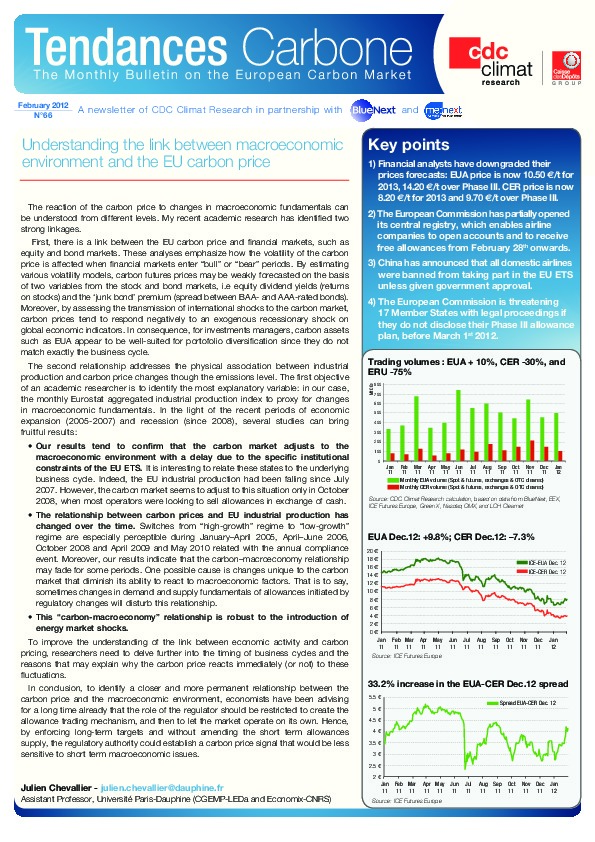
The reaction of the carbon price to changes in macroeconomic fundamentals can be understood from different levels. My recent academic research has identified two strong linkages.
First, there is a link between the EU carbon price and financial markets, such as equity and bond markets. These analyses emphasize how the volatility of the carbon price is affected when financial markets enter “bull” or “bear” periods. By estimating various volatility models, carbon futures prices may be weakly forecasted on the basis of two variables from the stock and bond markets, i.e equity dividend yields (returns on stocks) and the ‘junk bond’ premium (spread between BAA- and AAA-rated bonds). Moreover, by assessing the transmission of international shocks to the carbon market, carbon prices tend to respond negatively to an exogenous recessionary shock on global economic indicators. In consequence, for investments managers, carbon assets such as EUA appear to be well-suited for portofolio diversification since they do not match exactly the business cycle.
Understanding the link between macroeconomic environment and the EU carbon price Download
To learn more
  • 03/03/2023 Foreword of the week
    World Bank’s reform: almost a new pilot onboard

    After the sudden resignation of David Malpass, the World Bank’s Trump-appointed President, mid-February, Washington surprised the world again last Thursday, with the nomination of Ajay Banga, long-time Mastercard CEO, as his potential successor. Not only was the timing very rapid, but the controversial profile of the nominee also generated some sense of puzzlement. His limited […]

  • 03/01/2023
    Supporting financial institutions in developing countries in their alignment journey with climate goals

    This report co-written with NewClimate provides practical guidance for international financial institutions to support financial institutions’ alignment with the Paris Agreement goals, and to more broadly contribute to transforming local financial systems. This guidance is developed around three pillars: a harmonised alignment assessment; the alignment of financial intermediaries; and the alignment of financial systems at the national level.

  • 02/17/2023 Foreword of the week
    Climate transition plans for banks: European legislators on a razor’s edge

    The proposal for mandatory climate transition plans for banks is slowly making its way through the regulatory debate. Proposed by the European Commission and confirmed by the EU Council, this proposal has now also been taken up by the European Parliament. This obligation could be a game-changer for financial risk management and the alignment of financial flows with the transition to a low-carbon economy. It could lead banks to limit their activities in climate-damaging activities, adjust their business models, review their strategies as well as their governance and risk management procedures.

See all publications
Press contact Amélie FRITZ Head of Communication and press relations Email
Subscribe to our mailing list :
I register !
Subscribe to our newsletter
Once a week, receive all the information on climate economics
I register !
Fermer