Publications

Climate and energy policies in the EU: a major role in reducing CO2 emissions from the energy and industry sectors

17 October 2013 - Carbon Trends

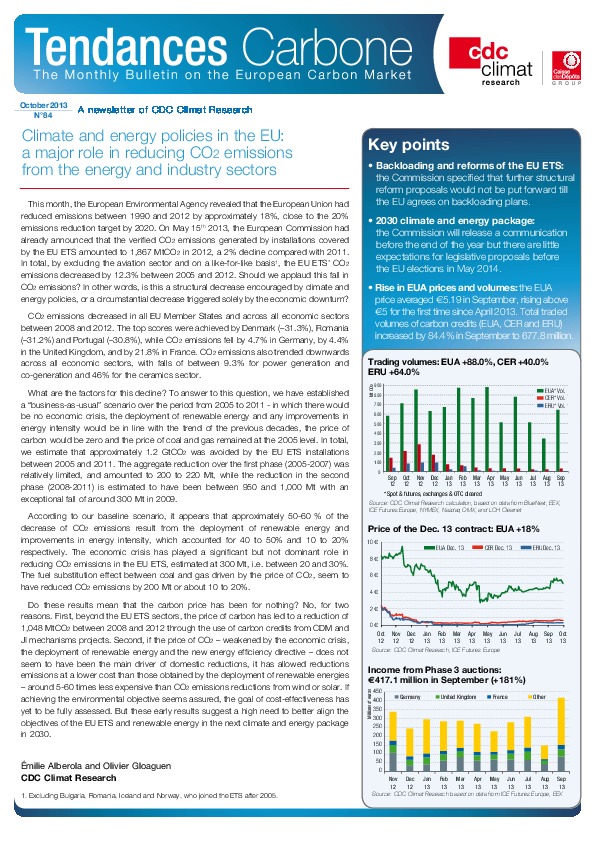
- Backloading and reforms of the EU ETS: the Commission specified that further structural reform proposals would not be put forward till the EU agrees on backloading plans.

- 2030 climate and energy package: the Commission will release a communication before the end of the year but there are little expectations for legislative proposals before the EU elections in May 2014.

- Rise in EUA prices and volumes: the EUA price averaged €5.19 in September, rising above €5 for the first time since April 2013. Total traded volumes of carbon credits (EUA, CER and ERU) increased by 84.4% in September to 677.8 million.
Climate and energy policies in the EU: a major role in reducing CO2 emissions from the energy and industry sectors Download
To learn more
  • 01/21/2026 Blog post
    On Carbon Removals and Carbon Farming the devil is in…the demand

    The implementation of carbon farming practices on European farms and in European forests is a lever for achieving carbon neutrality, but also for farm resilience, the adaptation of forest stands to climate change and for contributing to our strategic independence. Certifying and financing low-carbon practices is the objective of the CRCF (Carbon Removals and Carbon Farming) regulation, which will come into effect in 2026. Now seems the right time to draw lessons from six years of experience with a similar standard in France: the “Label Bas-Carbone” (Low Carbon Label – LBC). The results show that striking a balance between scientific rigour and accessibility for stakeholders has led to the development of a substantial range of projects. However, the real challenge is to build sufficient and appropriate demand to finance the projects. There is no miracle solution, but complementary financing channels may emerge. 

  • 01/16/2026 Foreword of the week
    2026: An electric atmosphere

    The year ahead promises to be electric. In a highly unpredictable geopolitical context, the European Union must balance its commitment to the long-term goals of climate neutrality and the immediate attention to security and competitiveness concerns. This puts electrification high on the agenda in Brussels. First, the Grids Package, presented in December 2025, provides for a more centralised approach to planning and is expected to be adopted by the Council in June. Second, before the summer, the Commission intends to present an Electrification Action Plan, which will focus on lowering prices and reinforcing demand. 

  • 12/12/2025 Blog post Foreword of the week
    Paris +10: France and Europe must step up on climate – to protect our security, sovereignty, competitiveness, and public finances

    How distant December 12, 2015 now seems. All delegations at COP21 had then rallied behind Laurent Fabius’s little green hammer. Ten years later, the trend is closer to backlash. Climate action is now often portrayed in the public debate as too costly, because it requires major investment. Ineffective, since our share of global emissions is small. Unfair, because it cuts into purchasing power. Too divisive, supported only by part of the electorate. Too late, since keeping the planet below +2°C of warming now seems out of reach. Arguments that are partly true—yet require substantial nuance. 

See all publications
Press contact Amélie FRITZ Head of Communication and press relations Email
Subscribe to our mailing list :
I register !
Subscribe to our newsletter
Once a week, receive all the information on climate economics
I register !
Fermer