Publications

The risks of CDM projects: how did only 30% of expected credits come through?

4 January 2012 - Special issues - By : Alain CORMIER

By Alain CORMIER and Valentin BELLASSEN

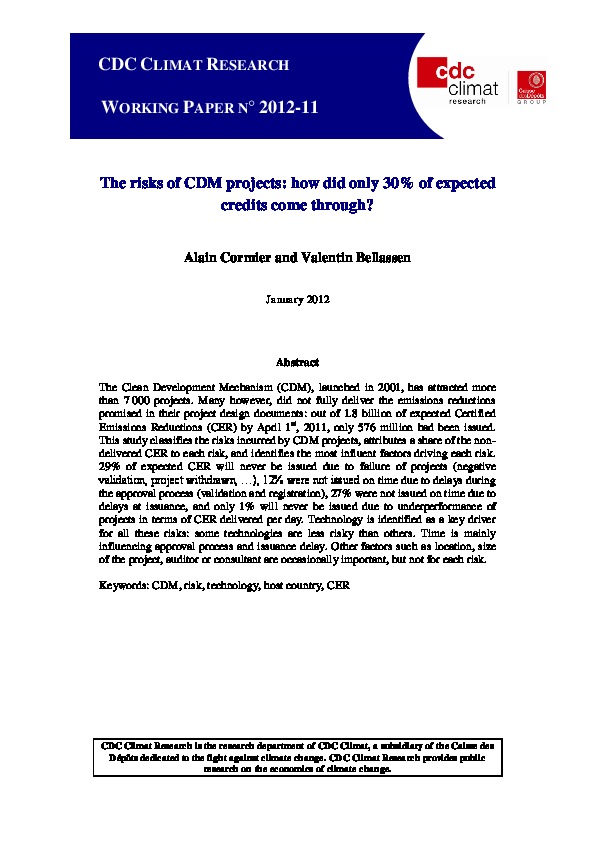
The Clean Development Mechanism (CDM), launched in 2001, has attracted more than 7 000 projects. Many however, did not fully deliver the emissions reductions promised in their project design documents: out of 1.8 billion of expected Certified Emissions Reductions (CER) by April 1st, 2011, only 576 million had been issued. This study classifies the risks incurred by CDM projects, attributes a share of the non-delivered CER to each risk, and identifies the most influent factors driving each risk. 29% of expected CER will never be issued due to failure of projects (negative validation, project withdrawn, …), 12% were not issued on time due to delays during the approval process (validation and registration), 27% were not issued on time due to delays at issuance, and only 1% will never be issued due to underperformance of projects in terms of CER delivered per day. Technology is identified as a key driver for all these risks: some technologies are less risky than others. Time is mainly influencing approval process and issuance delay. Other factors such as location, size of the project, auditor or consultant are occasionally important, but not for each risk.
The risks of CDM projects: how did only 30% of expected credits come through? Download
To learn more
  • 03/06/2026 Foreword of the week
    Stay the course: why a stronger ETS is the key to industrial competitiveness 

    Since 2005, the EU Emissions Trading System (EU ETS) has been a cornerstone of Europe’s climate policy. With the price per tonne of CO2 now beginning to stabilise at between €60 and €80, and the gradual reduction in free allowances, 2026’s review of the system should be an opportunity to reflect on and upgrade its performance as the EU continues towards climate neutrality.  

  • 03/03/2026 Blog post Op-ed
    To strengthen European industry, let’s strengthen the ETS

    Several voices are now being heard in Europe, coming from Member States – including that of Chancellor Merz – and from industry, calling for the rules of the CO2 quota system to be weakened. For Benoît LEGUET and Jean PISANI-FERRY, this would be a mistake for Europe. And for France. On the contrary, we must strengthen this unique public policy in order to develop our industry. 

  • 02/27/2026 Foreword of the week
    Risk levels and priorities: financing climate adaptation requires clear decisions

    As the European Commission prepares an integrated framework on climate resilience and risk management for the EU, the public consultation has just wrapped up – an important step towards the publication of the proposals for the framework later this year. One of the main areas of focus will be the issue of financing adaptation, with the first key challenge being to mainstream the concept of resilience by design into all European funding currently under discussion, including structural policies such as the Common Agricultural Policy and the Connecting Europe Facility.

See all publications
Press contact Amélie FRITZ Head of Communication and press relations Email
Subscribe to our mailing list :
I register !
Subscribe to our newsletter
Once a week, receive all the information on climate economics
I register !
Fermer