Putting adaptation to the impacts of climate change on the French agenda of discussions between local and national authorities
While French local authorities have important levers for adaptation, they will only be able to mobilize them if certain conditions are met at national level: the entire effort cannot rest on their initiative alone. This is what this I4CE‘s Climate Report shows. There is an urgent need for a discussion on adaptation between the national government and subnational authorities.
Report only available in French
The impacts of climate change, such as the worsening of the heat island effect, increased risk of flooding, accelerated coastal erosion, water shortages and reduced snow cover, are felt first and foremost at the local level. Adapting to these impacts is therefore often seen as the responsibility of subnational actors, and local authorities in particular. This Climate Report shows that, while local authorities do indeed have important levers for adaptation and must act now (I4CE 2023), they will only be able to mobilize them if certain conditions are met at national level: the entire effort will not be able to rest on their initiative alone. There is therefore an urgent need for a discussion between the national government and subnational authorities on this critical issue.
If we look at the adaptation challenges facing local authorities and the levers they have at their disposal, we can see that municipalities, their groupings and the Regions all play a key, multi-faceted role in the planning and implementation of adaptation policies. As owners, organizers and financiers of numerous projects and activities, local authorities are also critical actors in the implementation of adaptation. Playing this role will require them to dedicate financial and human resources and will have budgetary consequences that they must be able to anticipate.
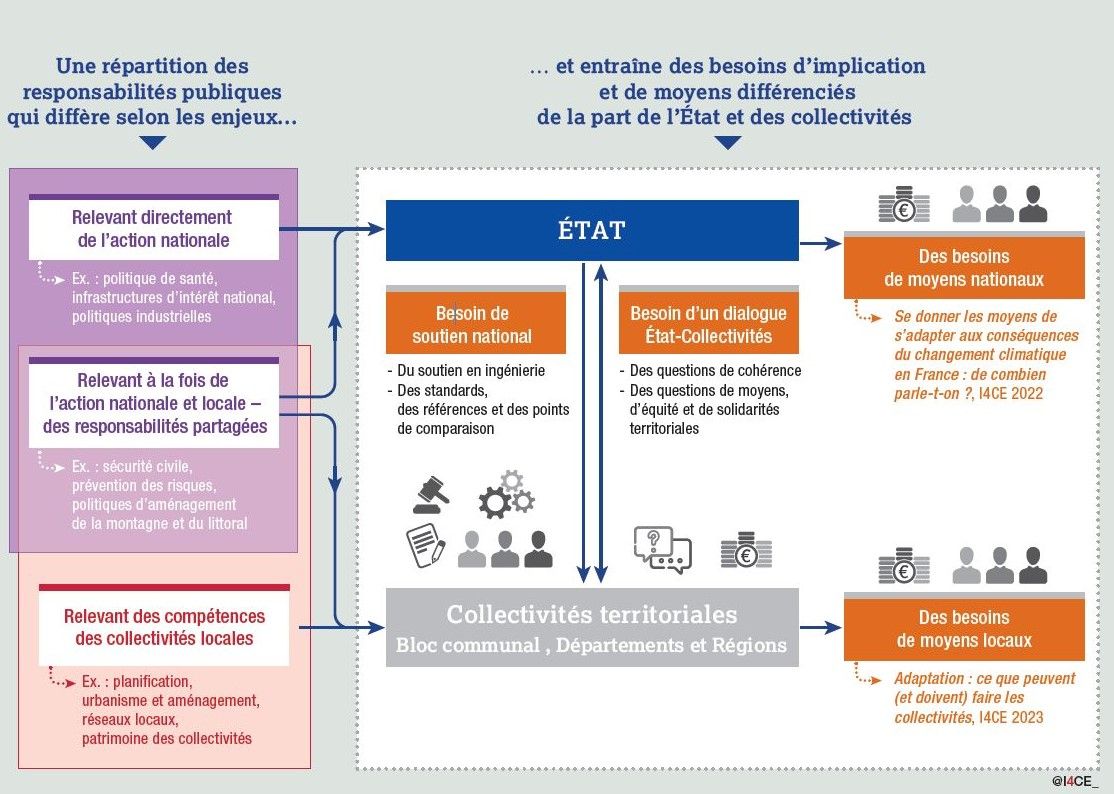
However, while this role addresses several of the major adaptation challenges, it does not cover all of them: taking account of climate change in public health policies, in the management of large critical infrastructures (e.g. major seaports, the rail network or electricity transmission) and in the steering of certain economic policies of national interest, such as forestry policy, is above all the responsibility of the central State and national operators.
In addition to that, even when it comes to issues that fall within their remit, local authorities don’t always hold all the cards when it comes to implementing ambitious adaptation measures:
- They – and the smallest among them in particular – will need to be able to draw on national resources, particularly in terms and to rely on norms and reference frameworks to justify politically difficult decisions such as assets relocation.
- Some adaptation choices go beyond the decisions that can be taken at the level of individual communities. Implementing ambitious adaptation trajectories may, on the one hand, require coordination between different levels of governance, and, on the other, call for resources to which not all territories have the same access, thus raising questions of equity and territorial solidarity.
It is therefore necessary for all local authorities to implement without delay the adaptation measures that fall within their remit, and to dedicate the necessary resources, while at the same time making adaptation an issue for dialogue between the national and local authorities. The aim of such a dialogue would be to collectively define common guidelines, to identify the resources that subnational authorities will have to deploy to achieve them, and to discuss the financial leeway needed at local level to implement them. To move in this direction, adaptation could appear as an explicit objective in future contractual arrangements between the national and local governments.
Support by