Publications Agriculture and food

Livestock farming transition: managing past investments and rethinking future ones

21 February 2023 - Climate Report - By : Thomas BONVILLAIN / Lucile ROGISSART / Claudine FOUCHEROT

Report only available in French


Accompanying the decline in livestock numbers

All transition scenarios rely on a decline in livestock numbers to meet climate targets. Yet in France, most livestock populations are already declining. The challenge is not only to continue this trend, but also to support it, to ensure a fair and acceptable transition for livestock farmers and other players in the livestock industry. This is particularly true for the dairy sector.


To support this transition, we need to understand its economic impact and assess the different types of costs associated with it. The investment requirements for developing new sectors, even if they need to be better quantified, are already the subject of discussion in the public debate, and even of public funding such as the €135 million “agro-equipment conversion premium” or the “plant proteins” component of the stimulus plan.


However, when an economic sector sees its activity decline, the question also arises as to the future of its production tools currently in place, which will lose value compared to a scenario in which activity is maintained. These are known as “assets at risk”. This is a particularly important issue in agriculture, since farmers invest in their business throughout their lives, with the prospect of increasing its value when they retire, in order to ensure a decent retirement.


Managing risky assets

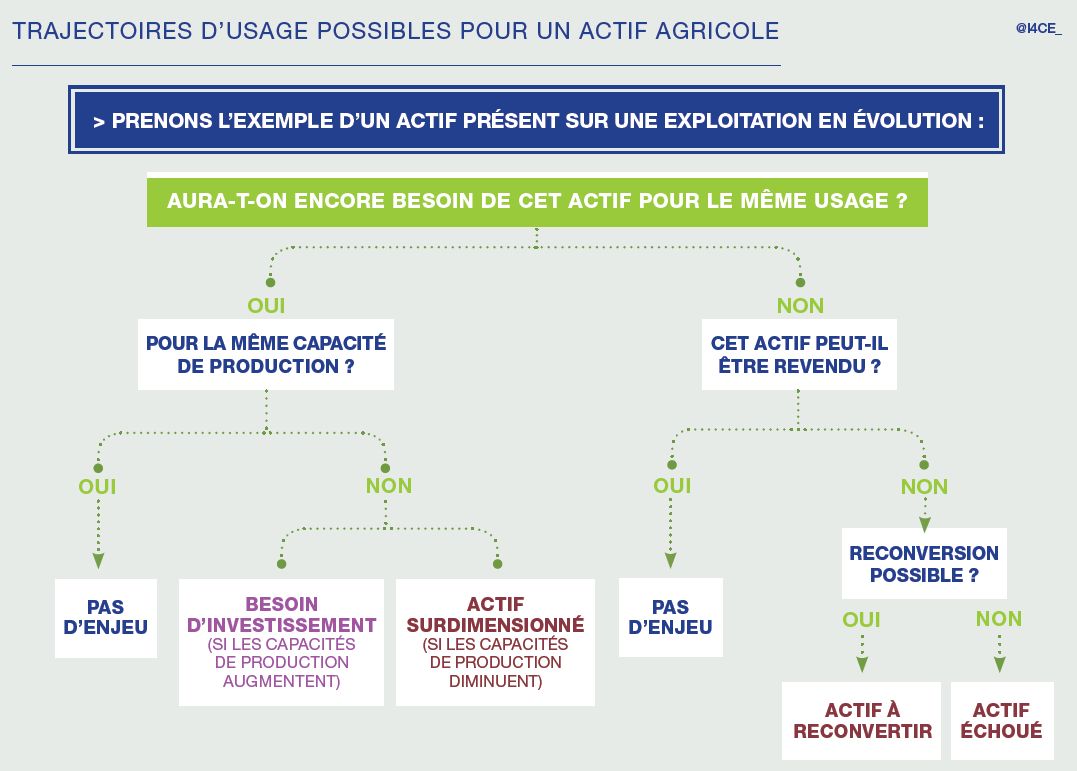
This is why I4CE has analyzed “assets at risk” in the livestock industry. It shows that assets at risk can be of 3 types. They may be :


  1. oversized, if the level of equipment far exceeds the use to which it is put;
  2. reconvertible, if they can be put to a new use, subject to the cost of adapting them;
  3. stranded, if they are no longer usable and have lost all value.


Click here to see the visual “Possible use trajectories for a farm asset” in French


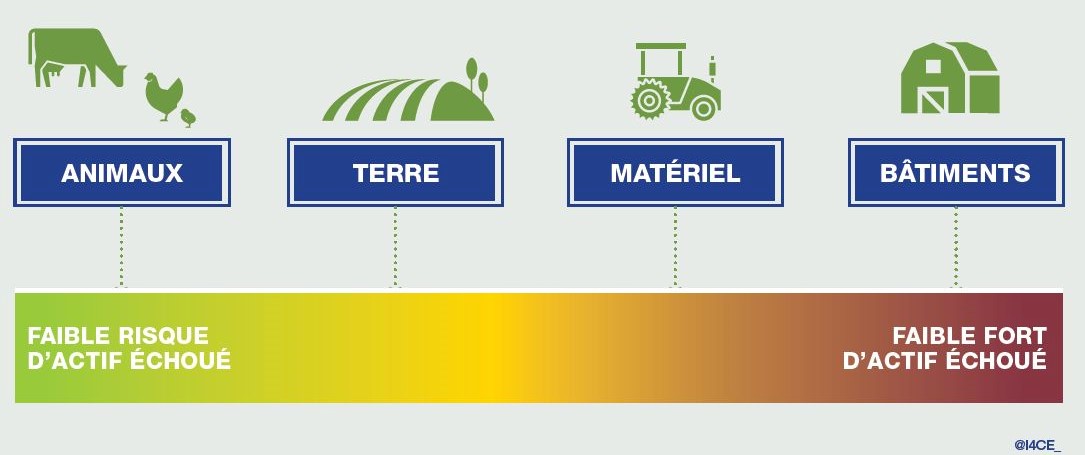
Our analysis shows that, of all the assets immobilized on livestock farms, buildings represent the greatest risk. While these at-risk assets represent a real challenge on an individual scale, on a national scale they represent several hundred million euros a year to manage over a decade.


Click here to see the visual “Summary of asset risk levels” in French


Don’t increase the stock of risky assets

Every year, over a billion euros in investment subsidies are granted to livestock farms. To avoid increasing the stock of risky assets, we need to:

  1. recalibrate these subsidies to avoid over-investment;
  2. redirect them to ensure that they favor production tools compatible with sustainability objectives.



Livestock farming transition: managing past investments and rethinking future ones Download
I4CE Contacts
Lucile ROGISSART
Lucile ROGISSART
Research Fellow – Financing the agricultural transition, Food systems Email
To learn more
  • 01/23/2026 Foreword of the week
    Financing carbon farming practices: lessons learnt in France can reinforce the EU level initiatives

    In a challenging economic and political context, especially for the agriculture sector, some incentive schemes can still help bring stakeholders together in climate transition and resilience initiatives. This is the case with carbon certification schemes, which both ensure the credibility of the climate impact of the actions implemented and provide remuneration for farmers and foresters for changes in practices. Some of these measures, such as replacing mineral fertilisers (mostly imported) with organic fertilisers, also help to meet the sector’s needs for resilience and strategic independence, which are crucial in the current context.

  • 01/16/2026 Blog post
    CBAM and fertilisers: ring-fencing budgets to help farmers reduce their use of mineral fertilisers

    The Carbon Border Adjustment Mechanism (CBAM) came into force on 1 January 2026. It is a carbon tax applied at the borders of the European Union to imports of certain industrial products covered by the EU Emissions Trading System (EU ETS). Nitrogen-based mineral fertilisers are included in this initial list of products. To avoid an increase in costs for the farmers concerned, the level of the tax has been reduced for fertilisers, and they may even be temporarily excluded from the scope of the CBAM. Yet, for the climate, but also for France’s strategic independence and food sovereignty, the CBAM will ultimately have to be fully applied to mineral fertilisers. To limit or even avoid an increase in farmers’ fertiliser expenditure, we need public policies – some of which are currently under threat. Ring-fencing budgets for these policies would be a way to support farmers’ incomes and the food sovereignty of both the European Union and France, while reducing the carbon footprint of our food system. 

  • 06/12/2025
    Six years of carbon certification in France: an assessment of the Label Bas-Carbone

    Six years after its inception, this study aims to review this mechanism and its projects: what activities are being implemented in the field, what impact are they having on the climate, with what robustness or, on the contrary, what limitations in terms of measurement, environmental integrity, accessibility, etc.? This exercise is also intended to feed into the process of continuous improvement of the scheme and to provide feedback for the current implementation of the European carbon certification framework (Carbon removals and carbon farming: CRCF).

See all publications
Press contact Amélie FRITZ Head of Communication and press relations Email
Subscribe to our mailing list :
I register !
Subscribe to our newsletter
Once a week, receive all the information on climate economics
I register !
Fermer