Turning the National Energy and Climate Plans (NECPs) into Investment Plans
I4CE’s response to the European Commission Consultation on the Revision of the Governance Regulation for the Energy Union and Climate Action
Adopted in 2018, the Governance Regulation of the Energy Union and Climate Action aims at strengthening the coordination of energy and climate policies across the European Union (EU). A central tool of this regulation is the National Energy and Climate Plan (NECP), developed by each Member State, which lists all sectoral national actions planned to reduce emissions in the medium run. The Commission ensures on this basis that the combined actions of the 27 plans allow the EU to achieve its climate objectives.
In December, the European Commission launched a public consultation to inform the next revision of the regulation, scheduled for the last quarter of 2026. The Commission is particularly seeking stakeholders’ views on the need to transform NECPs into real investment plans.
In its consultation’s response, I4CE emphasises that transforming the NECPs into investment plans represents a real opportunity for Member States to implement long-term investment planning. Done well, the investment plans could become essential tools to keep the transition on track in the face of future energy crises. This would also serve to meet investors’ demand for clear and predictable national investment strategies in the medium term.
An investment plan has the capacity to actively steer economic transformation and guide public and private investment. However, to remain effective, these plans must go beyond a simple compliance exercise and be supported by real political ambition. They must reflect national priorities, which differ in each Member States, and their framework should adapt to existing investment strategies.
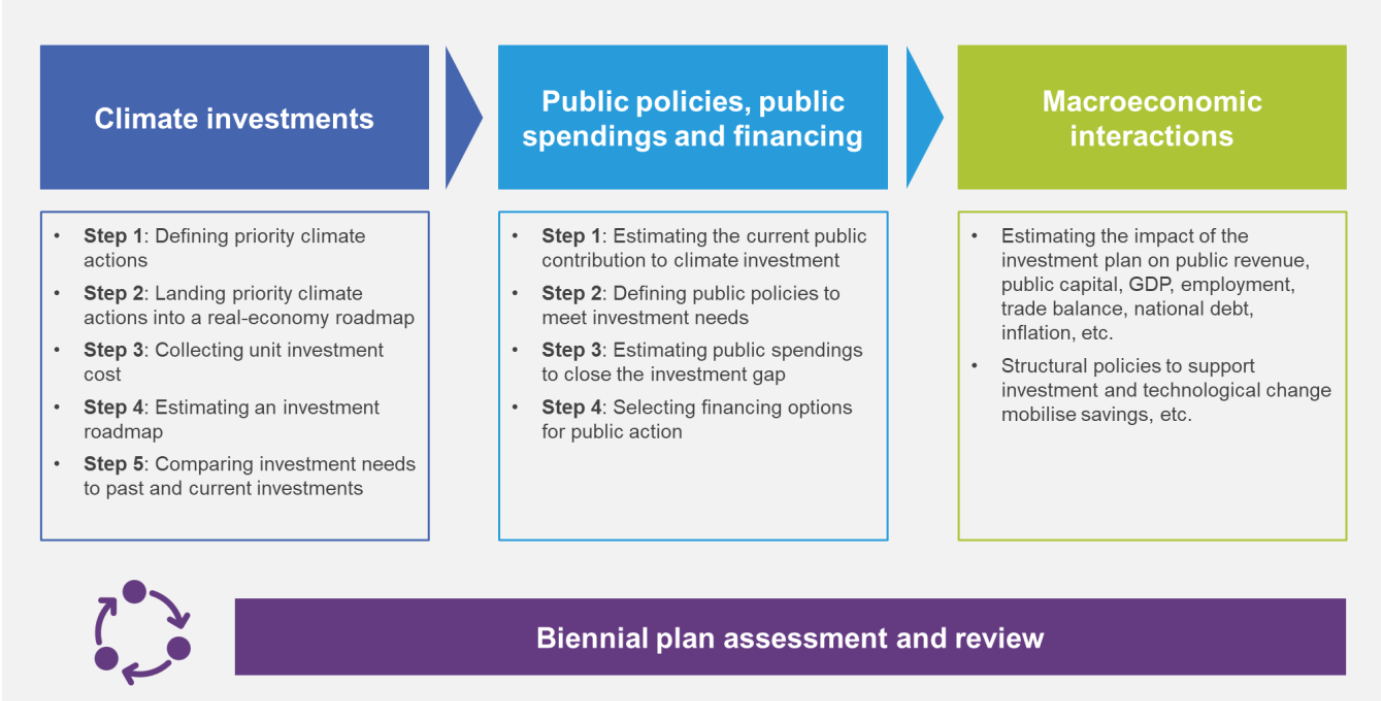
Building on its previous work, I4CE identifies four key building-blocks of an energy and climate investment plan (see figure 1). The objective of this proposal is to support policymakers in designing their investment plans by providing them with key initial elements that should be included.
Thus, an effective investment plan should include:
-
- The translation of energy-climate objectives into sectoral investment roadmaps, reflecting financial needs by priority sectoral climate actions, with regard to current investment levels.
- The definition of public policies and spendings to meet the climate investment needs, and their financing.
- The production of macroeconomic impact analysis of the defined actions to ensure robustness at the state level.
- And the implementation of a dynamic assessment system, allowing Member States to regularly evaluate and revise their plan to improve their effectiveness, for example through a biennial review of the plans.
- The translation of energy-climate objectives into sectoral investment roadmaps, reflecting financial needs by priority sectoral climate actions, with regard to current investment levels.
Figure 1: Key building blocks for a climate and energy investment plan
Source : I4CE
Finally, I4CE examines the factors that could encourage the effective implementation of the plans. The European Commission could propose to link the disbursement of EU funds to the achievement of milestones defined on the basis of the plans, support Member States’ capacity-building for the elaboration of the plans, and improve the tracking of private investments, by mandating National Competent Authorities (NCAs) to aggregate transition-related information in CSRD reports of listed companies.