Publications

Ex-post evaluation of the Kyoto Protocol : Four key lessons for the 2015 Paris Agreement

17 May 2014 - Climate Report

Signed in 1997, following the 1992 United Nations Framework Convention on Climate Change (UNFCCC), the Kyoto Protocol (KP) is the first international tool focused on greenhouse gas (GHG) mitigation involving as many countries : in its final configuration, thirty six developed countries committed to reduce their emissions by 4% between 1990 and 2008-2012 – the first commitment period (CP1). In April 2014, the data from the CP1 was officially published. This report thus presents the first comprehensive ex-post analysis of the first period of the KP.

Based on the results of this report, it is possible to draw four key lessons from the Kyoto experience for the establishment of a new global agreement that is expected to be signed in Paris in 2015 :

1. Expanding the coverage : striking a balance between overall environmental integrity and flexibility for specific circumstances
2. Removing the virtual specter of internationally legally binding commitments and limiting the focus on methods of compliance
3. Focusing on MRV processes
4. Providing flexibility in the agreement and its adoption process
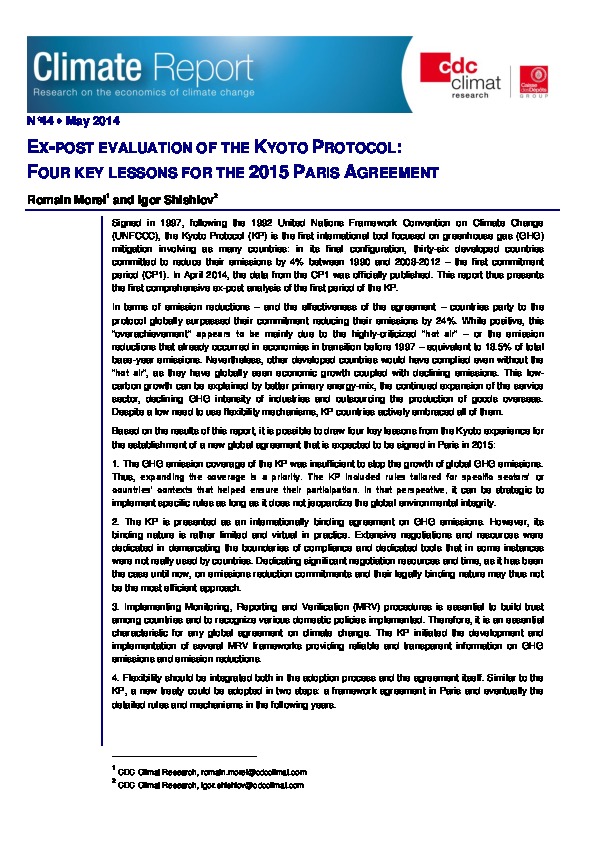
Ex-post evaluation of the Kyoto Protocol : Four key lessons for the 2015 Paris Agreement Download
To learn more
  • 03/06/2026 Foreword of the week
    Stay the course: why a stronger ETS is the key to industrial competitiveness 

    Since 2005, the EU Emissions Trading System (EU ETS) has been a cornerstone of Europe’s climate policy. With the price per tonne of CO2 now beginning to stabilise at between €60 and €80, and the gradual reduction in free allowances, 2026’s review of the system should be an opportunity to reflect on and upgrade its performance as the EU continues towards climate neutrality.  

  • 03/03/2026 Blog post Op-ed
    To strengthen European industry, let’s strengthen the ETS

    Several voices are now being heard in Europe, coming from Member States – including that of Chancellor Merz – and from industry, calling for the rules of the CO2 quota system to be weakened. For Benoît LEGUET and Jean PISANI-FERRY, this would be a mistake for Europe. And for France. On the contrary, we must strengthen this unique public policy in order to develop our industry. 

  • 02/27/2026 Foreword of the week
    Risk levels and priorities: financing climate adaptation requires clear decisions

    As the European Commission prepares an integrated framework on climate resilience and risk management for the EU, the public consultation has just wrapped up – an important step towards the publication of the proposals for the framework later this year. One of the main areas of focus will be the issue of financing adaptation, with the first key challenge being to mainstream the concept of resilience by design into all European funding currently under discussion, including structural policies such as the Common Agricultural Policy and the Connecting Europe Facility.

See all publications
Press contact Amélie FRITZ Head of Communication and press relations Email
Subscribe to our mailing list :
I register !
Subscribe to our newsletter
Once a week, receive all the information on climate economics
I register !
Fermer