Climate mitigation and adaptation financing needs in emerging and developing economies: unpacking global estimates, supporting effective mobilisation
Context
Finance is in the spotlight in international climate discussions. The difficult negotiations and half-satisfactory outcomes on the NCQG at COP29, followed by the missed opportunity to build consensus around concrete measures to mobilise finance outlined in the Baku-to-Belém roadmap at COP30, underscored just how critical finance is to climate action. However, country-level financing needs assessments are nearly always missing (I4CE 2024, Chimowu, Hulme and Munro 2019), while they should provide the factual basis of such discussions and actions.
Global financing needs estimates try to make up for this gap. However, due to the lack of base data to work with, they are forced to various assumptions. When combined with variations in the scope of instruments, the dimensions of climate, nature, and development actions considered, and other methodological choices, this results in widely divergent estimates (See Figure below).
Figure. Sample estimates and uncertainty ranges of annual climate finance needs in EMDEs by 2030
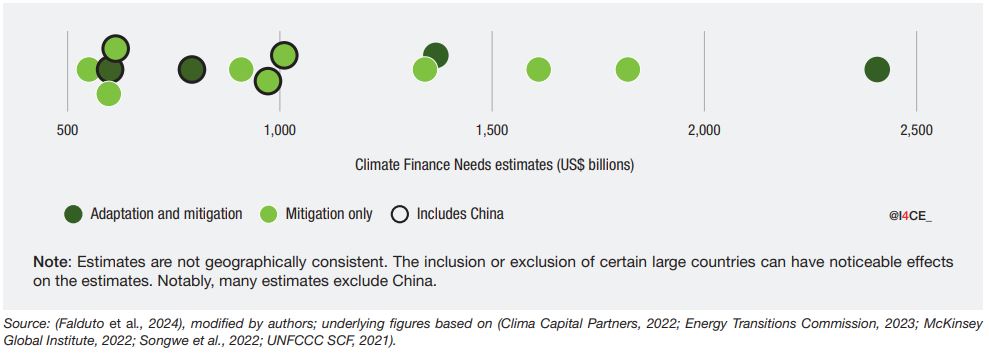
Source : OECD 2024, based on (Climate Capital Partners, 2022; CPI, 2023; ETC, 2023; IEA/IFC, 2023; Songwe, Stern and Bhattacharya, 2022; McKinsey & Company, 2022; UNFCCC SCF, 2021; UNEP, 2023).
One key reference figure, serving as an anchor in international negotiations, is the estimate by the Independent High-Level Expert Group on Climate Finance (IHLEG). Their third report estimates that approximately US$2.4 trillion in investment are needed annually by 2030 in EMDEs, excluding China, to support five key areas of climate action: clean energy transition, adaptation and resilience, loss and damage, natural capital and just transition.
Such estimates offer valuable signals for raising awareness and structuring international negotiations, but they often fall short of guiding concrete country-level action or supporting effective mobilisation strategies. Several key limitations undermine their practical usefulness.
- Inconsistent assumptions and targets undermine the coherence and credibility of aggregated needs estimates. For example, the IHLEG figure relies for each area of climate action on external assessments, including the IEA’s Net-Zero scenario and UNEP’s Adaptation Gap Report, which sometimes rely on definitions and assumptions that are not aligned with each other.
- Conceptual divergences surrounding the additionality of climate action – in particular the boundary between climate and development finance, as well as the consideration of the incremental or total costs of climate action – can result in very different figures of investment needs.
- Most estimates only cover investment needs, excluding the cost of capital, which is particularly high in EMDEs and hinders public and private developers from financing climate projects. Financing needs estimates should be aligned with realistic assessments of available financial resources, taking into account the cost of capital, to avoid gaps between ambition and feasibility.
Objective
Given the high profile of such figures in international talks, this project aims to explore the main limitations of existing figures and identify areas for improvement, in order for climate financing needs estimates to meaningfully inform both international policy discussions and finance mobilisation efforts at country level.
This research project draws upon I4CE’s expertise in transition financing plans and national-level financing needs assessments.
A first report was published in July 2025. Its main findings fed into the Bruegel-CEPR Paris Report 3 on “Accelerating the Transition and Protecting Nature in EMDEs”.
A second report was published in February 2026, with a focus on adaptation financing.
Period
December 2024 – Ongoing