Developing a climate-aligned investment plan
A step-by-step methodology for local governments to integrate climate goals into multi-annual investment plans
An innovative tool to align financial and climate strategies
Local governments play a pivotal role in driving the ecological transition. They hold key responsibilities in critical sectors such as mobility, urban planning, and energy-efficient building renovation, and account for a significant share of public investment. However, financing the transition remains a major challenge.
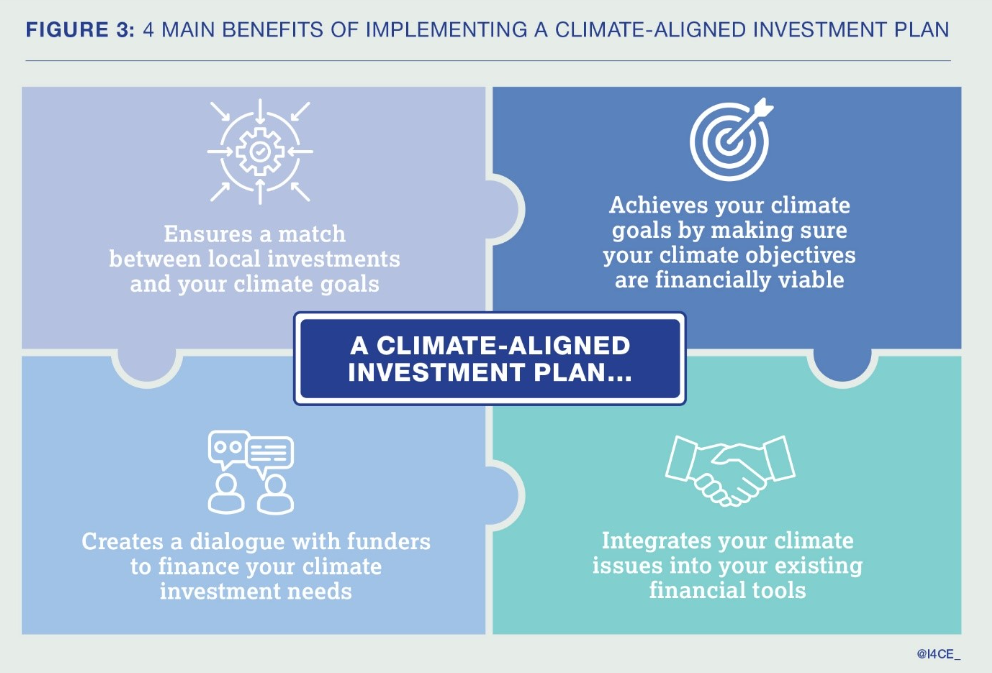
This methodology provides a step-by-step framework to:
- Estimate the long-term costs of climate investments, even before specific projects are identified,
- Align financial planning with climate objectives to achieve your climate goals,
- Anticipate funding needs and facilitate a dialogue with funders about climate actions,
- Optimize the use of your financing tools to support the climate.
Key Questions the Methodology Addresses
1. How much is necessary to meet local authority’s climate goals?
Climate investment needs differ significantly across territories. This methodology helps local governments quantify the financial requirements of their climate strategy, ensuring that investments are tailored to their unique context.
2. How leverage available financing tools?
Local authorities have access to multiple financing levers, such as debt and borrowing (e.g., green bonds, disintermediated markets), redirection of existing funds (repurposing budgets to prioritize climate actions), local taxation and fees, or public grants and subsidies.
The methodology helps local governments assess and optimize the use of these tools based on their political priorities and financial flexibility.
3. How can we ensure climate actions are funded?
A climate strategy is only as strong as its financial backing. This methodology ensures that climate objectives are realistically budgeted within the multi-year investment plan and financial strategies account for climate investment needs.
A Sustainability of Local Public Finances project The methodology presented in this report focusing on climate objectives is part of the Sustainability of Local Public Finances (SLPF) project, in partnership with KDZ–Austrian Centre for Public Administration Research, to more effectively embed sustainable development goals (SDGs) within budgetary governance systems. The SLPF project supports four European cities (Bordeaux Métropole, and the Cities of Amsterdam, Barcelona and Hamburg) to integrate the SDGs as steering indicators to prioritize investments and influence budget reviews, helping cities across Europe to take concrete steps towards sustainability and climate action. Partners
I4CE would like to express its gratitude to all partners involved in this project. Their active involvement in the co-construction of the proposed method has been key to the delivery of this project. In particular: Bordeaux Métropole, co-pilot of this project, the local authorities, including both the climate and the finance teams, the financial partners, the local government associations and all the reviewers.
This project is funded by the European Union via the Technical Support Instrument (TSI), and implemented by Expertise France, KDZ-Austrian Centre for Public Administration Research in coorperation with the European Commission.
The ADEME (the French agency for ecological transition), the Fondation de France, the Banque des territoires and the European Climate Foundation (ECF) have also contributed to the successful completion of this project.
The views expressed herein are solely those of the authors and can in no way be taken to represent the official opinion of the European Union or the financial partners.