Adaptation : Public financial institutions (also) have a role to play – a study based on the french example
In this study, I4CE reviews the characteristics and areas of intervention of public financial institutions, which make them essential actors for adaptation. The study also reviews all of the Public Financial Institutions’ business lines to determine their levers for action.
In France, insured damages from natural disasters have already tripled since the 1980s to reach an average of 3.6 billion euros per year over the period 2016-2020 and costs linked to natural disasters could increase by a factor of 5 to 6 in some French departments between 2020 and 2050.
In many cases, we are not ready. Financial and human resources must be deployed to support adaptation to climate change in all regions. A significant number of climate change adaptation measures will rely on public intervention, in which Public Financial Institutions could play a role, and sometimes do already.
This study was primarily carried out to explore what this role might be in the French context. However, the challenge does not only relate to France, and Public Financial Institutions are a type of actor present in many countries, which share certain objectives and modes of action (Plihon and Rigot 2021).
WHY IS THIS AN ISSUE FOR PUBLIC FINANCIAL INSTITUTIONS?
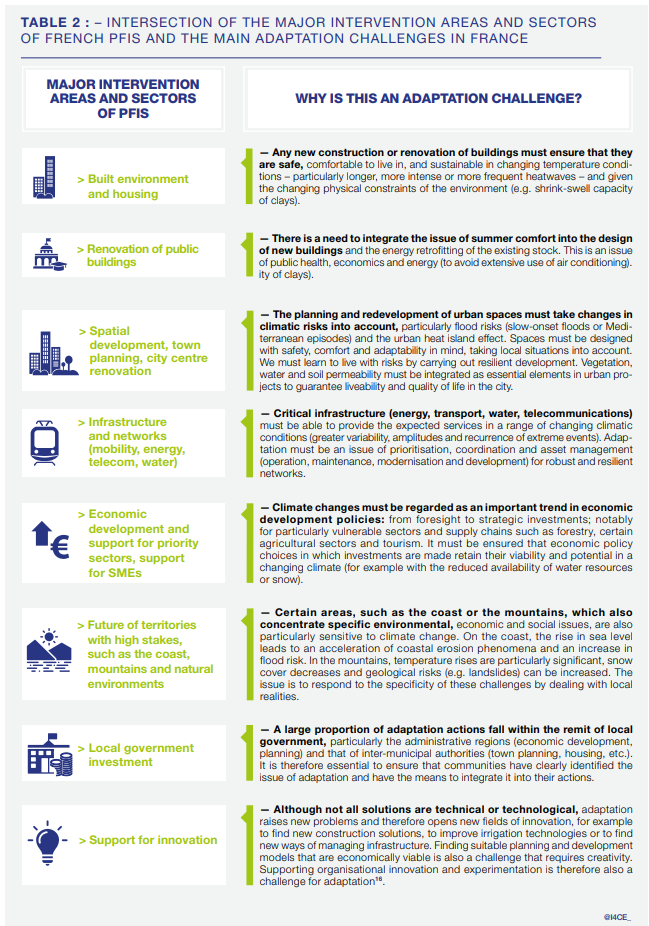
Public Financial Institutions (PFIs), together with other public actors, have a particular responsibility to challenge and support local actors and to take climate change into account in financial models to support territorial adaptation:
• Challenges are in line with their mandate: adaptation is highly relevant to the areas in which they operate and their strategic objectives.
• Historic role in accompanying major transformations and a proactive capacity.
• Assets to boost financing for adaptation and drive private funding towards more adapted models:
– Financial capacity;
– Appropriate time horizons;
– Genuine expertise to apply to quality projects.
• Ability to combine public interest with the approach of a responsible financial actor with risk management expertise.
• Strategic interest in listening to the emerging demands of their clients and their environment (peers, regulators, etc.).
Cliquez sur ce bouton pour voir l’image
HOW CAN PFIS CONTRIBUTE TO ADAPTATION ?
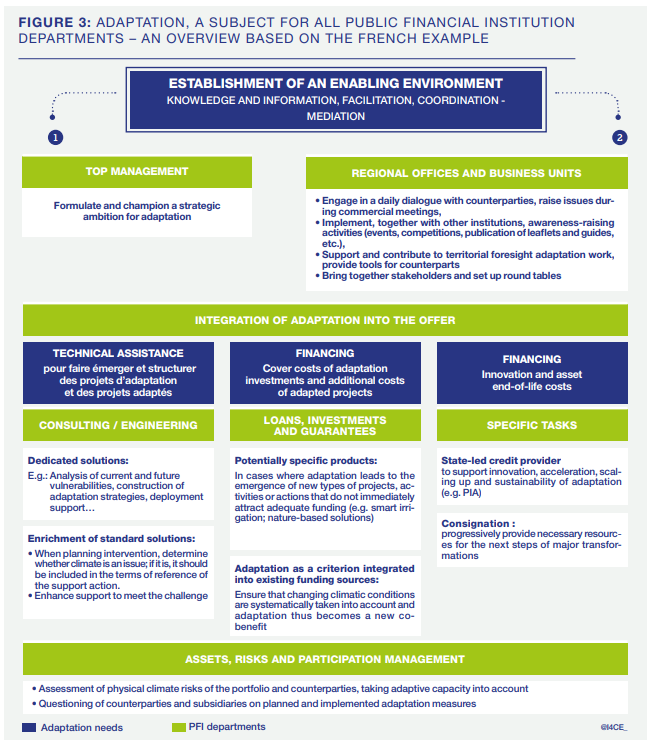
Due to their characteristics and intervention areas, PFIs must play a proactive role in adaptation. All PFI departments have levers to accelerate adaptation.
Cliquez sur ce bouton pour voir l’image
To contribute effectively to the challenge, PFIs will have to organise themselves, increase the skills of their teams on climate change adaptation, equip themselves with tools, and coordinate with each other and with other financial and technical assistance actors in territories.
Of course, PFIs will be unable to meet all adaptation needs singlehandedly. Their action would be more effective and coherent if they were part of a better defined and more ambitious public policy framework.
What role can financial institutions play in adaptation? Vivian Dépoues presents the main results of the study in two minutes :