Adapting French forests: investing wisely
Adapting French forests to climate change is becoming an important political issue. From droughts to forest fires, the consequences of climate change on tree stands are more and more visible. Adaptation is all the more important to ensure that forests remain in good enough condition to play the key mitigation role we expect of them.
Report only available in French
The publication of a collectively written “Roadmap for adapting the French forest” in 2019, followed by the Assises de la Forêt et du Bois in 2021-2022, have very clearly pinpointed the issues and actions to be implemented to adapt the forest and the forest-wood industry. The challenge now is to turn these actions into practice. To achieve this, it will be necessary to mobilize resources commensurate with the challenge. The analysis presented in this study aims firstly at clarifying the means required – in terms of financial and human resources – to implement adaptation measures. It then seeks to put these needs into perspective with the financial responses provided over the past two years (notably as part of the post-covid stimulus package, followed by the announcements resulting from the Assises de la forêt et du bois and the France 2030 investment plan).
Four main lessons can be drawn from this analysis:
- After decades of under-investment, the plans put implemented over the past two years as part of the stimulus package appear to be up to the challenge in terms of the amounts committed. In upstream forestry, the order of magnitude of the investment envelopes announced for forest renewal corresponds well to estimated needs – which is all the more positive in that it is part of the long-term France 2030 Plan. As far as modernization of the processing industry is concerned, the significant resources mobilized seem to be the start of a very encouraging dynamic whose knock-on effect needs to be confirmed. One point to note is the investment in research which, despite announcements, has not yet materialized to the extent required.
- Nevertheless, we will need to be particularly vigilant to ensure that we are investing properly and that the sums committed actually contribute to making the forest more resilient and adapting the industrial tool to a changing climate and therefore to a changing forest. It’s also a question of efficient public spending. If the right decisions are not taken now to make forests more resilient – if we invest, for example, in plantations that are not adapted or resilient to the future climate – it is possible that the millions of euros mobilized today will disappear with the forests in future crises (drought, fires, pest attacks…). This vigilance should be reflected in more stringent requirements to take account of the consequences of climate change in public funding for investment in forests and the timber industry.
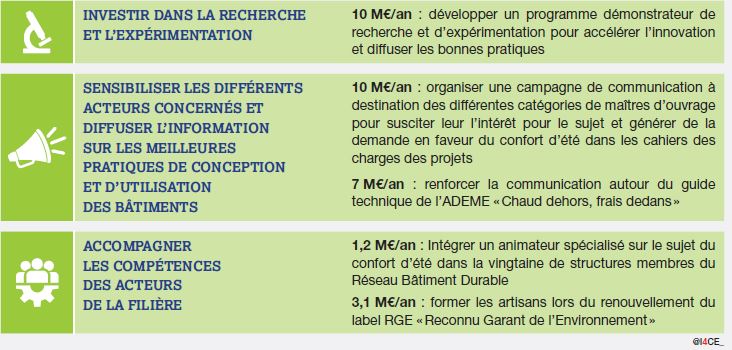
- In addition to making public subsidies conditional on adaptation, it is crucial to give industry players the means to make the right choices. Indeed, many of the Roadmap’s actions do not require large budgets, but are nonetheless essential for adaptation. This is notably the case for resources dedicated to observation networks, health monitoring and crisis management capabilities, experimentation and the promotion of forest-society dialogue. Yet, while these actions are often talked about, it is not always easy to guarantee that they are actually funded and will remain so in the long term. In order to ensure this, we have sought to assess needs precisely, topic by topic. All in all, our analysis estimates that €25m/year will be required for the “small” actions that will make the difference in giving all stakeholders in the sector the capacity and flexibility they need to face up to the consequences of climate change.
- Mobilizing resources for forest adaptation is a question of budget, but also of human resources, and therefore of budgetary rules such as the employment ceiling imposed on public operators. The 25 M€/year previously mentioned includes numerous actions which above all require time and expertise, and therefore personnel expenditures, often borne by public bodies. However, the current trend in the resources of public operators contributing to adaptation seems to be in contradiction with the evolution of their missions. This appears to be one of the main limiting factors for ambitious action to adapt forests to climate change.