Publications

Durban: one small promising step for climate… by 2020

29 December 2011 - Climate Brief - Climate Report

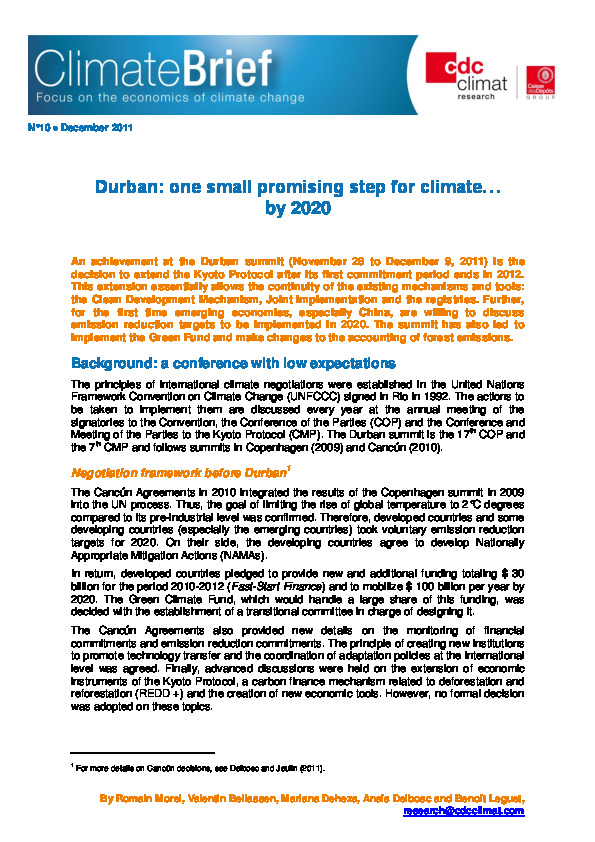
An achievement at the Durban summit (November 28 to December 9, 2011) is the decision to extend the Kyoto Protocol after its first commitment period ends in 2012. This extension essentially allows the continuity of the existing mechanisms and tools: the Clean Development Mechanism, Joint Implementation and the registries. Further, for the first time emerging economies, especially China, are willing to discuss emission reduction targets to be implemented in 2020. The summit has also led to implement the Green Fund and make changes to the accounting of forest emissions.
Durban: one small promising step for climate… by 2020 Download
To learn more
  • 03/03/2023 Foreword of the week
    World Bank’s reform: almost a new pilot onboard

    After the sudden resignation of David Malpass, the World Bank’s Trump-appointed President, mid-February, Washington surprised the world again last Thursday, with the nomination of Ajay Banga, long-time Mastercard CEO, as his potential successor. Not only was the timing very rapid, but the controversial profile of the nominee also generated some sense of puzzlement. His limited […]

  • 03/01/2023
    Supporting financial institutions in developing countries in their alignment journey with climate goals

    This report co-written with NewClimate provides practical guidance for international financial institutions to support financial institutions’ alignment with the Paris Agreement goals, and to more broadly contribute to transforming local financial systems. This guidance is developed around three pillars: a harmonised alignment assessment; the alignment of financial intermediaries; and the alignment of financial systems at the national level.

  • 02/17/2023 Foreword of the week
    Climate transition plans for banks: European legislators on a razor’s edge

    The proposal for mandatory climate transition plans for banks is slowly making its way through the regulatory debate. Proposed by the European Commission and confirmed by the EU Council, this proposal has now also been taken up by the European Parliament. This obligation could be a game-changer for financial risk management and the alignment of financial flows with the transition to a low-carbon economy. It could lead banks to limit their activities in climate-damaging activities, adjust their business models, review their strategies as well as their governance and risk management procedures.

See all publications
Press contact Amélie FRITZ Head of Communication and press relations Email
Subscribe to our mailing list :
I register !
Subscribe to our newsletter
Once a week, receive all the information on climate economics
I register !
Fermer