Publications Development finance

From Aligning with Paris to the SDGs

4 November 2020 - Climate Brief - By : Alice PAUTHIER / Ian COCHRAN, Phd

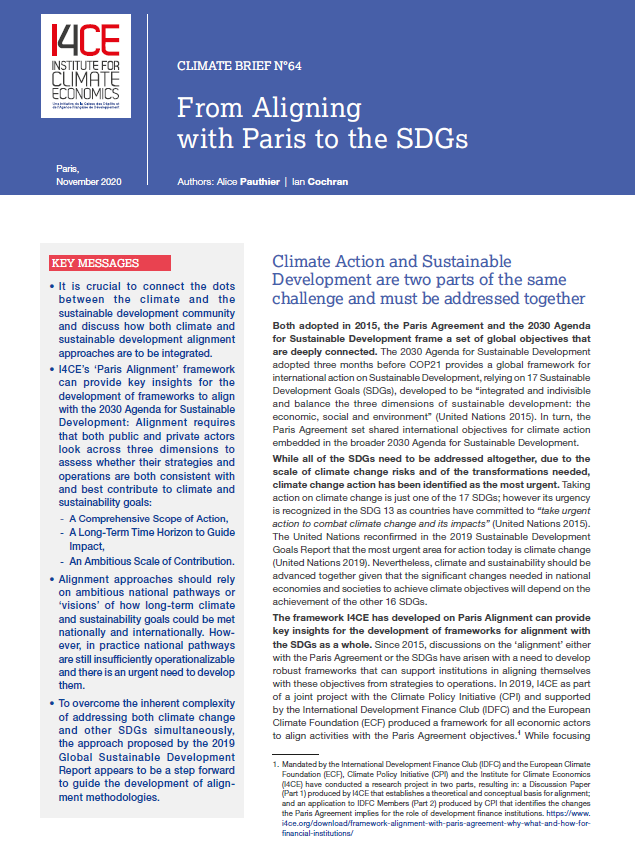
Climate Action and Sustainable Development are two parts of the same challenge and must be addressed together. Both adopted in 2015, the Paris Agreement and the 2030 Agenda for Sustainable Development frame a set of global objectives that are deeply connected.  


Since 2015, discussions on the ‘alignment’ either with the climate or sustainable development objectoves have arisen with a need to develop robust frameworks that can support institutions in aligning themselves with these objectives from strategies to operations. This document aims to connect the dots between the climate and the sustainable development community and discuss how to connect – if not unify – alignment approaches.


This Climate Brief discusses how I4CE’s Framework for Alignment with the Paris Agreement could be used as a basis for broader SDGs alignment frameworks. It is intended to serve as a basis for exchange between financial institutions’ practitioners and the think tank and research community who have started to develop and sometimes implement alignment approaches with either climate or sustainable development objectives, or both.


Key messages:


– Alignment requires that both public and private actors look across three dimensions to assess whether their strategies and operations are both consistent with and best contribute to climate and sustainability goals:
– A Comprehensive Scope of Action,
– A Long-Term Time Horizon to Guide Impact,
– An Ambitious Scale of Contribution.

– Alignment approaches should rely on ambitious national pathways or ‘visions’ of how long-term climate and sustainability goals could be met nationally and internationally. How-ever, in practice national pathways are still insufficiently operationalizable and there is an urgent need to develop them.

– To overcome the inherent complexity of addressing both climate change and other SDGs simultaneously, the approach proposed by the 2019 Global Sustainable Development Report appears to be a step forward to guide the development of align-ment methodologies.
 

To learn more
  • 12/11/2025 Blog post
    Climate finance at COP30: Progress, pitfalls, persistent challenges and the path ahead

    A few weeks ago, COP30 concluded in Belém with all parties agreeing on a “global mobilization” (or mutirão) against climate change, proving that multilateralism remains a viable path for action, despite strong geopolitical and economic headwinds. However, Belém delivered underwhelming results: no roadmap to transition away from fossil fuels –despite a powerful push from President Lula, rallying over 80 countries, a lack of concrete decisions on deforestation –disappointing for an “Amazon COP”, and mixed results on the global goal on adaptation, among other outcomes.  

  • 11/28/2025 Foreword of the week
    COP30: The missed turn to implementation – and the coalitions moving ahead anyway

    COP30 concluded with an agreement, proving that multilateralism is still alive. However, the results are underwhelming: no push to transition away from fossil fuels, no decision on deforestation, and mixed outcomes on adaptation metrics.  On climate finance, Belém failed to shift from ambition to implementation. Negotiations quickly drifted back to a battle on yet another high-level quantitative target. The decision to triple adaptation funding by 2035 disappointed many, with its distant time horizon, lack of baseline and non-binding wording. COP30 also missed the opportunity to engage with – and build consensus around – concrete measures outlined in the Baku to Belém roadmap to get to $1.3 trillion. Instead, it defaulted to launching new processes – a work programme on climate finance and a ministerial roundtable on the NCQG.  

  • 11/13/2025
    How solidarity levies can help bridge the climate and development finance gap

    The climate and development finance gap is large and widening, as Official Development Assistance (ODA) declines and needs multiply. With shrinking fiscal space in vulnerable countries, solidarity levies are gaining attention as a predictable source of international finance. Launched at COP28 by Barbados, France, and Kenya, the Global Solidarity Levies Task Force (GSLTF) is the main initiative in this space.

See all publications
Press contact Amélie FRITZ Head of Communication and press relations Email
Subscribe to our mailing list :
I register !
Subscribe to our newsletter
Once a week, receive all the information on climate economics
I register !
Fermer