Turn green budgets into green AND social budgets?
Number of climate public policies have social impacts, and conversely. To foster the consideration of these joint climate and social effects in the development of public policies, actors are calling to turn the increasingly popular climate budget tagging exercises into climate AND social budget tagging exercises. Is it a good idea? Chloé BOUTRON and Solène METAYER, who attempted the exercise, are sharing their insights.
The importance of the joint consideration of climate and social issues
Number of measures against climate change have repercussions on social issues such as poverty or inequalities. These can be negative, as seen with carbon taxes which can increase income inequality unless accompanied with appropriate redistributive mechanisms, or positive, with investments in public transportation enhancing mobility for less connected populations. Social measures can also impact levels of greenhouse gas emissions, with energy subsidies for poorest households often – unwillingly – incentivizing the consumption of fossil energies, or, conversely, with taxes on vacant dwelling facilitating access to housing in areas of real estate tension and therefore avoiding GHG emissions induced by the construction of new housing units.
Considering climate and social issues jointly therefore appears as a necessity, to avoid political gridlock as embodied by the French “Yellow Vests” protests in 2018 and their counterparts in Ecuador in 2019, and to maximize opportunities for climate and social co-benefits in the development of public policies. Several NGO and governmental initiatives are paving the way on the matter, with, for example, the Pacte du Pouvoir de Vivre developed by about 50 French NGO, or with the Citizens’ Convention on Climate established by the French government. Internationally, the Sustainable Development Goals adopted in 2015 and the Silesia Declaration signed in 2019 encourage governments to take holistic approaches to these issues.
It is with the same goal in mind that NGO and institutions like the UNDP, in France and internationally, invite to enhance climate budget tagging exercises and turn them into climate and social budget tagging.
From a climate to a climate and social assessment of budgets
Climate Budget Tagging (CBT) consists in systematically identifying budgetary measures with positive or negative impacts on climate change mitigation and/or adaptation. CBT belongs to the wider range of practices facilitating “green budgeting”, a principle by which the state budget helps achieve national climate objectives. These exercises are increasingly popular worldwide, with at least 60 countries having undertaken at least one CBT exercise since 2012.
For actors aiming to foster the consideration of joint social and climate effects in policymaking, CBT exercises offer an analytical basis for measures written within states’ budgets, a large share of all public policies. Through enhancing CBT exercises to turn them into SCBT – socio-climate budget tagging – governments and their administrations could make better-informed budgetary arbitration.
A methodological proposal tested on the French state budget
I4CE sought to test the SCBT and therefore developed a methodology to identify budgetary measures with climate impacts and impacts on either or combinations of five social dimensions. These dimensions are income inequality, poverty, employment, health, and access to basic needs and services (energy, clean water, food, infrastructures). This methodology also incorporates individual and group characteristics such as age, gender, level of income, sector of employment, and urban or rural residence which condition the impact of budgetary measures on the social dimensions listed above. For example, the health benefits of budgetary measures aiming to reduce air pollution are magnified when such measures affect young or elder populations, known to be more vulnerable to air pollution.
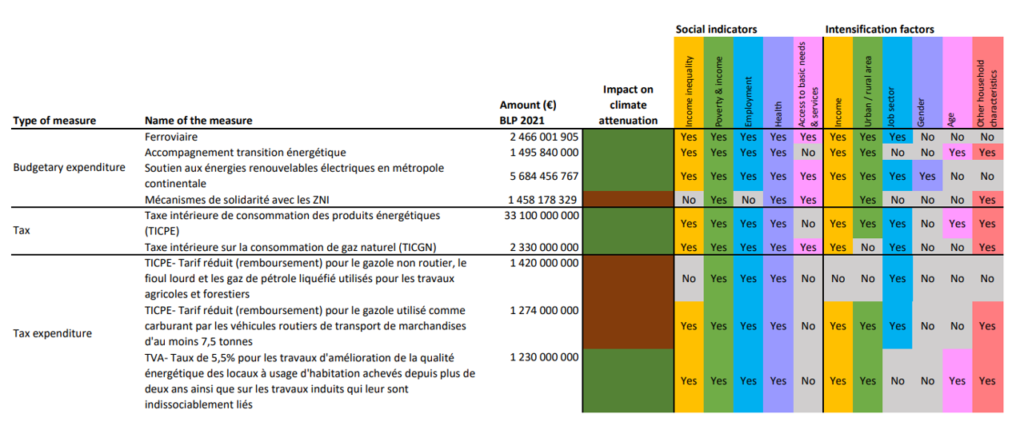
To test it, this methodology was applied to the CBT of the French budget law project for 2021. The graph below presents first results for a sample of budgetary measures, with positive or negative impacts on climate change mitigation or adaptation. Altogether, 93% of budgetary measures with climate impacts can have social impacts. Impacts on health and poverty are most numerous: respectively 90% and 88% of measures with climate impacts can affect these social dimensions.
Figure 1 : the SCBT applied to the CBT of the French budget law project (BLP) for 2021.
Click on this button to see the image
A useful exercise?
These first results confirm the existence of important interrelations between climate and social issues. However, for the SCBT to foster their joint consideration during policymaking, numerical results are not key. The study currently underway needs to be augmented with an in-depth, measure specific analysis of social and climate effects, and with this analysis’ insertion within budget arbitration processes, or, more generally, within public policy development and evaluation processes. Such analyses should ideally not be limited to measures with climate impacts, nor solely to measures recorded in states’ budgets.
In the coming months, I4CE will continue working on this topic by exploring how such analyses could inform budgetary decision-making processes. It will do though by studying these processes in France, as well as in another country interested in trying the SCBT: Indonesia.