Publications

Climate governance & the Paris Agreement: the bold gamble of transnational cooperation

3 November 2016 - Climate Brief
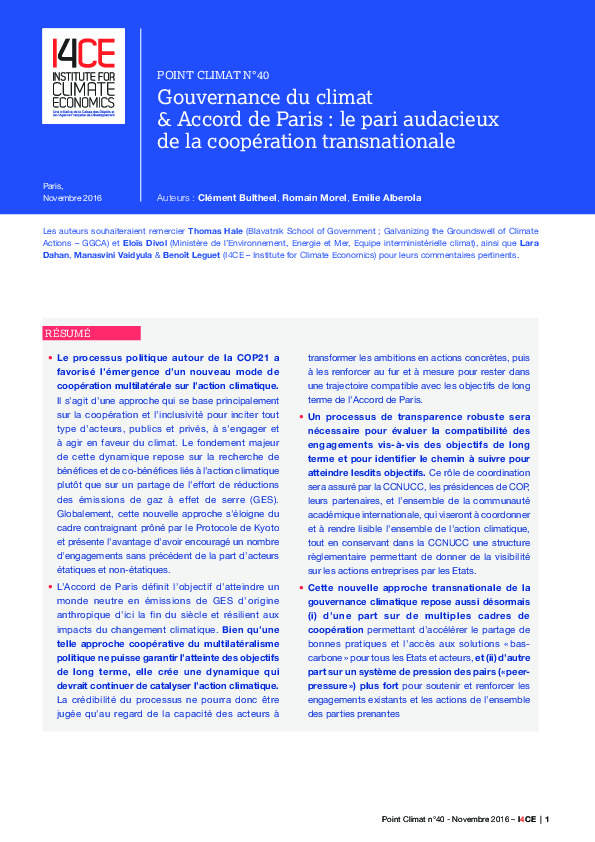
  • The political process introduced by COP21 has enabled a new avenue for multilateral cooperation on climate action. This new process focuses largely on cooperation and inclusivity to encourage all actors, public and private, to commit and act for the climate. In contrast to simply sharing the burden of emissions reduction effort, this dynamic encourages actors to explore and capitalize on benefits and co-benefits of climate action. Overall, this new approach moves away from the constrained climate framework advocated by the Kyoto Protocol, and as a result has encouraged an unprecedented level of climate commitment from both States and non-state actors.
  • A stringent transparency process will be necessary to assess the compatibility of all commitments with long-term goals as well as to identify potential avenues to achieve those objectives. The role to coordinate and communicate on climate actions will be performed by the UNFCCC, the COP Presidencies and their partners as well as the wider international academic community. Meanwhile, the UNFCCC will also maintain a regulatory framework that provides visibility on the actions undertaken by Parties.
  • This new transnational approach of climate governance also relies on (i) multiple cooperative frameworks to accelerate sharing of best practices and afford access to low-carbon solutions for all Parties and actors, and (ii) a stronger “peer-pressure” system to maintain and enhance existing commitments and actions from all stakeholders
 

Climate governance & the Paris Agreement: the bold gamble of transnational cooperation Download
To learn more
  • 03/06/2026 Foreword of the week
    Stay the course: why a stronger ETS is the key to industrial competitiveness 

    Since 2005, the EU Emissions Trading System (EU ETS) has been a cornerstone of Europe’s climate policy. With the price per tonne of CO2 now beginning to stabilise at between €60 and €80, and the gradual reduction in free allowances, 2026’s review of the system should be an opportunity to reflect on and upgrade its performance as the EU continues towards climate neutrality.  

  • 03/03/2026 Blog post Op-ed
    To strengthen European industry, let’s strengthen the ETS

    Several voices are now being heard in Europe, coming from Member States – including that of Chancellor Merz – and from industry, calling for the rules of the CO2 quota system to be weakened. For Benoît LEGUET and Jean PISANI-FERRY, this would be a mistake for Europe. And for France. On the contrary, we must strengthen this unique public policy in order to develop our industry. 

  • 02/27/2026 Foreword of the week
    Risk levels and priorities: financing climate adaptation requires clear decisions

    As the European Commission prepares an integrated framework on climate resilience and risk management for the EU, the public consultation has just wrapped up – an important step towards the publication of the proposals for the framework later this year. One of the main areas of focus will be the issue of financing adaptation, with the first key challenge being to mainstream the concept of resilience by design into all European funding currently under discussion, including structural policies such as the Common Agricultural Policy and the Connecting Europe Facility.

See all publications
Press contact Amélie FRITZ Head of Communication and press relations Email
Subscribe to our mailing list :
I register !
Subscribe to our newsletter
Once a week, receive all the information on climate economics
I register !
Fermer