Publications

I4CE tweets that YOU preferred in 2018

17 January 2019 - Blog post - By : Benoît LEGUET

I4CE begins the new year by highlighting its 2018 activities that you have preferred. After dedicating our last newsletter/news to the five most read I4CE publications, we continue this week with the most popular I4CE tweets. Throughout the second half of 2018, we selected the most viewed tweet each month. A way to remember and take stock of the past year.


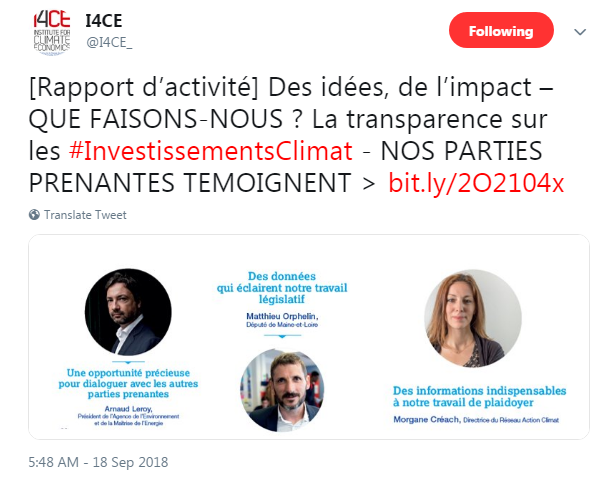
TOP TWEET SEPTEMBER : Is I4CE useful? Our stakeholders testify in our activity report

In September, in its activity report, I4CE highlighted the think tank’s daily concern: to have an impact, to provide useful information and ideas to decision-makers. Report in which we asked public decision-makers, associations or companies to testify about the usefulness of I4CE‘s actions. We enjoyed reading what our stakeholders think of us and tweeting about it, and a priori you too.
 

Read the report


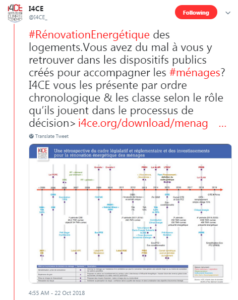
TOP TWEET OCTOBER: The (many) public policies for energy renovation

To find its way through the proliferation of measures put in place to encourage French households to renovate their homes, I4CE gave an overview in a brief published in October. An overview in the form of two illustrations: the first presented them in chronological order; the second ranked them according to the role played by these measures in the household decision-making process.
 

Learn more


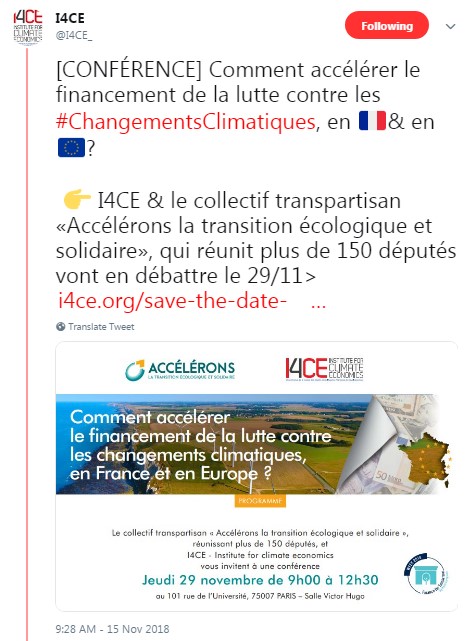
TOP TWEET NOVEMBER: Financing the fight against climate change on the National Assembly’s agenda

On November 29, I4CE organized a major conference at the National Assembly with the transpartisan group “Accélérons” that brings together more than 150 deputies. The objective: to take stock of climate investment in France thanks to the 2018 edition of I4CE‘s Landscape, and to discuss the measures to be taken to accelerate this investment, both on a French and European scale. Many of you twittered the invitation to this event, and many came to attend the discussions with MPs.
 

Learn more


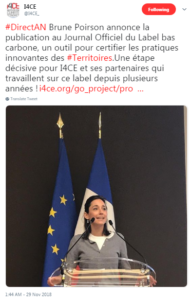
TOP TWEET NOVEMBER #2: Brune Poirson, Secretary of State for Ecology, announces the release of the low carbon label

I4CE having been very present on twitter in November 2018, we are adding the second most popular tweet this month. At a conference organized by I4CE, Brune Poirson launched the low carbon label. Thanks to this label, actors that innovate for climate, and in particular actors in agriculture and forestry, will be able to quantify and certify their reductions in greenhouse gas emissions and receive funding for these reductions. The result of several years of I4CE‘s work in close collaboration with multiple partners.
 

Learn more


TOP TWEET DECEMBER: Understanding everything about climate in a few figures

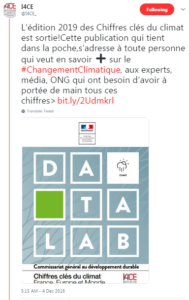
On the opening of COP 24 in Katowice, the Ministry of Ecological Transition and I4CE published the 2019 edition of the Key Climate Figures. A small document to keep in your pocket, which provides many figures and graphs on the causes and effects of climate change, the policies put in place to fight this phenomenon, or the greenhouse gas emissions worldwide, in Europe and France.

 

Learn more


I4CE Contacts
Benoît LEGUET
Benoît LEGUET
Managing Director Email
To learn more
  • 01/23/2026 Foreword of the week
    Financing carbon farming practices: lessons learnt in France can reinforce the EU level initiatives

    In a challenging economic and political context, especially for the agriculture sector, some incentive schemes can still help bring stakeholders together in climate transition and resilience initiatives. This is the case with carbon certification schemes, which both ensure the credibility of the climate impact of the actions implemented and provide remuneration for farmers and foresters for changes in practices. Some of these measures, such as replacing mineral fertilisers (mostly imported) with organic fertilisers, also help to meet the sector’s needs for resilience and strategic independence, which are crucial in the current context.

  • 01/21/2026 Blog post
    On Carbon Removals and Carbon Farming the devil is in…the demand

    The implementation of carbon farming practices on European farms and in European forests is a lever for achieving carbon neutrality, but also for farm resilience, the adaptation of forest stands to climate change and for contributing to our strategic independence. Certifying and financing low-carbon practices is the objective of the CRCF (Carbon Removals and Carbon Farming) regulation, which will come into effect in 2026. Now seems the right time to draw lessons from six years of experience with a similar standard in France: the “Label Bas-Carbone” (Low Carbon Label – LBC). The results show that striking a balance between scientific rigour and accessibility for stakeholders has led to the development of a substantial range of projects. However, the real challenge is to build sufficient and appropriate demand to finance the projects. There is no miracle solution, but complementary financing channels may emerge. 

  • 01/16/2026 Blog post
    CBAM and fertilisers: ring-fencing budgets to help farmers reduce their use of mineral fertilisers

    The Carbon Border Adjustment Mechanism (CBAM) came into force on 1 January 2026. It is a carbon tax applied at the borders of the European Union to imports of certain industrial products covered by the EU Emissions Trading System (EU ETS). Nitrogen-based mineral fertilisers are included in this initial list of products. To avoid an increase in costs for the farmers concerned, the level of the tax has been reduced for fertilisers, and they may even be temporarily excluded from the scope of the CBAM. Yet, for the climate, but also for France’s strategic independence and food sovereignty, the CBAM will ultimately have to be fully applied to mineral fertilisers. To limit or even avoid an increase in farmers’ fertiliser expenditure, we need public policies – some of which are currently under threat. Ring-fencing budgets for these policies would be a way to support farmers’ incomes and the food sovereignty of both the European Union and France, while reducing the carbon footprint of our food system. 

See all publications
Press contact Amélie FRITZ Head of Communication and press relations Email
Subscribe to our mailing list :
I register !
Subscribe to our newsletter
Once a week, receive all the information on climate economics
I register !
Fermer