Assessing the sustainability of the French food system: methodological issues and results
To learn more about the methodology used by I4CE to assess the contribution of financing flows to the emergence of a sustainable food system, this technical paper introduces it and identifies its limitations and key methodological challenges for the future.
The transition of the French food system towards a sustainable development model is essential from the perspective of climate change mitigation, adaptation to climate change consequences, protection of biodiversity, soil and water, as well as protection of the health of farmers and consumers in general. The implementation of this transition however is complex, especially given the economic context of the stakeholders involved in the food chain.
The financial lever is one of the various levers available to steer this transition. In ‘Décryptage des financements du système alimentaire français et de leur contribution aux enjeux de durabilité’ (2021)I4CE has drawn up an initial estimate of the number of financial flows that cross the food system and their contribution to sustainability. The resulting conclusion is that activating the financial lever has two components: financing investments that transform the means of production in the long term and securing the income of sustainable production methods so that they are economically viable.
This working paper discusses the methodology we have used to assess the contribution of financing flows to the emergence of a sustainable food system.
The following methodological challenges have been identified :
• The definition of a clear and consensual parameter for the food system, the links that form it and the financial flows involved.
• The consensual definition of a sustainable food system, which simultaneously satisfies environmental, social, and economic objectives.
• The evaluation of the funding in relation to the objective of a sustainable food system, whist considering that:
– information on the projects and products funded is incomplete, and knowledge of the funding levels necessary to achieve a sustainable food system is negligible;
– in contrast to the energy sector, where the objective is to replace fossil fuels entirely with renewable sources, a sustainable food system is characterised by complex balances that make it difficult to distinguish between financing that is favourable or unfavourable to the transition.
Click on this button to see the image
In response to these challenges, we propose a methodology and present the results here.
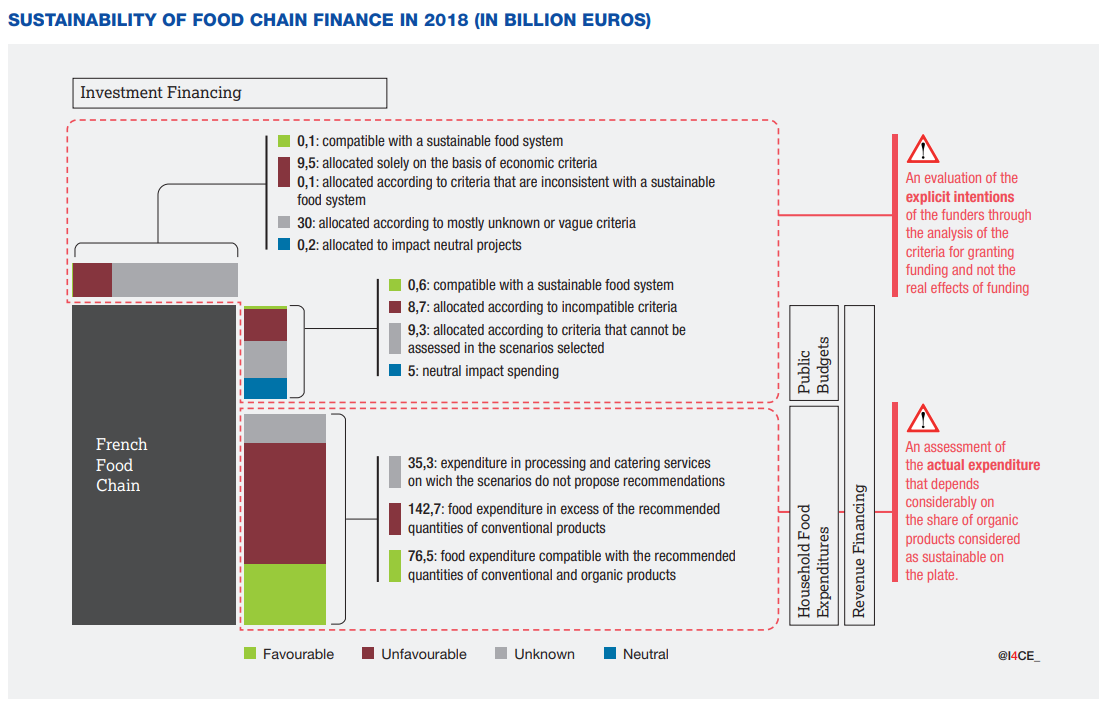
The assessment of the sustainability of household spending has been separated from all other types of financing: government grants, loans, equity, bonds, and donations.
For each of these types of funding, we assess the compatibility of the criteria used by the different institutions to allocate their funding to companies in the food chain. The results obtained should be interpreted as an assessment of the explicit intentions of the funding grant providers rather than an evaluation of their actual contribution to the transition.
• A large part of public funding is still directed according to criteria that are inconsistent with the transition to a sustainable food system.
• The financing of non-subsidy investments in the food chain is largely opaque and not sufficiently linked to sustainability criteria.
As this assessment of financing criteria does not apply to household food expenditures, we explore a methodology that focuses on what is ‘actually’ financed by households.
Due to the dependence of the results of this study on a non consensus indicator, we do not consider them sufficiently robust to determine a share of current total expenditure that
would be ‘sustainable’.
Nevertheless, the work carried out allows us to draw the following lesson:
• Household food expenditures are still far from the recommendations of the three scenarios.
In addition to providing relatively general results, the objective of this working paper is to open the debate about the evaluation of the sustainability of the French food system and in particular, the methodology to be used.