Feedback from the workshop chaired by I4CE during the Climate Plan Anniversary Conference

17 July 2018 - Blog post - By : Benoît LEGUET

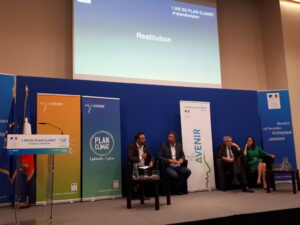
On 6 July, the Minister for the Ecological and Inclusive Transition, Nicolas Hulot, organized a conference to mark the first anniversary of the Climate Plan. After a morning spent reviewing the progress made by France, the afternoon was dedicated to four workshops. These workshops were chaired by two Secretaries of State from the Ministry, the ADEME President, and Benoit Leguet the Managing Director of I4CE.


The latter provided an opportunity to discuss the biological carbon sinks in France. Agricultural and forest soils, as well as forest biomass, will have key roles to play in achieving carbon neutrality and offsetting residual emissions from other economic sectors. In a format inspired by the UN Talanoa Dialogue, participants highlighted the many technical solutions available to promote carbon capture while preserving biodiversity: agroecology, agroforestry, hedge planting, use of organic matter in cities, etc. They also highlighted the importance of the future reform of the Common Agricultural Policy, identified existing tools to be reinforced, and innovative tools such as the upcoming low-carbon standard, a project in which I4CE is a partner.


All these proposals were then presented by Benoit Leguet to the Minister Nicolas Hulot. They should enable the Ministry to identify new avenues for action to move France towards carbon neutrality.

 

I4CE Contacts
Benoît LEGUET
Benoît LEGUET
Managing Director Email
To learn more
  • 01/13/2023 Foreword of the week
    2023 agenda: there has never been a better time to act

    2022 was an eventful year in terms of climate. The year saw the emergence of a new concept, that of the polycrisis: war in Ukraine, the aftereffects of Covid, the return of inflation, the gas crisis, agricultural shortages, persistent droughts and other dramatic climatic events… all of these crises have ultimately pointed to our direct or indirect dependence on fossil fuels; our weaknesses when faced with a changing climate; and the vulnerability of our economies and the middle and lower classes.

  • 12/02/2022 Foreword of the week
    European Carbon Certification must be demanding… and appealing

    How can we differentiate between projects that really enable carbon to be stored and those that only claim to do so? This is a complicated question when dealing with projects in agriculture and forestry, where quantifying carbon storage is complex, and where other environmental challenges, like the preservation of biodiversity, must also be taken into account. A complicated question, therefore, but one that needs an answer! Private actors and public authorities want to ensure that the agricultural and forestry projects financed in the name of the climate have a real environmental benefit.

  • 12/01/2022 Blog post
    Carbon certification: the Commission publishes a stringent certification framework that should also be and appealing

    Yesterday, 30 november 2022, the European Commission adopted a proposal for a first EU-wide voluntary framework to reliably certify high-quality carbon removals. This proposal provides a framework, broad guiding principles, and the details will be specified in 2023 supported by an expert group on Carbon Removals. “The devil may be in the detail”, but the framing is no less important. Claudine Foucherot of [i4ce] has analysed it and identified four points on which we must be vigilant. Overall, it can be said that the Commission is submitting an ambitious proposal, which nevertheless presents a risk: not being sufficient incentives to ensure a massive deployment of certified projects.    

See all publications
Press contact Amélie FRITZ Head of Communication and press relations Email
Subscribe to our mailing list :
I register !
Subscribe to our newsletter
Once a week, receive all the information on climate economics
I register !
Fermer