Financing the climate transition in France: what room for manœuvre on public funding needs?

Report only available in French


France is facing a climate investment deficit relative to its climate objectives. Today, these investment are already putting a strain on public finances, whether in terms of investing in public facilities or co-financing projects by households and business. Increasing climate investments is therefore a challenge for public finances. But the scale of the challenge varies, depending on future policies. So what room for manoeuvre is there in terms of climate-related public spending needs?


In this report, we analyse the options for allocating public and private funding to achieve France’s climate investment targets identified in the Landscape of Climate Finance in France, on the basis of the draft national low-carbon strategy (SNBC) currently under review.


Private finance cannot be summoned by decree. Today, households and businesses often lack a viable economic model for their climate investments. And what the private sector cannot do, the public sector will have to fund. Thus, in the face of the climate investment deficit and without action to limit spending, the need for additional public spending would reach €71 billion in 2030.


However, this funding need can be reduced by deploying a variety of measures: tightening regulations, eliminating certain tax provisions, refocusing aid on the lowest-income beneficiaries, but also increasing energy saving certificates (CEE) or user service charges. Combining all these measures, which shift the burden of financing onto households and businesses, the minimum additional public spending required is €39 billion, of which €18 billion is for the State. At this lower level, the public funding need is restricted to public facilities, such as administrative and school buildings and transport infrastructures.
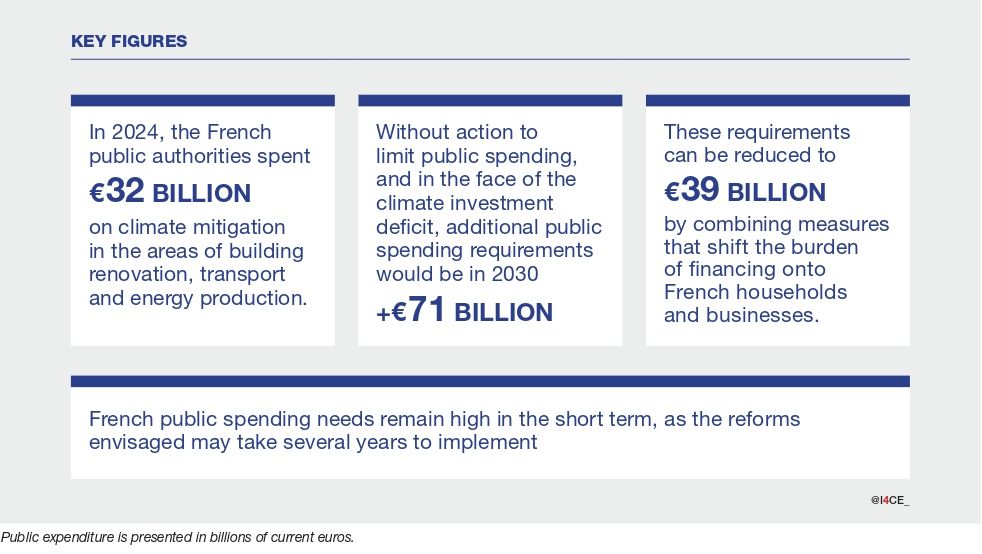


Looking ahead to 2030, there is considerable room for manoeuvre in terms of public spending requirements in France. Nevertheless, they remain high in the short term, as the reforms envisaged to curb them may take several years. 


The orders of magnitude of the climate-related public spending needs can inform the preparation of the future multiannual financing strategy for the ecological transition, expected in France this autumn. The strategy will have to take account of the effectiveness of the instruments available, as well as the fair distribution of the funding. Between the top and bottom of the range, intermediate options are possible. It should be noted that other financing options exist, but they have not been included in this exercise due to the obstacles outlined at the end of this note.


This publication summarises the initial results of the Financing Scenarios project, which may be further developed in the autumn.

Financing the climate transition in France: what room for manœuvre on public funding needs? Download
I4CE Contacts
Hadrien HAINAUT
Hadrien HAINAUT
Program director – Climate finance, energy transition and forecasting Email
Maxime LEDEZ
Maxime LEDEZ
Research Fellow – Landscape of climate finance, Buildings, French State budget Email
Maia DOUILLET
Maia DOUILLET
Research Fellow – Landscape of climate finance, Transport Email
Solène METAYER
Solène METAYER
Research Fellow – Financing the transition at the international level Email
To learn more
  • 01/16/2026 Blog post
    CBAM and fertilisers: ring-fencing budgets to help farmers reduce their use of mineral fertilisers

    The Carbon Border Adjustment Mechanism (CBAM) came into force on 1 January 2026. It is a carbon tax applied at the borders of the European Union to imports of certain industrial products covered by the EU Emissions Trading System (EU ETS). Nitrogen-based mineral fertilisers are included in this initial list of products. To avoid an increase in costs for the farmers concerned, the level of the tax has been reduced for fertilisers, and they may even be temporarily excluded from the scope of the CBAM. Yet, for the climate, but also for France’s strategic independence and food sovereignty, the CBAM will ultimately have to be fully applied to mineral fertilisers. To limit or even avoid an increase in farmers’ fertiliser expenditure, we need public policies – some of which are currently under threat. Ring-fencing budgets for these policies would be a way to support farmers’ incomes and the food sovereignty of both the European Union and France, while reducing the carbon footprint of our food system. 

  • 01/16/2026 Foreword of the week
    2026: An electric atmosphere

    The year ahead promises to be electric. In a highly unpredictable geopolitical context, the European Union must balance its commitment to the long-term goals of climate neutrality and the immediate attention to security and competitiveness concerns. This puts electrification high on the agenda in Brussels. First, the Grids Package, presented in December 2025, provides for a more centralised approach to planning and is expected to be adopted by the Council in June. Second, before the summer, the Commission intends to present an Electrification Action Plan, which will focus on lowering prices and reinforcing demand. 

  • 10/28/2025
    Adapting France to +4°C: current resources, additional needs, and funding options

    Cette étude s’inscrit dans la continuité des travaux d’I4CE engagés depuis plusieurs années sur la qualification et la quantification des besoins et des moyens pour l’adaptation en France. Elle propose une vision d’ensemble de ce que l’on peut dire à date sur ces aspects, basée sur le suivi et l’analyse d’une quinzaine de domaines d’action publique concernés par le changement climatique. Alors que l’adaptation est souvent un grand oublié des PLF, ce rapport apporte des éléments sur l’effort consenti aujourd’hui, les besoins identifiés pour demain et les modalités de répartition des coûts.

See all publications
Press contact Amélie FRITZ Head of Communication and press relations Email
Subscribe to our mailing list :
I register !
Subscribe to our newsletter
Once a week, receive all the information on climate economics
I register !
Fermer