Investing in climate can help France drive its economic recovery
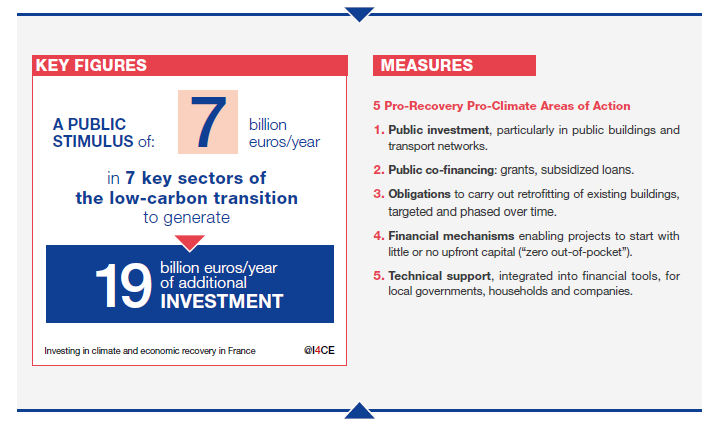
Confronted with a health crisis that has caused a global social and economic shock, the European Union and countries around the world are adopting major economic support programs. Following the initial focus that must be on overcoming the health emergency itself, actions that contribute to climate goals can be an effective part of improving both the economy and the resilience of our society. I4CE’s proposal calls for a public finance package of 7 billion euros per year that is estimated to trigger 19 billion euros of additional public and private investment. Altogether, this package would contribute to the economic recovery post-crisis, while simultaneously reinforcing our society against future shocks without reducing France’s contribution to international climate goals.
Responding to the health emergency, protecting the economy and recovering from the COVID-19 crisis
France is facing a health crisis that is causing a global economic shock. Economic experts do not yet fully comprehend this shock due to the high number of unknowns. Indeed, growth, unemployment and debt are being subjected to an unprecedented public health crisis.
Beyond this “economic resuscitation” phase, a crisis recovery strategy will have to be deployed by mobilizing public policy, particularly public investment capacity and taxation. In France, the recovery strategy’s effectiveness will also depend on the coordination of national and European responses.
I4CE are convinced that climate action is not an obstacle to a crisis recovery, but an effective response to the demand for resilience that is likely to emerge in European societies. For this reason, I4CE contends that a recovery package must prioritize those policies and actions that support outcomes in three areas:
- Environment: by maintaining the credibility of the Green Deal, by preserving the industrial capital of low-carbon sectors, by adapting our economy to climate change;
- Economy: by contributing to the revival of activities in the short term while simultaneously reducing exposure to future crises: oil price shocks, food and industrial supply, etc.;
- Health: by reducing the vulnerability of society to health threats, particularly through the improvement of air quality and reduction of fuel poverty.
Staying on Track with the France’s Climate Goals
Even in view of the major economic shock ahead, the French National Low-Carbon Strategy (SNBC) remains a useful and essential benchmark for developing a pro-climate economic recovery package. The strategy sets out how France plans to reduce its greenhouse gas (GHG) emissions from each sector through 2030. Drawn up by the government following consultations with stakeholders and revised last year, it has also been communicated to Europe and to the signatories of the Paris Agreement.
I4CE has looked at seven sectors that are particularly significant because they account for two-thirds of the France’s low-carbon investment. For each sector, I4CE has assessed the investment objectives expressed in the SNBC and has proposed pro-climate pro-recovery measures, together with a financing plan that assesses the contributions of governments, companies, households and financial institutions.
These sectors are: (1) retrofitting of private housing, (2) retrofitting of tertiary buildings (public and private), (3) deployment of low-emission passenger vehicles, (4) urban public transport infrastructure, (5) rail infrastructure, (6) cycle paths and network, and (7) renewable electricity generation.
I4CE recognizes that the SNBC and PPE represent more than just investments in these sectors, and that essential public action is needed in other areas. I4CE also recognizes that action taken to reduce GHG emissions does not preclude the need to adapt buildings, infrastructure and equipment to climate change.
A 7 billion euros per year public stimulus package to trigger 19 billion euros in additional annual investment
Click on this button to see the image
- The French State should increase the existing level of support for climate investment an additional 4.3 billion euros per year. This should be made up of 1.3 billion euros for off taking guarantees for renewable electricity producers and 3.0 billion euros for the co-financing of households, companies and local governments that undertake new investments;
- Local governments should increase current levels of investment and co-financing by 2.1 billion euros per year. This increase could be financed with limited to no impact on their budgets through the use of by project-specific instruments, such as national grants, white certificates (Certificats d’économies d’énergie, CEEs) or loans from public and commercial banks.
- State-owned banks should increase by 2.3 billion euros per year their new commitments to businesses, local governments and project companies.
Over and above these actions, energy suppliers, public infrastructure management companies (such as RATP and SNCF Réseau), co-financed by public authorities and borrowing from banks and financial markets, should increase annual investments.