Landscape of Climate Finance in France – Edition 2025
I4CE‘s Landscape of Climate Finance is an overview of climate investments made by households, companies and public authorities. Such investments include retrofitting buildings, purchasing electric vehicles, installing renewable energy, as well as paying for rail, cycling and urban public transport infrastructure.
Read the report in French
Climate investments stall in 2024
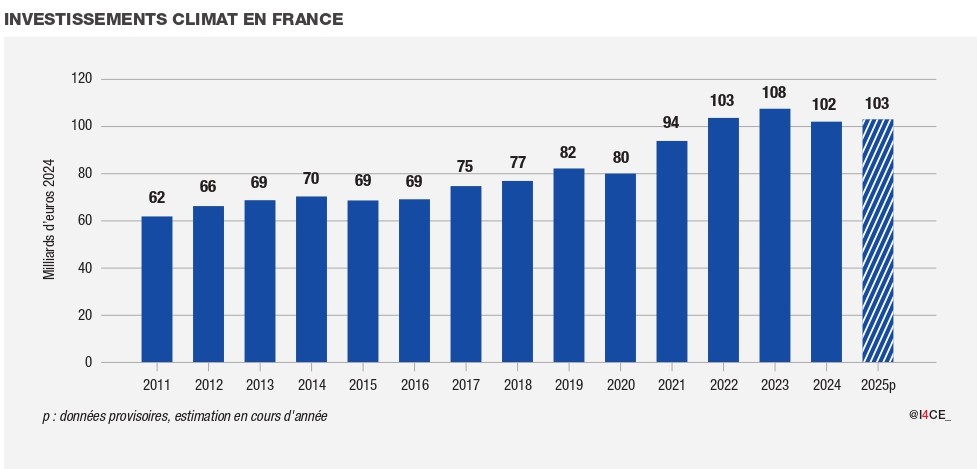
After rising steadily between 2021 and 2023, climate investment slowed down and ended at €102 billion in 2024, falling 5% compared to the previous year. The slowdown is mainly due to energy-efficient construction and building renovation, but also some renewable energies such as offshore wind power and biomethane injection. According to early data, climate investment is expected to flatten in 2025 at €103 billion.
Click here to see “Climate investment in France ” in French
Part of the decline in climate investment reflects the general economic downturn, particularly in the building sector, which has been hampered by high interest rates. But this slowdown can also be explained by setbacks in public policies, illustrated by the relaxation of European targets for reducing vehicle emissions by 2025.
Above all, public spending on climate action has started to shrink, whether in terms of government subsidies for energy-efficient renovations, for electric vehicles, or funding for public transport infrastructure. However, although they account for only 16% of total climate investment, these public funds are crucial for the economic viability of projects and for overcoming the lack of financial capacity among households and businesses.
Considerable funding needs to achieve climate goals
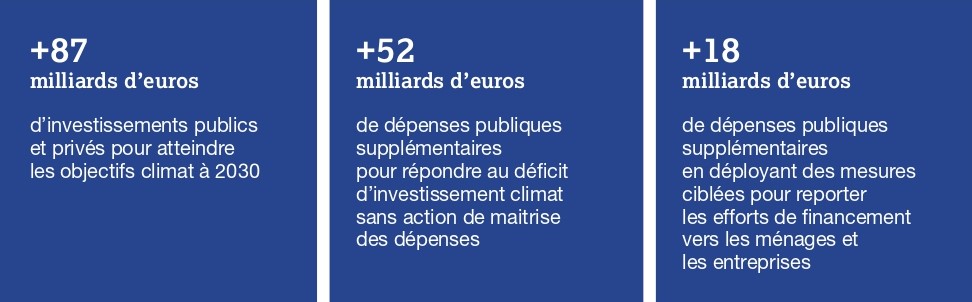
Public and private investment must ramp up quickly to cut greenhouse gas emissions, according to the draft scenario of the French national low-carbon srategy (Stratégie nationale bas-carbone, SNBC). By 2030, climate investment needs to increase by €87 billion compared to 2024 levels.
Given the climate investment deficit, and without taking action to limit expenditure, additional public spending requirements would reach €52 billion in 2030. However, funding needs can be reduced by strengthening regulations, cutting certain tax breaks, refocusing subsidies on low-income households, and increasing the level of energy-saving certificates (called white certificates) or utility fees. Combining these measures reduces the additional public spending requirement to €18 billion but requires a greater contribution from households and firms as project promoters, which may conflict with their limited capacities or exacerbate inequalities regarding the cost of the transition.
Click here to see the Key figures in French
Reviving the climate investment dynamic
Public authorities must strengthen their financing strategy to restore climate investment momentum. They are equipped with a wide range of financing instruments, both budgetary and extra-budgetary, such as white certificates, own equity and debt from social landlords and public infrastructure managers, as well as loans and equity investments from public banks.
Mais si les marges de manœuvre sont importantes, elles ne sont ni illimitées, ni immédiates : les réformes nécessaires peuvent prendre plusieurs années. Il faut donc agir sur la réglementation et la fiscalité bien avant de pouvoir réduire les financements publics. En outre, un rebond des investissements fossiles reste possible et doit être contrecarré, par un renforcement des réglementations et des dispositifs fiscaux.
However, while there is substantial room for manoeuvre, it is neither unlimited nor immediate: the required reforms may take several years to implement. Action must therefore be taken on regulation and taxation well before public spending can be reduced. Furthermore, a rebound in fossil fuels investment remains possible and must be countered by strengthening regulations and tax measures.
The climate investment series is recognised as being of general interest by the French Public Statistics Authority (Autorité de la statistique publique)
L’Autorité de la statistique publique a adopté le 18 décembre 2025 un avis portant sur la reconnaissance de la qualification d’intérêt général à la série statistique des investissements climat produite par I4CE. Cette reconnaissance, attribuée pour 3 ans, concerne la série des investissements climat en euros courants et en euros constants.

La série est téléchargeable ici.
Lire l’avis du Comité du label de la statistique publique
Lire l’avis du 18 décembre 2025 de l’Autorité de la statistique publique